A Trusted Learning and Development Advisor

State Government

Generic selectors
Exact matches only
Search in title
Search in content
Post Type Selectors
Categories

Example Tailored Lean Training & Thinking Styles Program Outline

9:00 AM – 9:15 AM:

Lean Thinking Fundamentals

  • Understanding lean thinking principles.
  • Ground rules and expectations.
  • The core principles of lean thinking.
  • Identifying value versus waste in government processes.
  • Exploring common types of waste (e.g., time, resources, inefficiencies).


10:15 AM – 10:30 AM:

  • Morning Tea Break

10:30 AM – 12:00 PM:

Mapping Processes and Identifying Waste

  • Process mapping techniques.
  • Identifying bottlenecks and inefficiencies.
  • Using affinity diagrams to identify and remove waste.

12:00 PM – 12:45 PM:

  • Lunch Break

12:45 PM – 1:45 PM:

Tools and Techniques for Continuous Improvement

  • Introduction to tools like 5S, Kaizen, and root cause analysis.
  • Practical application of lean tools to government scenarios.
  • Encouraging team involvement in improvement initiatives.

1:45 PM – 2:30 PM:

Fostering a Lean Culture

  • Building a mindset of innovation and efficiency.
  • Overcoming resistance to change.
  • Leading change.
  • Removing role ambiguity.

2:30 PM – 2:45 PM:

  • Afternoon Tea Break

2:45 PM – 4:15 PM:

Action Planning and Implementation

  • Developing a lean implementation plan.
  • Setting achievable goals and metrics.
  • Low hanging productivity improvements.
  • Ensuring sustainability of improvements.

4:15 PM – 4:45 PM:

Review, Refocus, and Refine

  • Sharing insights and takeaways.
  • Group discussion: Overcoming specific challenges in government.
  • Finalising personal action plans.

4:45 PM – 5:00 PM:

Closing and Feedback

  • Summary of key learnings.
  • Participant feedback and evaluations.

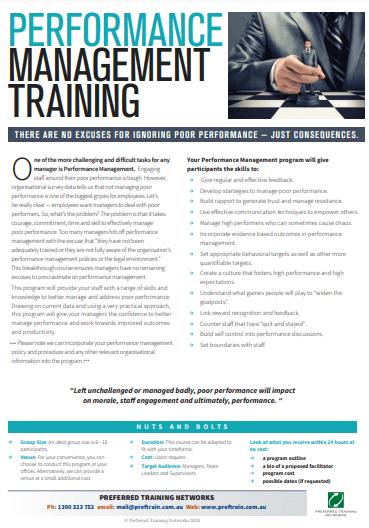
This program will provide your staff with a range of skills and knowledge to better manage and address poor performance. Drawing on current data and using a very practical approach, this program will give your managers the confidence to better manage performance and work towards improved outcomes and productivity. Equip your team with real-world tools to lift accountability, tackle underperformance, and align expectations.

*** Please note, we can incorporate your performance management policy and procedure and any other relevant organisational information into the program.***

Your tailored Performance Management inhouse training course will give participants the skills to:

  • Give regular and effective feedback.
  • Develop strategies to manage poor performance.
  • Build rapport to generate trust and manage resistance.
  • Use effective communication techniques to empower others.
  • Manage high performers who can sometimes cause chaos.
  • Incorporate evidence based outcomes in performance management.
  • Address avoidance behaviours and strengthen your leadership team’s ability to manage performance proactively.
  • Set appropriate behavioural targets as well as other more quantifiable targets.
  • Create a culture that fosters high performance and high expectations.
  • Apply structured performance conversations that align with HR compliance and Fair Work standards.
  • Understand what games people will play to “widen the goalposts”.
  • Link reward recognition and feedback.
  • Counter staff that have “quit and stayed”.
  • Build self-control into performance discussions.
  • Set boundaries with staff.
“Left unchallenged or managed badly, poor performance will impact on morale, staff engagement and ultimately, performance.”

Performance Management In-House Program Details

Group Size: An ideal group size is 6 – 10 participants. “Tailored for Fair Work and current HR frameworks”

Venue: For your convenience, you can choose to conduct this program at your offices. Alternatively, we can provide a venue at a small additional cost.

Duration: This course can be adapted to fit with your timeframe.

Cost: Upon request.

Target Audience: Managers, Team Leaders and Supervisors

“You need to engage the reader with policy and procedure writing. The reader needs to understand the ‘why’ and the ‘consequences,’ otherwise you’re just treading water.” – P Quinn

Some policies are too long and impossible to understand. Other policies are wafer thin and serve no useful purpose.

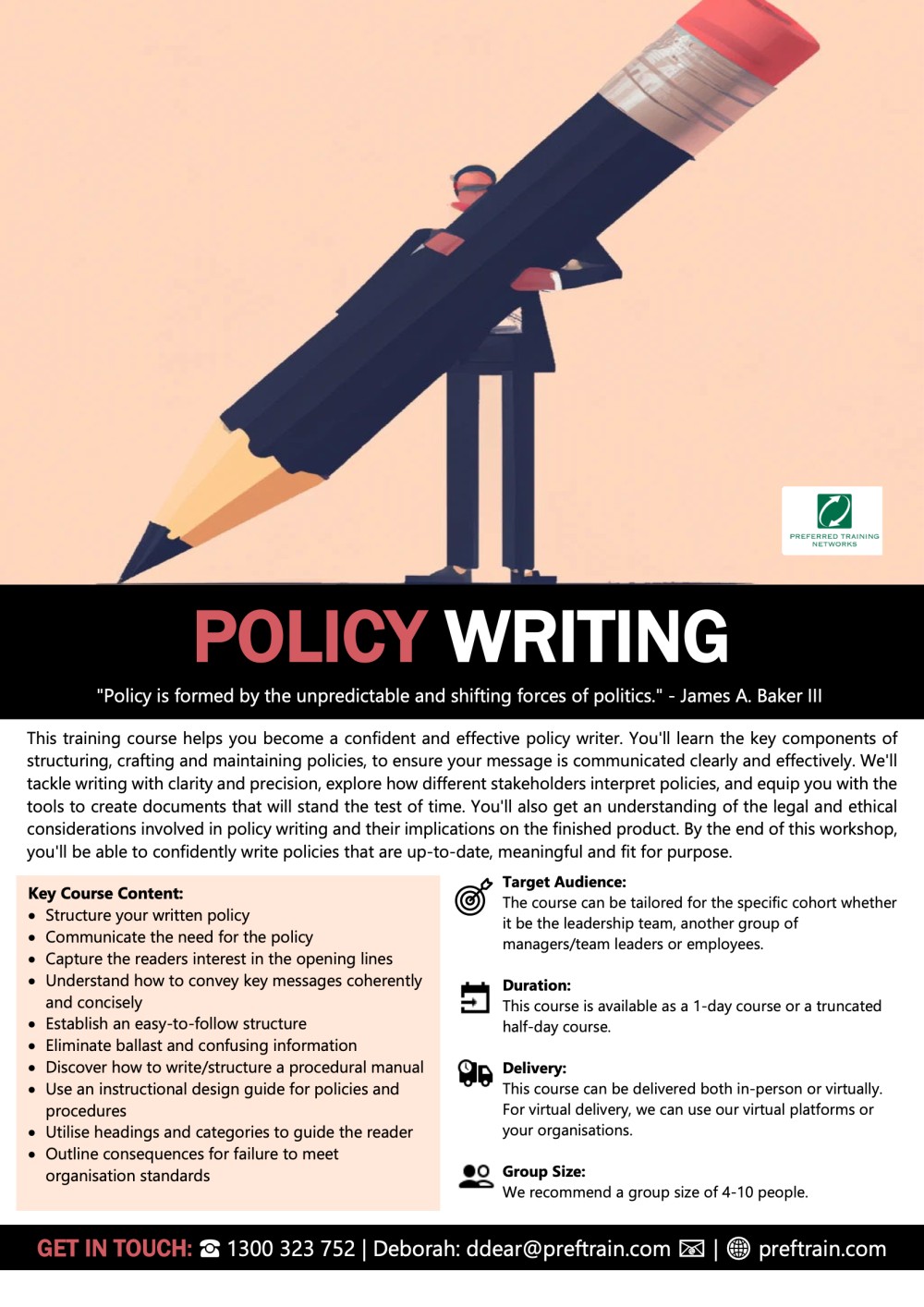
So, if you’d like to improve how your policies are written and communicated, then this course is perfect.

Policy Writing Skills Training In-House Program Details

For maximum effectiveness, this course is best conducted as an in-house program.

Venue: For your convenience, you can choose to conduct this course at your workplace. Alternatively, we can provide a training venue at a small additional cost.

Duration: Each course can be tailored to suit your timeframes.

Target Audience: Document control teams

Policy Writing was ranked 4.3 out of 5 based on 33 user ratings.
Generic selectors
Exact matches only
Search in title
Search in content
Post Type Selectors

Get Lightning Flash Quote Within 30 mins!