A Trusted Learning and Development Advisor
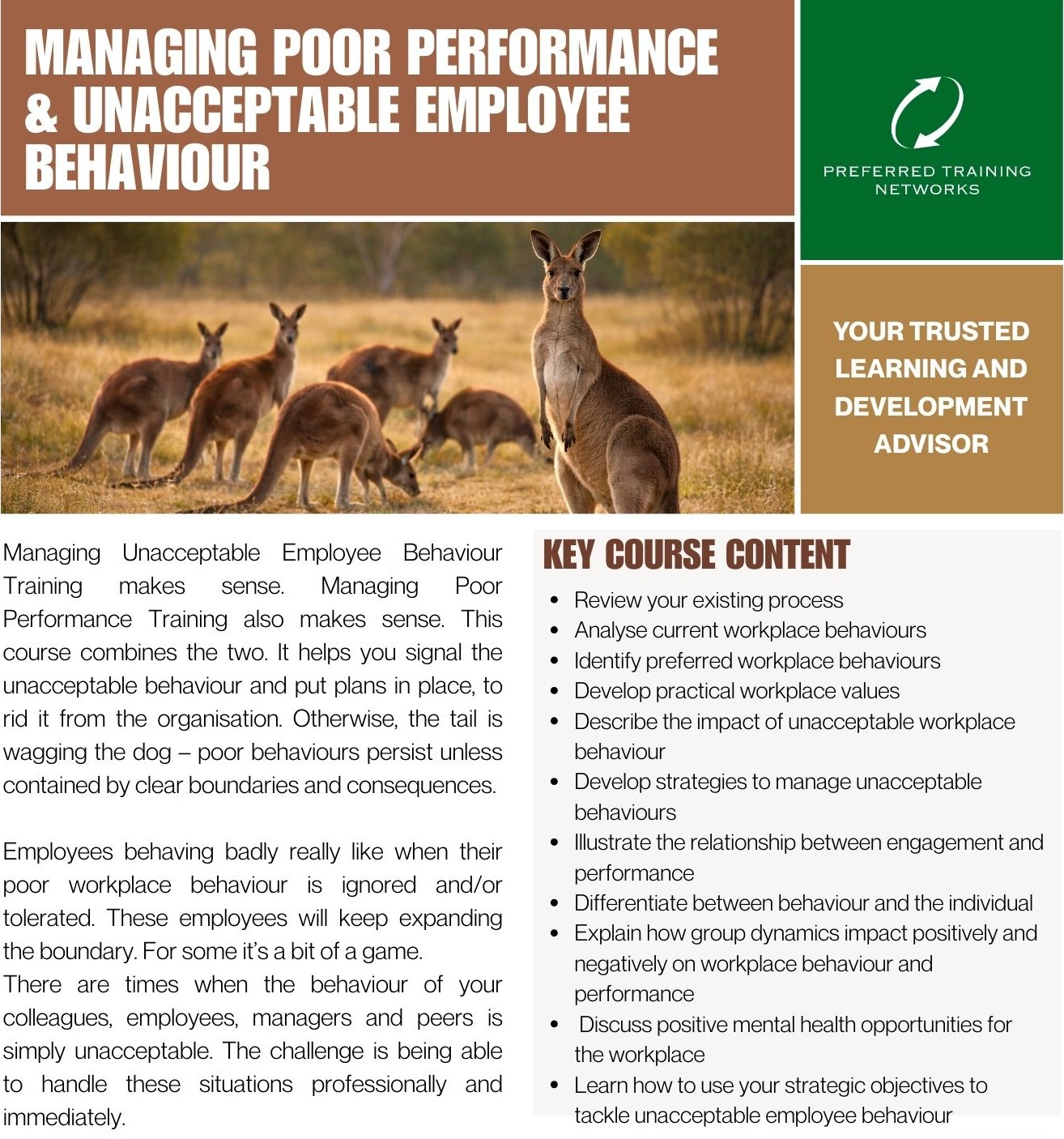
When an unacceptable behaviour is not addressed, it sends a message that misbehaviour is OK. Workplaces need to ensure that unacceptable behaviour is challenged and managed effectively. The vast majority of people want to come to work to do their job, enjoy the workplace and get along with their fellow employees and managers.
The first step is to get rid of unacceptable behaviours by establishing a strong functional workplace culture. Current workplace studies indicate that you need seven good employees, to counter the impact of one errant employee. In the current tight workplace conditions, you simply cannot afford poor workplace behaviour. This program will provide you with the tools and insights to better manage unacceptable behaviour whilst at the same time developing a positive workplace culture.
Which behaviours are prevalent in your workplace?
Imagine the difference if you had no boxes to tick! Believe it or not some workplaces operate seamlessly where employees actually look forward to coming to work! When employees are engaged and feel valued they are more likely to contribute productively to the workplace and their work.
Case Study
Your organisation should have existing processes in place to manage unacceptable employee behaviour. However, a recurring problem is that managers try and shortcut the process. Here is a commonplace scenario:
Manager: “Liam is absolutely useless. We need to get rid of him today. He is driving everyone nuts and since he started, the team has become dysfunctional.”
HR: “That doesn’t sound good, what conversations have you had with him?”
Manager: “None – I’m letting you know now. How about you get rid of him next week.”
HR: “What have you done so far to manage the situation?”
Manager: “Nothing”
HR: “You need to manage it locally. Follow the process and if that doesn’t work then please come back to me.”
Manager: “But that’s not fair, I don’t have time. Isn’t HR’s job to look after the people stuff?”
HR: “It’s also your job to manage your people. Our process is that you need to try and resolve these issues locally before coming to HR. That’s the process. You’ll find its robust enough to help you but you need to try and manage it locally and get more involved. Please don’t think you can simply dump the problem on HR. It simply doesn’t work that way. I know this might be hard to believe but your understanding of the situation might be completely wrong. The process will help us discover what’s really happening and will give us strategies to manage the situation”
If this sounds familiar, then this course will certainly help participants to manage unacceptable employee behaviour.
“When employees are engaged and feel valued, they are more likely to contribute productively to the workplace and their work.”
This program can be conducted as in-house training at your offices.
Guidelines
Group Size: An ideal group size is 6 – 14 participants.
Venue: For your convenience, you can choose to conduct this program at your offices. Alternatively, we can provide a training venue at a small additional cost.
Duration: This course can be adapted to your time frame
Cost: Upon request.
Target Audience: Supervisors, Team Leaders and Managers
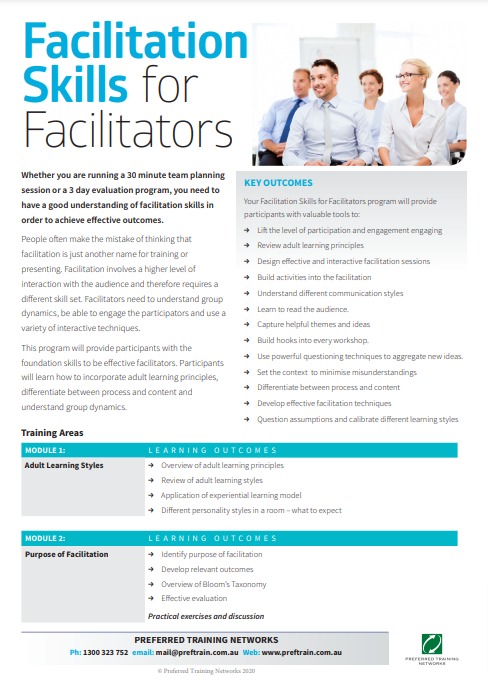
This program will provide participants with the foundation skills to be effective facilitators. Participants will learn how to incorporate adult learning principles, differentiate between process and content and understand group dynamics.
MODULE 1: Adult Learning Styles
MODULE 2: Purpose of Facilitation
MODULE 3: Process and Content
MODULE 4: Questioning and Listening Skills
MODULE 5: Group Dynamics
MODULE 6: Facilitation Techniques
Group Size: An ideal group size is 4– 10 participants.
Venue: For your convenience, you can choose to conduct this facilitation skills program at your offices. Alternatively, we can provide a venue at a small additional cost.
Duration: This course can be tailored to meet your timeframes.
Cost: Upon request.
Target Audience: Trainers, Facilitators and Projects Leads
Complementary and aligned courses include:
If you would like more information on this training program, please contact: Deborah Dear on 1300 323 752 or email: [email protected] or contact us online today.
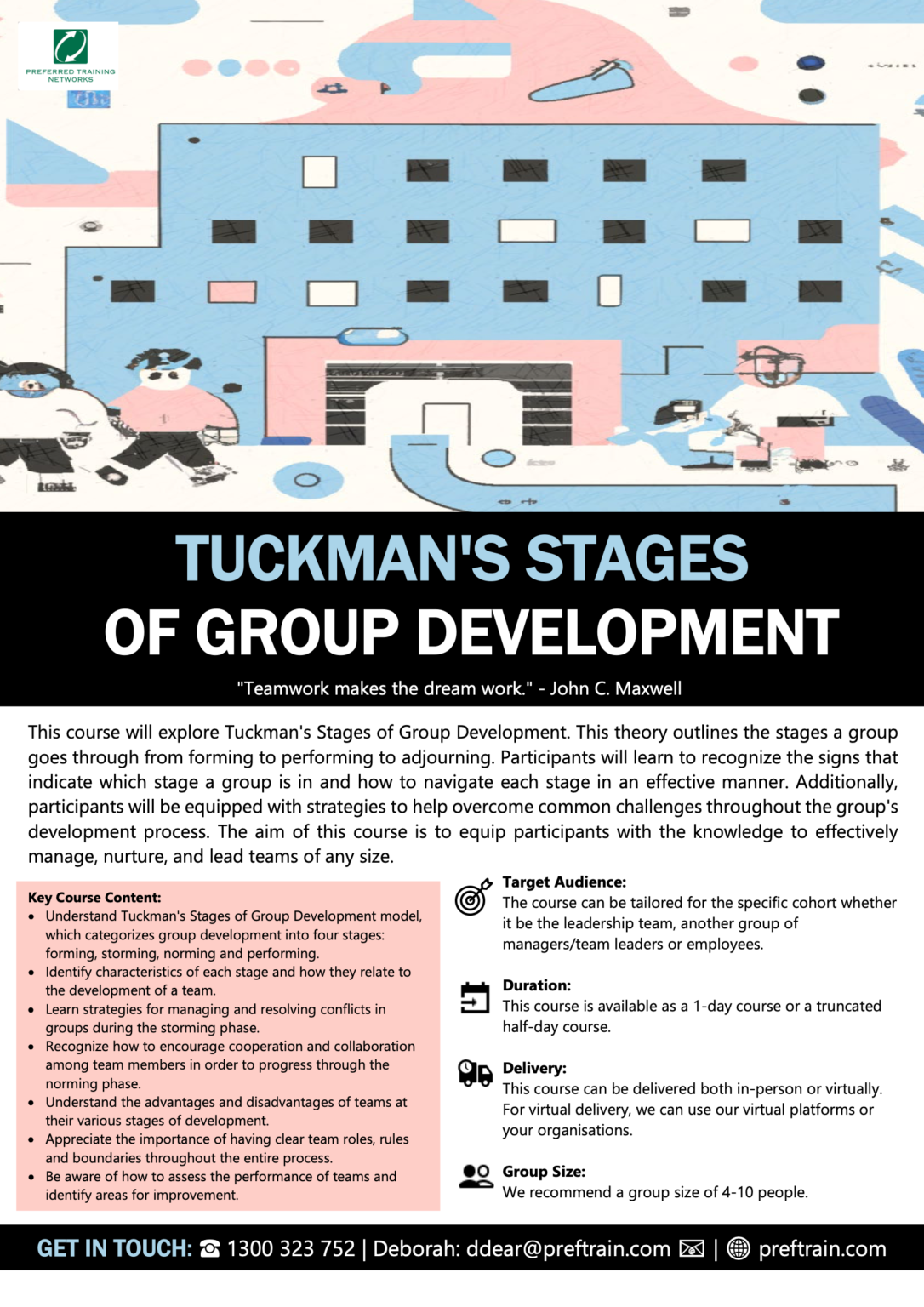
Tuckman’s stages of group development describe the four different stages of a group as they get together to operate collectively. The stages of group development by Tuckman enable people to gather a better understanding of how groups work.
Forming: This stage is marked by the desire of people to be accepted by others without any conflict. People avoid issues and focus on understanding team structures. However, people are gathering information about each other.
Storming: People can remain polite to each other only as long as issues are being addressed. This stage is marked by the presence of minor confrontations and, depending upon the organisation’s culture, most of the issues are suppressed.
Norming: This stage marks the establishment of ‘rules of engagement’. People understand each other better and learn to appreciate skills.
Performing: This is the stage of interdependence and flexibility. People know each other well and are able to trust them to make way for independent activity. Group identity and morale are high and people are able to direct their efforts towards desired goals.
Adjourning: This phase marks the completion of the task and dissolution of the team. Following this stage, team members may either become less focused or highly focused. The behaviour at this stage varies.
If you are looking for professional development course in Australia, get in touch with Preferred Training Networks. We have the best trainers, facilitators and instructional designers in Australia. We offer a wide range of courses to meet your specific requirement. To know more about our courses, get in touch with us. You can contact us through our online form or call us to receive a free quote.
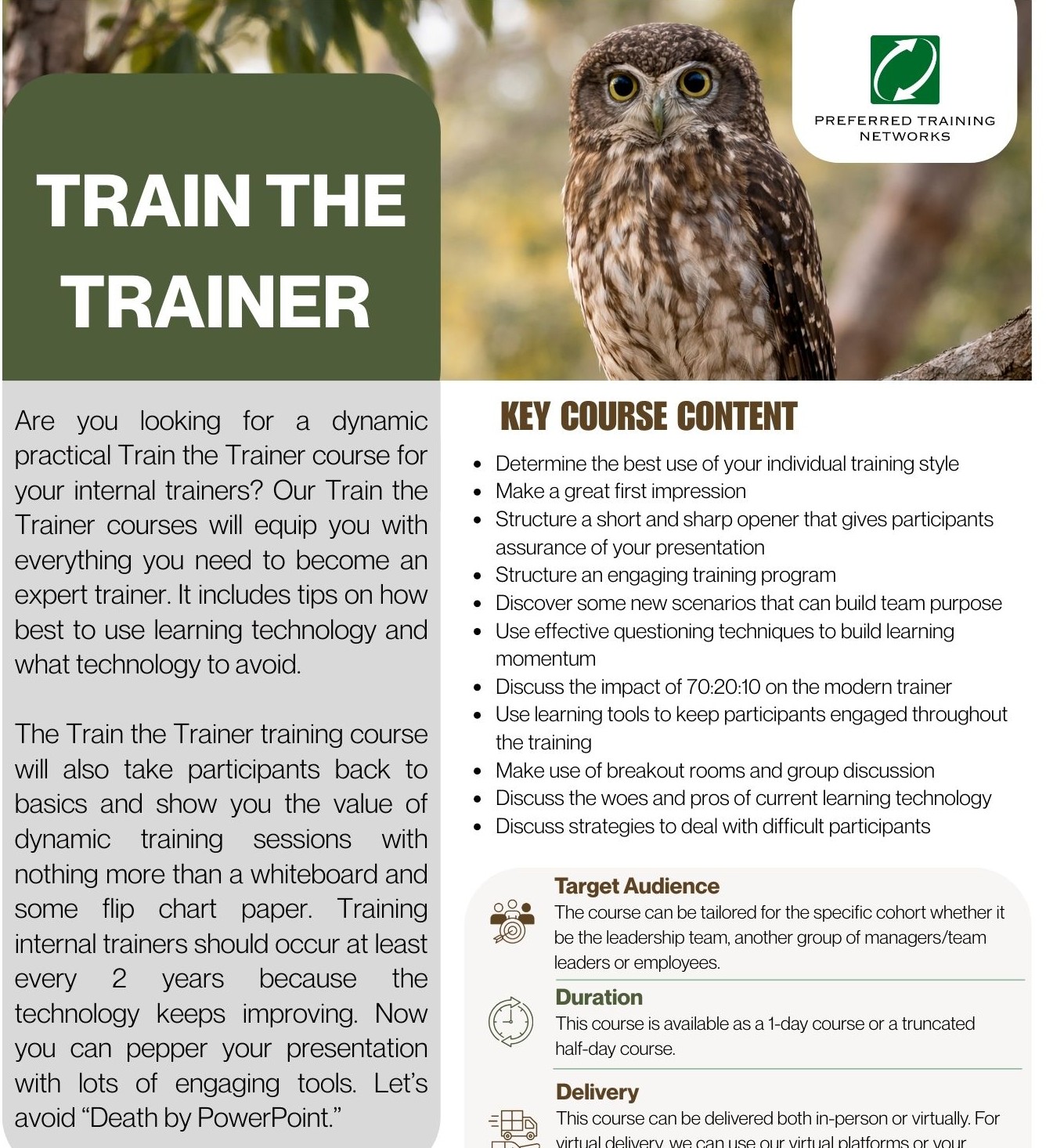
This Train the Trainer workshop pivots around the 70:20:10 model. Participants discover tools to help embed organisational learning. So, if you would like to boost levels of audience engagement and learning, then this course is perfect. This training has been designed for new and experienced trainers. Your experienced trainers will learn some new skills to engage the newer generations entering the workplace. Previous participants have found that the course helps them to move away from “slide decks” and “stand and deliver” formats.
Key elements of this course include people management workshops, communication training, front-line management and supervisor training, and general soft skills development.
For maximum effectiveness, this course is best conducted as an in-house program.
Venue: For your convenience, you can choose to conduct this course at your workplace. Alternatively, we can provide a training venue at a small additional cost.
Duration: Each course can be tailored to suit your timeframes.
Target audience: New and existing trainers and facilitators
Explore some of our other highly recommended courses including presentation skills training, dealing with conflict at work, strategic thinking and workplace conflict resolution training.
Whether you’re looking for help with time management, communication techniques, effective leadership skills, professional or interpersonal development or anything in between, we can help.
Pre-requisites
There are no prerequisites other than the participant will be responsible for delivering technical training. Some course participants may have the Cert IV, but it is not essential. This course is completely different to the Cert IV. There is very little overlap, as the Cert IV is too theoretical and top-heavy in process and assessment. Whereas this course is practical and hands on.
This program can be conducted as in house training at your offices.
Group Size: An ideal group size is 6–10 participants.
Venue: For your convenience, you can choose to conduct this program at your offices. Alternatively, we can provide a training venue at a small additional cost.
Duration: Each course can be conducted as a one-day program.
Cost: Upon request.
Target Audience: Specialist Technical Trainers, e.g. technical, subject experts, OH&S trainers looking to improve on delivery.
If you would like more information on this training program, please contact: Deborah Dear on 1300 323 752 or email: [email protected] or contact us online today.
Effective Presentation Skills
Learn how to deliver an effective business presentation that will bring about the results your organisation is looking for. Learn to structure your presentation to meet the audience’s expectations. Learn how to engage the audience no matter what the subject is. Presentations are often used as a formal method to plan and progress any business idea. They can be fun as they give people a chance to hold the stage and speak their mind. Organisations can use effective presentation skills to raise issues and find solutions to problems. An effective business presentation delivers a clear, concise impression on the audience.
Advanced Presentation Skills Training
If your people are already experienced presenters then we can jump straight into developing their presentation styles. We can critique their presentations. Each presentation can be videotaped too. Depending on the existing skill level of the audience we will customise a program that brings your people to the next level. Professional presentation skills training can often be the difference between clinching the outcome and missing the outcome. Don’t let your organisation miss out. For advanced training and effective business presentation techniques training, enrol in one of our professional courses. Download the Presentation Skills Training full course outline and submit your training request online.
How good are you at presenting?
Ask yourself the following:
Would you like to attend this program?
For maximum effectiveness, this program is best conducted as an in-house program.
Ideal group size: 4 – 10 participants
Venue: For your convenience, you can choose to conduct this program at your business premises. Alternatively, we can provide a training venue at a small additional cost.
Duration: Your Presentation Skills Course can be modified to fit inside your timeframe.
Cost: Price on request.
Target Audience: Employees, Supervisors, Team Leaders, Senior Managers or CEO’s
If you would like more information on this training program, please contact: Deborah Dear on 1300 323 752 or email: [email protected] or contact us online today.