A Trusted Learning and Development Advisor
Customer experience mapping is a methodology used to discover how customers (and potential customers) feel as they experience your services. Customer experience mapping will allow your organisation to identify the required skills and knowledge to deliver a positive customer experience.
These professional workshops are designed to map the customer experience. Using a visual/process mapping process, participants will analyse and map the touch points with the customer. This proven process is also known as journey mapping. You can also identify moments of truth to enhance the customer’s experience. Don’t make the overcomplicating this process as you could get lost in Stage 1 for years (with no actual result).
Participants will then use this information to analyse the skills that staff would require to ensure a positive customer experience. This process involves identifying how and when staff can positively influence the customer experience and the role that learning and development can play. This information will form the basis of the learning content and format. It is recommended to run up to 3 Customer Experience workshops with key stakeholders and internal influencers. There is also a debrief session with management at the end of Stage 1 with key findings and recommendations.
Stage 2 will involve designing and developing a learning program based on the outcomes of the Customer Experience Mapping workshops which means that the learning program will focus on developing staff to deliver on the customer experience. This stage will include developing a range of learning and activities and formats that will allow you to build individually focused learning programs based on staff needs.
The next stage is delivering the learning programs. Learning programs can be arranged as stand-alone activities or as part of an agreed development plan or curriculum for individual staff. This means that staff can either focus on very specific development needs (e.g. Challenging Conversations) or a development program that includes a range of learning programs and activities. During the execution phase, we will work closely with the learning and development team to evaluate the learning programs to ensure relevance and effectiveness. During the execution stage we will employ a rapid design process to design and develop learning programs as the need arises.
Other complementary activities include sales training programs, training for dealing with difficult or angry customers, persuasion skills training, customer service skills training and other soft skills development training.
For a no obligation free consultation please contact our offices 1300 323 752
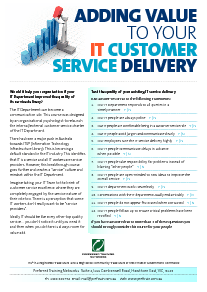
There has been a major push in Australia towards ITIL® (Information Technology Infrastructure Library). This is becoming a default standard in the IT industry. This identifies that IT is a service and all IT workers are service providers. However, this breakthrough course goes further and creates a “service” culture and mindset within the IT Department. Imagine taking your IT Team to the brink of customer service excellence where they are completely engaged by the service nature of their role too. There is a perception that some IT workers don’t really want to be “service providers”. Ideally IT should be like every other top quality internal service.
Test the quality of your existing IT service delivery
Just answer Yes or No to the following statements:
If you have answered No to more than 3 of these questions, you should strongly consider this course for your people.