A Trusted Learning and Development Advisor
Most people and organisations have simply no idea how much risk and liability surrounds sending and receiving emails. What about the risk of losing key clients and customers by sending poorly constructed or misunderstood emails? Emails are legal documents, and email training skills will help your people learn to write dynamic, risk-free emails.
Many organisations don’t adequately check the quality of emails for perceived employee privacy issues. Make sure that your people use an email style guide and a training framework that keeps your emails integrated and easy to read. Get rid of sloppy grammar and jargon too. Writing a well constructed email isn’t rocket science, and all your people should be writing quality emails every time.
For maximum effectiveness, this program is best conducted as an in-house program.
Ideal group size: 4–12 participants.
Venue: For your convenience, you can choose to conduct this program at your business premises. Alternatively, we can provide a training venue at a small additional cost.
Duration: Your ‘Email Writing Skills Training and Etiquette’ Course can be modified to fit inside your timeframe.
Cost: Price on request.
Target Audience: Employees, Supervisors, Team Leaders, Senior Managers or CEO’s.
If you would like more information on this training program, please contact: Deborah Dear on 1300 323 752 or email: [email protected] or contact us online today.
You might be interested in our other exciting courses like: managing meetings training, managing conflict in the workplace, and Employee and engagement training. Get in touch with us today if you have any queries.
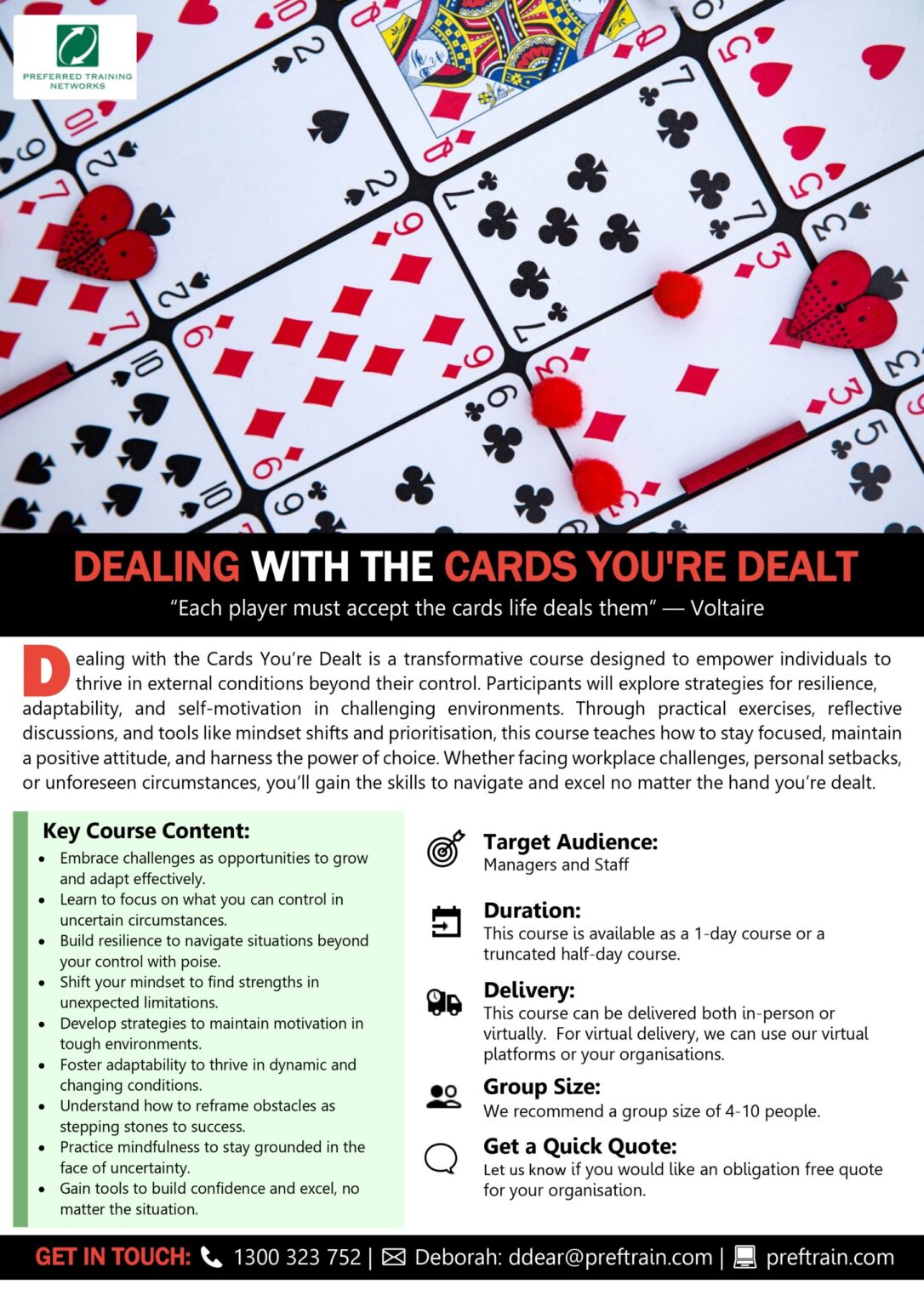
Let’s draw a similarity with your team and your workplace. Your team and workplace are also unique. Just like cards, you’ll find that you may have not been dealt a Royal Flush. But the secret is to work with what you’ve got and strive to make it better.
Have you ever observed people playing bridge? Even with a poor hand, they work fervently improving their position.
In a nutshell, this course will help participants shift from complaining to proactively making the workplace more cohesive and effective.
For maximum effectiveness, this program is best conducted as an in-house program.
Venue: For your convenience, you can choose to conduct this program at your workplace. Alternatively, we can provide a training venue at a small additional cost.
Duration: Each course can be tailored to your timeframes.
Target Audience: Managers and staff.
If you would like more information on this training program, please contact: Preferred Training Networks on 1300 323 752 Email: [email protected]
Plan of action
Even the best commanders in the world know not to overuse command skills. However, many leaders completely under use their command skills to the detriment of the organisation. Command skills are a situational tool and are imperative in certain instances particularly when personal safety is at risk.
The 10 commandments of Command Skills:
“Never tell people how to do things. Tell them what to do and they will surprise you with their ingenuity.” – George S Patton
Would you like to attend this program?
For maximum effectiveness, this program is best conducted as an in-house program.
Ideal group size: 4 – 12 participants.
Venue: For your convenience, you can choose to conduct this program at your business premises. Alternatively, we can provide a training venue at a small additional cost.
Duration: This program can be adapted to meet your requirements.
Cost: Price on request.
Target Audience: Supervisors, Team Leaders and Management.
If you would like more information on this training program, please contact: Deborah Dear on 1300 323 752 or email: [email protected] or contact us online today.
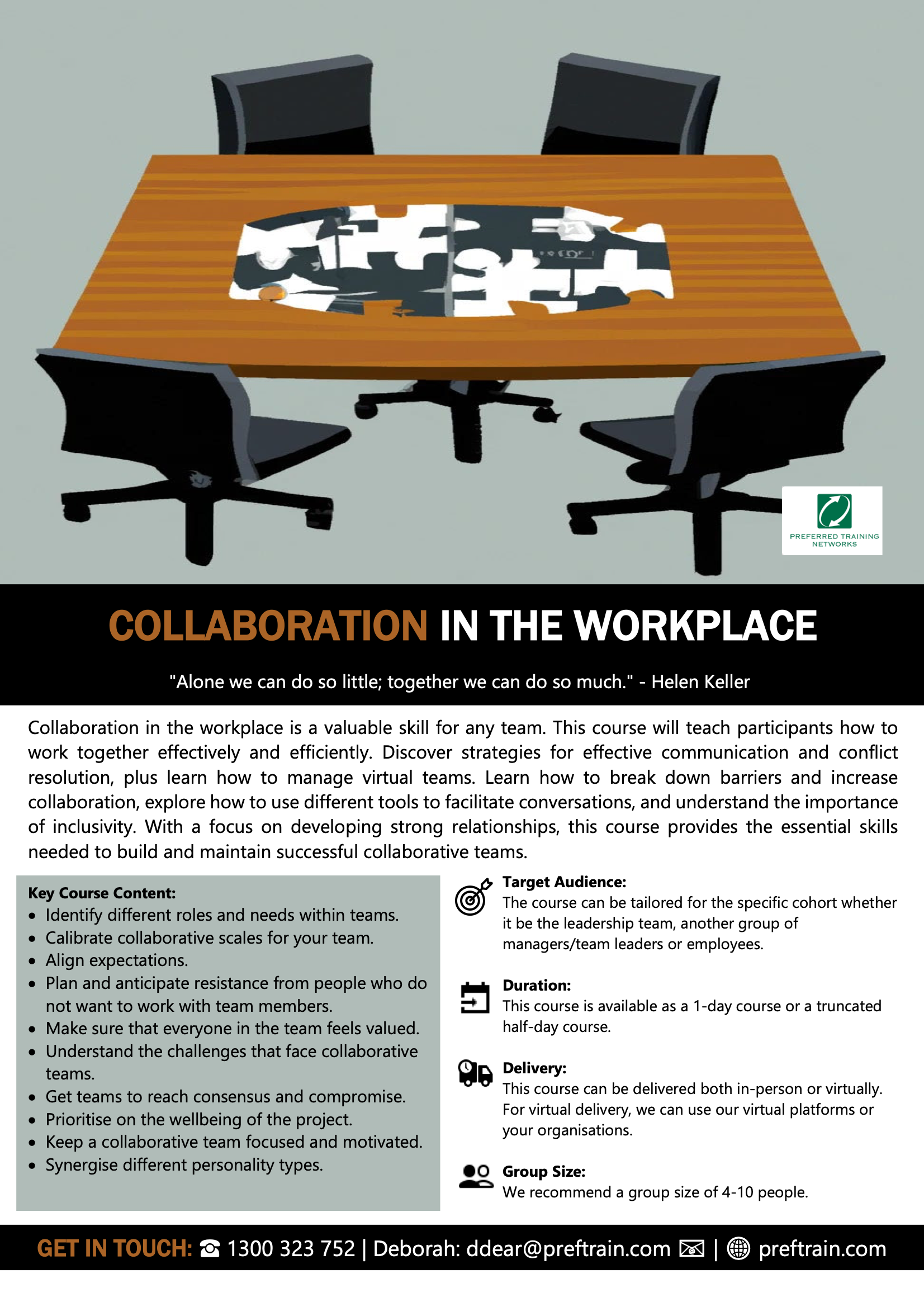
This program was designed to equip managers with collaboration techniques to ensure their teams work collaboratively in business to pursue organisational objectives.
Would you like to attend this program?
For maximum effectiveness, this course is best conducted as an in-house program.
Venue: For your convenience, you can choose to conduct this course at your workplace. Alternatively, we can provide a training venue at a small additional cost.
Duration: Each course can be tailored to suit your timeframes.
If you would like more information on this training program, please contact: Deborah Dear on 1300 323 752 or email: [email protected] or contact us online today.
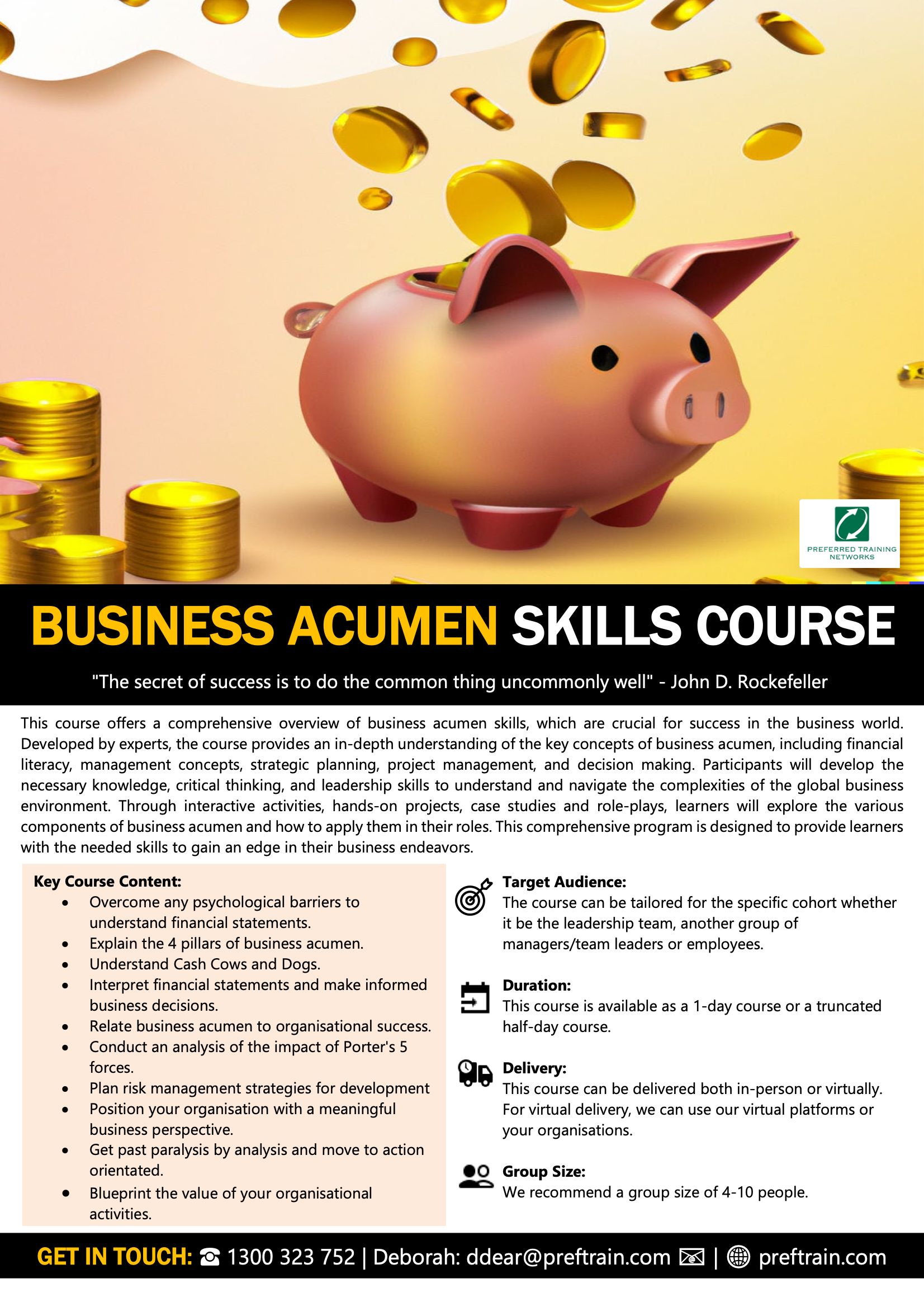
This program helps participants to understand business acumen, the proven linkages that exist and the importance of developing strategic skill sets.
“You have to combine instinct with good business acumen. You just can’t be creative, and you just can’t be analytical.” – Andrea Jung
Would you like to attend this program?
For maximum effectiveness, this program is best conducted as an in-house program.
Ideal group size: 4 – 12 participants.
Venue: For your convenience, you can choose to conduct this program at your business premises. Alternatively, we can provide a training venue at a small additional cost.
Duration: This program can be adapted to meet your requirements.
Cost: Price on request.
Target Audience: Supervisors, Team Leaders and Management.
If you would like more information on this training program, please contact: Deborah Dear on 1300 323 752 or email: [email protected] or contact us online today.
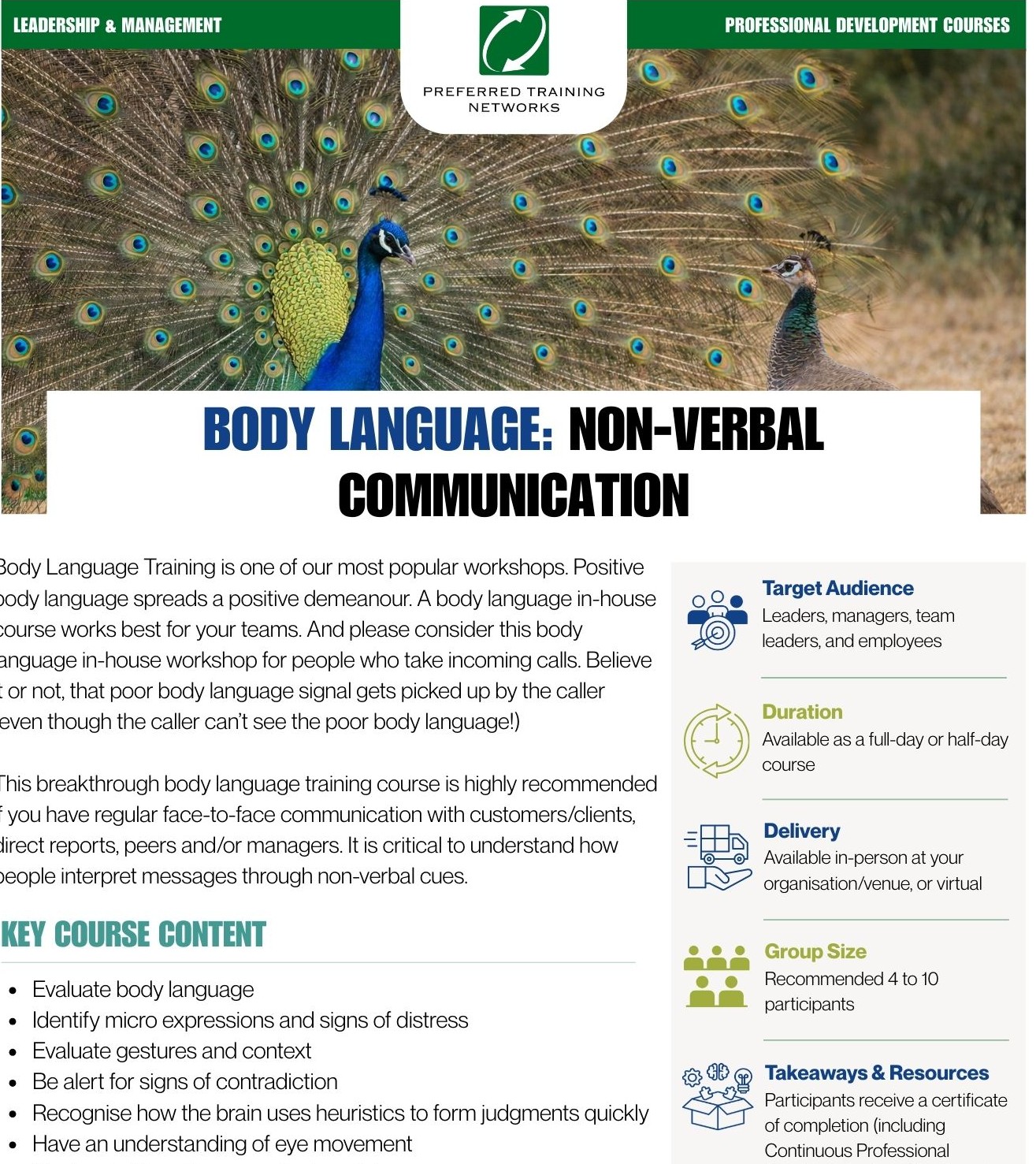
Verbal communication (talking) is only responsible for about 15% of communication. The majority of the message is communicated and transmitted through body language (also known as non-verbal communication). Consider your reaction about how you might interpret a message from a manager whom you met in the corridor and they asked your opinion on what colour the office should be if they were:
Are you ready for body language training? If you hear any of these questions then it’s probably prime time to run this course. How do I read other people’s non-verbal communication? How do I spot buying signals from customers? What does my body language portray? Think of Preferred Training Networks when you are looking out for courses on body language or body language training. Additionally, our team can assist you with confidence building courses, workplace behaviour training, business presentation training, soft skills training for employees and more. Who can benefit from Body Language Training? For maximum effectiveness, this program is best conducted as an in-house program.
Q: What skills will I learn in this course?
A: You’ll learn to read non-verbal signals, present yourself with confidence, and interpret subtle cues in conversations.
Q: Is this course delivered in-person or virtually?
A: The course can be delivered in-house across Australia or virtually to suit your team’s preferences.
Q: How long is the Body Language Training Course?
A: It can be tailored as a half-day or full-day session depending on your needs.
How do I apply design thinking to work? How can I do things better at work? What new ideas can we implement at work?
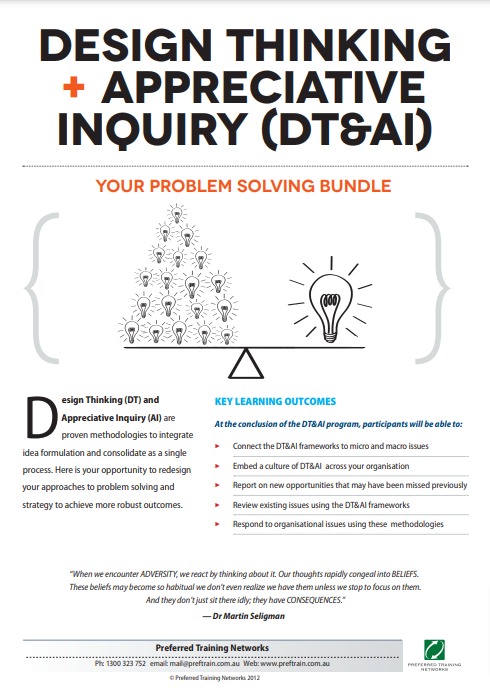
The process of design thinking is gaining popularity and has emerged to be a powerful tool to handle various problems at work. Design Thinking (DT) and Appreciative Inquiry (AI) are proven methodologies to integrate idea formulation and consolidate as a single process. Our design thinking course equips you with the skill to structure your creativity in a way that you are able to deal effectively with challenging situations.
Our Design Thinking and Appreciative Inquiry Training Course offers you the knowledge to integrate (AI) Appreciative Inquiry and design thinking with confidence. The course is specifically developed to be engaging and provide a practical learning experience. If you are eager to apply design thinking to your work, this course is ideal for you. In combination with Appreciative Inquiry, the course aims to transform your approach for better results.
With our enriching appreciative inquiry training course, you get an insight into the advantages of looking for the positives of a situation and to deal with problems in an efficient way.
Here is your opportunity to redesign your approaches to problem-solving and strategy to achieve more robust outcomes.
“When we encounter ADVERSITY, we react by thinking about it. Our thoughts rapidly congeal into BELIEFS. These beliefs may become so habitual we don’t even realise we have them unless we stop to focus on them. And they don’t just sit there idly; they have CONSEQUENCES.”
— Dr Martin Seligman
DESIGN THINKING + APPRECIATIVE INQUIRY (DT&AI)
DESIGN THINKING (DT)
Developed by Tim Brown, Design Thinking incorporates the concept of creative thinking in action as a response to ill defined problems and issues. Rather than focusing on defining and scoping the problem, Design Thinking starts with a solution or end goal, and works towards what could be achieved.
“Thinking like a designer can transform the way you develop products, services, processes—and even strategy.”
— Tim Brown
APPRECIATIVE INQUIRY (AI)
Appreciative Inquiry was adopted from work done by earlier action research theorists and practitioners and further developed by Dr David Cooperrider and Suresh Srivastva. Cooperrider and Srivastva suggest that an organisation is a miracle to be embraced rather than a problem to be solved.
“Appreciative Inquiry is revolutionising the field of organisation development and change.”
— Robert Quinn, University of Michigan
GOODBYE SWOT FOREVER
Surely it’s time to get past the SWOT analysis that can often leave people dejected, feeling there is a huge burden of tasks to carry. The SWOT reminds everyone of the organisation’s weaknesses whereas this combined approach harnesses the positive power of your organisation. This course synergises these two proven innovative problem solving methodologies. You’ll be surprised at the depth of creative solutions derived from this integrated approach. The workshop energises people because it works from the end goal and avoids the paralysis by analysis dynamic. The creative thinking in action quickly engages people and generates animated discussion and participation. Everyone leaves in a positive frame of mind and this positivity filters through the senior leadership team and the organisation.
5 Immediate Benefits of using DT&AI Bundle
You should consider DT & AI for your organisation in any of the following circumstances:
This program can be conducted as In house training at your offices.
GUIDELINES
Group Size: An ideal group size is 6 – 10 participants.
Venue: For your convenience, you can choose to conduct this program at your offices. Alternatively, we can provide a training venue at a small additional cost.
Duration: Each course can be tailored to fit your timelines.
Cost: Upon request.
Target Audience: Ideal for Supervisors, Leaders and Management
Look at what you receive within 24 hours at no cost:
CONTACT US TODAY – Ph: 1300 323 752, Email: [email protected]
AI Appreciative Inquiry and Design Thinking 4.6 out of 5 based on 32 user ratings.