A Trusted Learning and Development Advisor
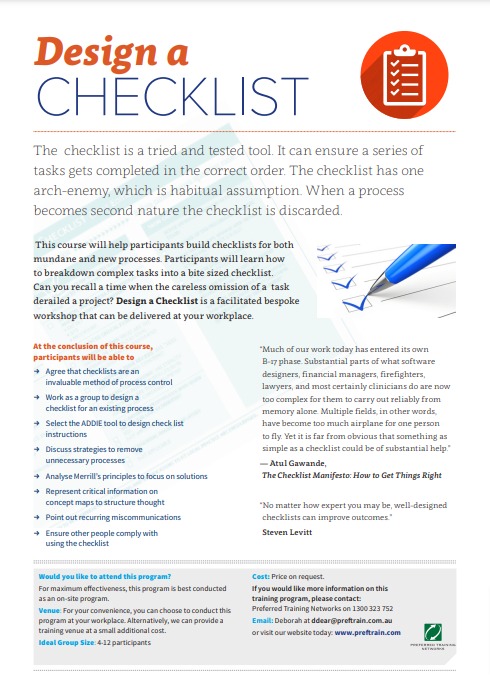
This tailored ‘Design a Checklist’ course will help participants build checklists for both mundane and new processes. Participants will learn how to breakdown complex tasks into a bite sized checklist. Can you recall a time when the careless omission of a task derailed a project? ‘Design a Checklist’ is a facilitated-bespoke workshop that can be delivered at your workplace.
The Checklist Manifesto: How to Get Things Right
For maximum effectiveness, this program is best conducted as an on-site program.
Venue: For your convenience, you can choose to conduct this program at your workplace. Alternatively, we can provide a training venue at a small additional cost.
Ideal Group Size: 4–12 participants.
Cost: Price on request.
If you would like more information on this training program, please contact: Preferred Training Networks on 1300 323 752 Email: Deborah at [email protected] or visit our website today: www.preftrain.com.au
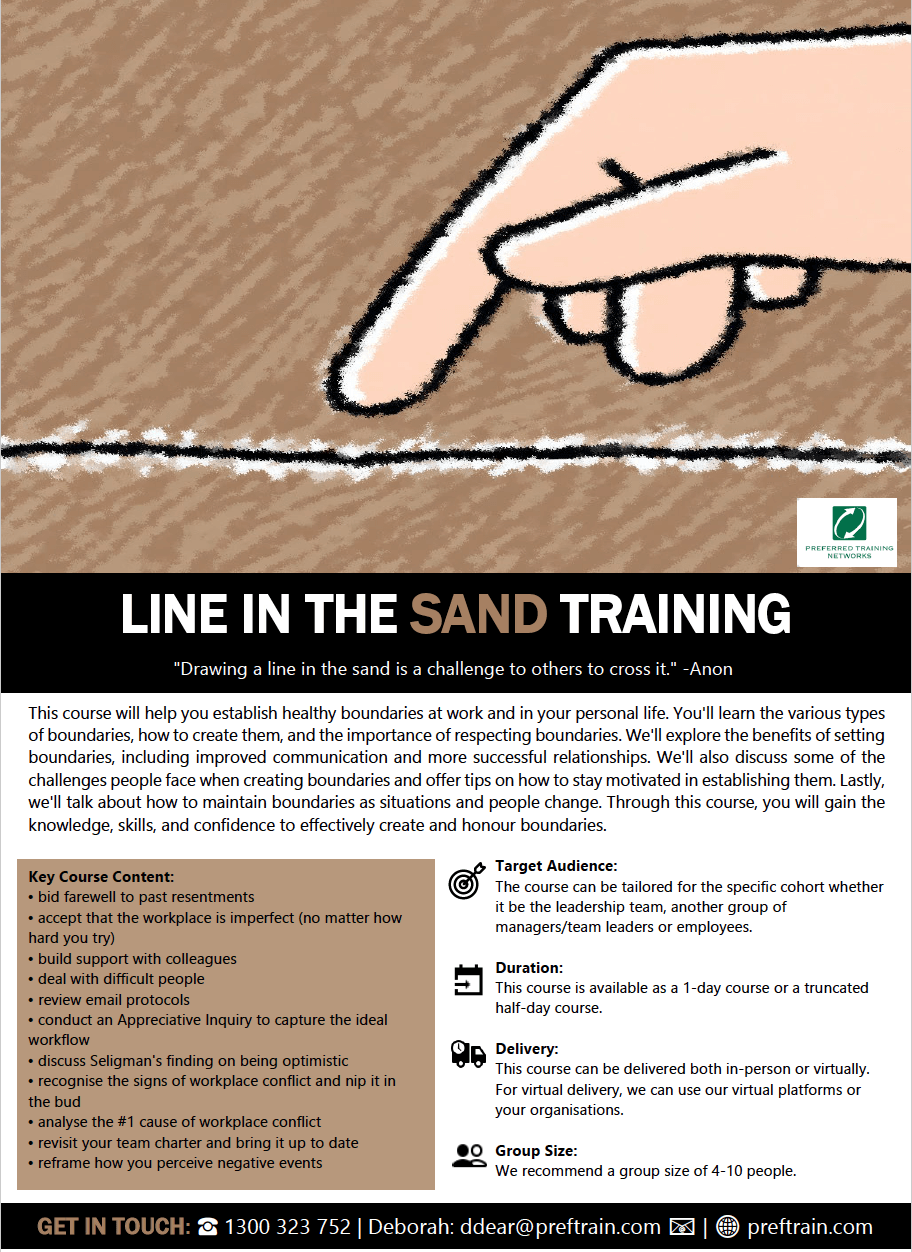
After this brinkmanship in-house training course, you’ll find the participants referring to the line in the sand. It’s a clear marker and an easy visual for people to remember.
You’ll also notice the participants have a pep in their step the very next day.
For maximum effectiveness, this program is best conducted as an in-house program.
Venue: For your convenience, you can choose to conduct this program at your workplace. Alternatively, we can provide a training venue at a small additional cost.
Duration: Each course can be tailored to your timeframes.
Target Audience: Managers and staff
“LATERAL LIGHTBULBS” Improve productivity and promote simplicity!
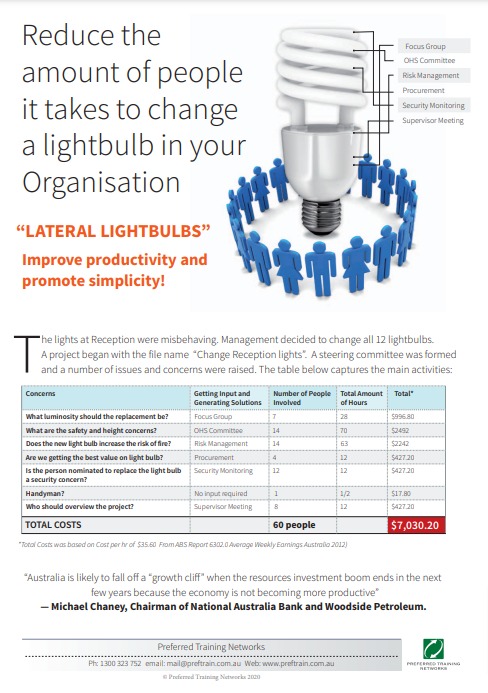
The lights at Reception were misbehaving. Management decided to change all 12 lightbulbs. A project began with the file name “Change Reception Lights”. A steering committee was formed and a number of issues and concerns were raised. The table below captures the main activities:
| Concerns | Getting Input and Generating Solutions |
Number of People Involved |
Total Amount of Hours |
Total* |
|---|---|---|---|---|
| What luminosity should the replacement be? | Focus Group | 7 | 28 | $996.80 |
| What are the safety and height concerns? | OHS Committee | 14 | 70 | $2492 |
| Does the new light bulb increase the risk of fire? | Risk Management | 14 | 63 | $2242 |
| Are we getting the best value on light bulb? | Procurement | 4 | 12 | $427.20 |
| Is the person nominated to replace the light bulb a security concern? |
Security Monitoring | 12 | 12 | $427.20 |
| Handyman? | No input required | 1 | 1/2 | $17.80 |
| Who should overview the project | Supervisor Meeting | 8 | 12 | $427.20 |
| TOTAL COSTS | 60 people | $7,030.20 |
*Total Costs was based on Cost per hr of $35.60 From ABS Report 6302.0 0
Lateral Lightbulbs
A lot of activity was generated around this project. The only downside was that knowledge was replacing action. In the groundbreaking book ‘The Knowing Action Gap’ by Pfeffer and Sutton, the authors relate how organisations often act on gathering knowledge rather than executing the project. Now, this is certainly reflected in the Australian Labour Productivity below. Notice how productivity in Australia continues to decline.
Is your organisation complex or simple?
Are tasks overly complicated in your organisation? Try this HFH Diagnostic Tool, designed by Organisational Psychologists. The level of complexity within organisations is staggering, and it’s only getting worse. Even the simplest of tasks can involve myriad choices, endless stakeholders, data to analyse and processes to manage. Thinking of your own organisation, plot the amount of effort and time (1–10) it takes to complete the following tasks on the graph below. …
Which quadrant is the most populated?
Q1 – Frustration Zone: Too much effort is required to achieve outcomes. Leads to medium to high levels of frustration, complexity and distraction.
Q2 – Dysfunction Zone: Way too much time & effort required to achieve outcomes. Leads to high levels of frustration, complexity and staff turnover.
Q3 – Ideal Zone: Appropriate amount of time and effort required to achieve outcomes. Leads to a calm, seamless working environment.
Q4 – Double Up Zone: Too much time spent to achieve outcomes, with medium to high levels of frustration, complexity and distraction.
This program can be conducted as in house training at your offices.
The Manager’s Guide to Reducing Workplace Sickies
Although sickies are often joked about as being an Australian institution, they cost Australia billions of dollars every year. Of course, sick days are inevitable but some sickies are signs of despair and some sickies are discretionary.
Every manager who attends this breakthrough program receives a “managing workplace sickies workbook” written by a psychologist to help reduce the amount of sickies in your organisation.
Signposts of Sickies:
Sick of self
From time to time, people feel low esteem. Self motivation ebbs and tasks become chores. When people are sick of themselves they often feel more isolated and find it difficult to get back on track.
Sick of colleagues and people
You might notice that some of your people are not themselves. They just don’t seem to care about their colleagues. They become indifferent and often focus more on the process than the person.
Sick of work
This is the number #1 cause of discretionary sick days in the workplace. The employee is sick of the workplace. When that alarm goes off in the morning, they groan and look for options to take a sickie. These employees often have a hostage mentality and they are disengaged from your organisation.
Sick of Pressure
Throughout our working lives, we face constant hurdles and struggle points. Occasionally, employees reach crisis points and either bottle up the pressure or explode. Learn proven methods to regulate and release the levels of stress and anxiety in the workplace.
Sick Sick
When you’re sick, you’re sick. That is why the sick days are there. Usually you don’t want sick people in the workplace, and you would much prefer them at home resting and recuperating. However, in this session participants learn ways to avoid and reduce the amount of bacterial based germs in the workplace. And you also learn some ideas on how to keep employees fit and healthy.
Maintaining a fit and healthy workforce – what can you do?
4 Benefits of running this course
THE NUTS AND BOLTS
This program can be conducted as in-house training on site anywhere in Australia.
GUIDELINES
Group Size: An ideal group size is 4?–12 participants.
Venue: For your convenience, you can choose to conduct this program at your offices. Alternatively, we can provide a training venue at a small additional cost
Duration: This program is conducted as a one day course.
Cost: Upon request.
Target Audience: Senior management, middle management, team leaders and supervisors.
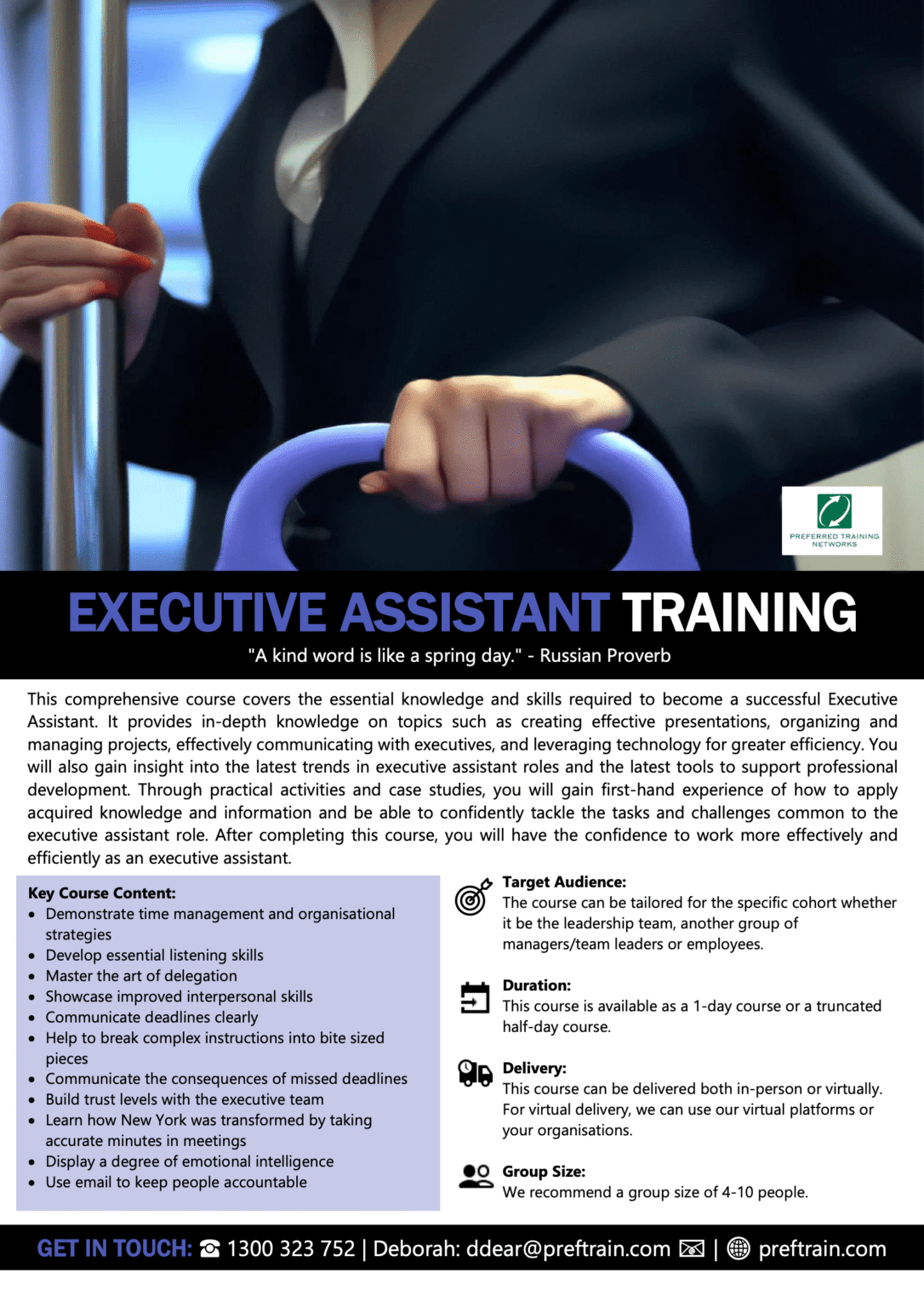
Executive Assistants are frantically working towards important deadlines. Yet amazingly, some EAs are gliding majestically like ducks on the water. You don’t see their feet paddling, and they spread a sense of calm and professionalism.
This course works best by including the team of EAs. After all, these key people work together to ensure critical tasks are delivered each and every day to a high standard.
For maximum effectiveness, this course is best conducted as an in-house program.
Venue: For your convenience, you can choose to conduct this course at your workplace. Alternatively, we can provide a training venue at a small additional cost.
Duration: Each course can be tailored to suit your timeframes.
Price: Available upon request.
If you would like more information on this training program, please contact us at 1300 323 752 or Email: [email protected]
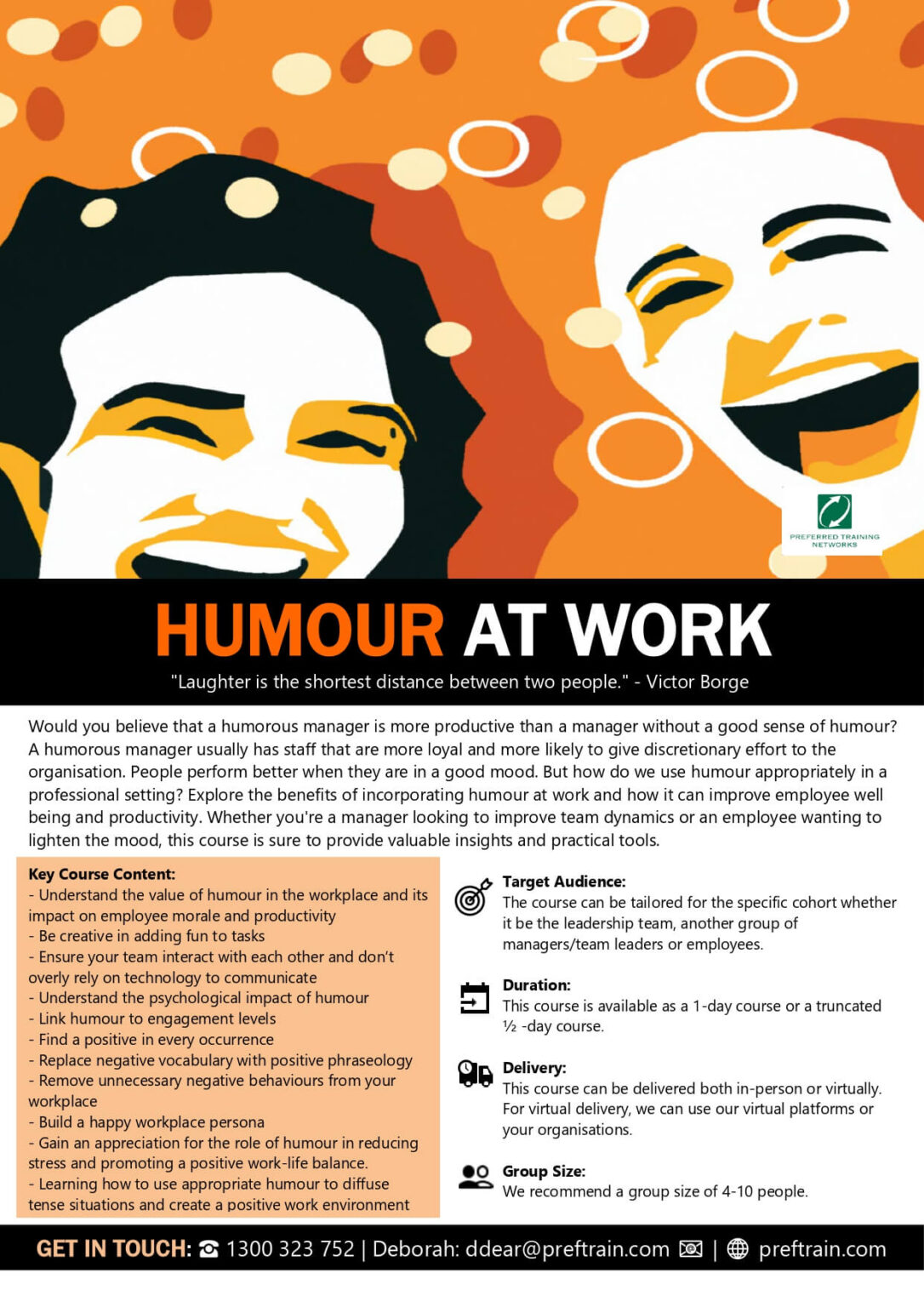
Would you believe that a humorous manager is more productive than a manager without a good sense of humour? A humorous manager usually has staff that are more loyal and more likely to give discretionary effort to the organisation. People perform better when they are in a good mood. This course was designed to teach people a framework of how to be humorous in the workplace. The program recognises that not everybody wants to be humorous. However, it is still possible to work in an environment of humour if you have a working knowledge of how to promote humour. How humorous is your workplace?
Ask yourself the following about your workplace:
1. People usually have smiles on their faces as they complete their tasks.
2. People gather in friendly groups and there are plenty of laughs.
3. Our people don’t backstab.
4. Our organisation promotes a positive workplace.
5. Our staff often go out on social occasions together.
6. We often reward people who were particularly positive.
7. Our staff are engaged.
8. Our customers are usually in a good frame of mind.
9. Role descriptions and expectations are very clear.
10. We avoid a blame culture.
11. Positive customer feedback is paramount to our success.
12. Management are very approachable by staff.
13. The banter in the office is positive.
14. Vocabulary in the office is positive, and the outlook is rosy.
Did you know?
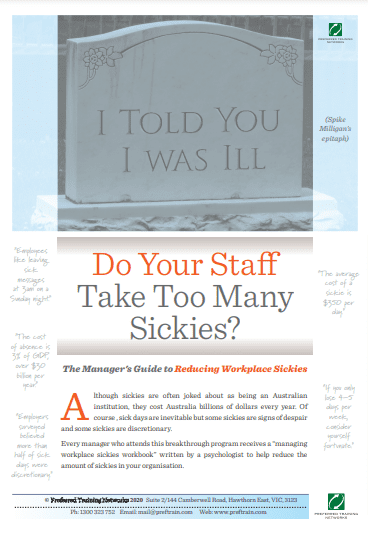
Workplaces that are considered positive generally score “YES” to 10 of these questions. If you scored less, you should think about learning how to improve your workplace environment. “I told you I was ill.” – Epitaph on Spike Milligan’s tombstone
For maximum effectiveness, this program is best conducted as an in-house program.
Ideal group size: 4–12 participants.
Venue: For your convenience, you can choose to conduct this program at your business premises. Alternatively, we can provide a training venue at a small additional cost.
Duration: This program can be adapted to meet your requirements.
Cost: Price on request.
Target Audience: Supervisors, Team Leaders and Management.
If you would like more information on this training program, please contact: Deborah Dear on 1300 323 752 or email: [email protected] or contact us online today.
As innovative confidence grows, the final group activity will help participants discover how to turn ideas into products processes and service.
If you’re seriously trying to make your people more innovative, then this is a must-do course. Workplace Innovation is an action rather than a contemplation. The final group activity will help participants discover how to turn ideas into products, processes and service.
Questions you might be asking yourself
How can I make the workplace more innovative? How do I nurture good ideas at work? How do I implement change into the workplace?
For maximum effectiveness, this program is best conducted as an on-site program.
Options: This course can be tailored to fit with your timeframe.
Venue: For your convenience, you can choose to conduct this program at your workplace. Alternatively, we can provide a training venue at a small additional cost.
Cost: Price on request.
If you would like more information on this training program, please contact: Preferred Training Networks on 1300 323 752
Email: Deborah at [email protected]
Imagine the difference if your managers and staff could manage the centre more effectively. Imagine anticipating and solving problems in their infancy, rather than a crisis management approach. Imagine being able to deflect anger rather than meet the anger head on. To address these concerns, we’ve designed this short, practical management course specifically for leisure centre managers, supervisors and team leaders.
“Imagine anticipating and solving problems in their infancy rather than a crisis management approach.”
The breakthrough course gives leisure centre managers proven tools to manage your leisure centre more effectively.
LEISURE MANAGEMENT, OR MANAGING LEISURELY
COMMON CONCERNS THAT LEISURE CENTRE STAFF HAVE ABOUT COUNCIL:
“Being apart from Council can make us feel isolated. A visit from Council often has some ego of authority involved as they wear suits and we wear gym gear which often bears bleach splatter stains from the pool.”
“Our customers can be at times unbelievably rude. Some of our customers treat the centre as a refuge centre. Some of our gym customers are narcissists who believe we are their slaves. And the hardest thing is that our staff get regularly shouted at and abused. When we ask Council for help, they make all these plans with very little action”
“An unexpected visit from the mother-in-law is preferable to an expected visit from Council.”
COMMON CONCERNS THAT COUNCILS HAVE ABOUT LEISURE CENTRE STAFF:
“We ask for the same reports umpteen times, and then they give us flak about how busy they are. If they know the reports are due, why does it always have to be so hard.”
“Leisure Management is a good description. The Managers won’t criticise staff. They won’t performance-manage staff properly and then when it all falls over they rely on Council to fix up the mess.”
“They don’t see the bigger picture. They think if they get through the day without any serious issues, then that’s productive. They think that is management. It’s not. Management should also be making things better and eliminating recurring problems. I reckon 90% of their workload is the same difficulties over and over again. No point in telling them as they won’t listen as they know better.”
This program can be conducted as in-house training at your centre.
Group Size: An ideal group size is 6 – 10 participants.
Venue: For your convenience, you can choose to conduct this in-house Leisure Centre management program at your centre. Alternatively, we can provide a training venue at a small additional cost.
Duration: Each course can be tailored to your timeframes.
Cost: Upon request.
Target Audience: Leisure centre managers, supervisors and team leaders
If you would like more information on this training program, please contact: Deborah Dear on 1300 323 752 or email: [email protected] or contact us online today.
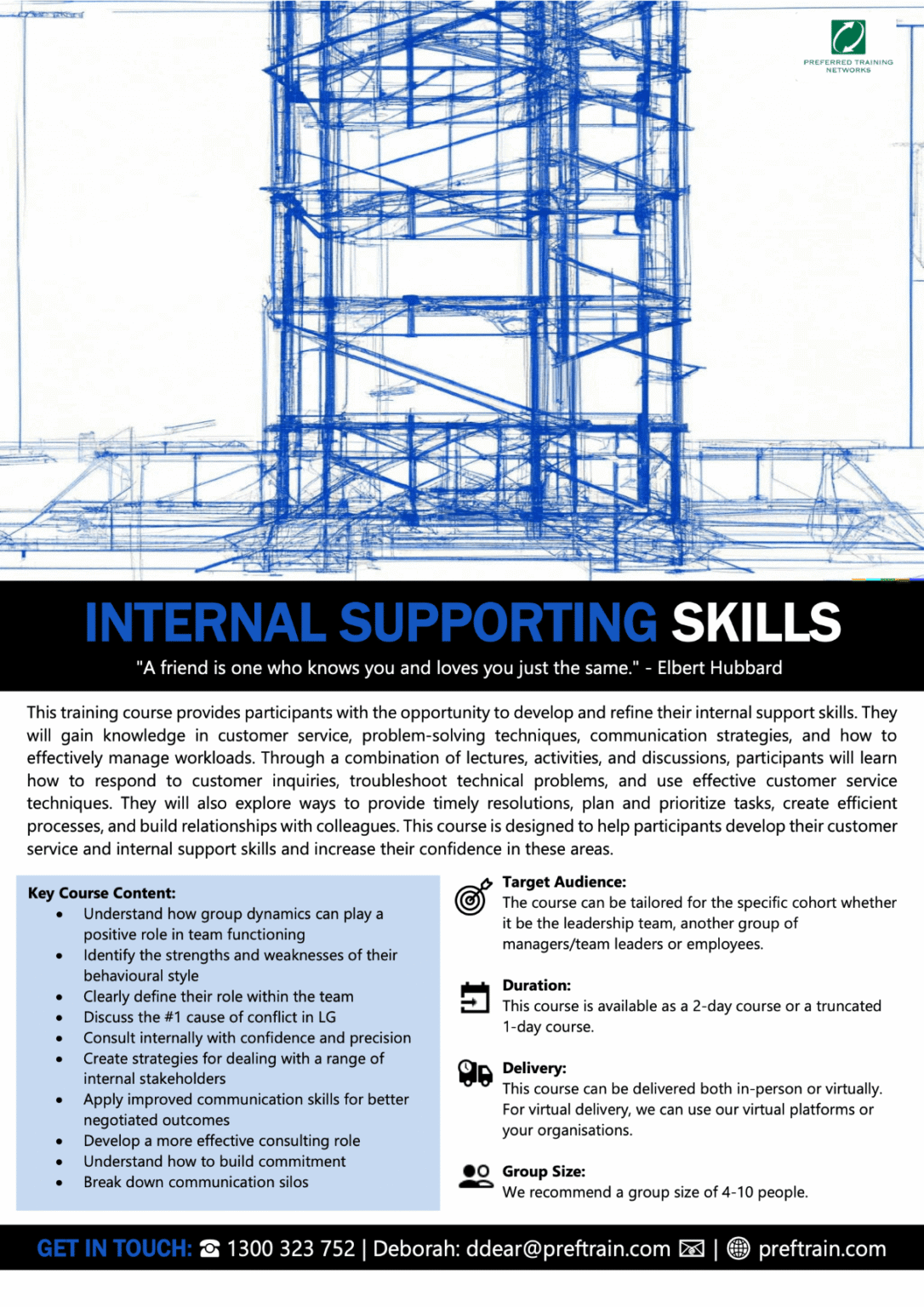
For any organisation to be effective, it needs harmony, collaboration and seamlessness between its internal departments and processes. A bridge (like an organisation) without adequate supports collapses.
On Site Delivery – using local facilitators means no travel costs in Sydney, Brisbane, Melbourne, Darwin, Canberra, Adelaide, Launceston and Perth.
For maximum effectiveness, this program is best conducted as an in-house program.
For more information, please contact: Preferred Training Networks on 1300 323 752 or email: [email protected]
Q. Who should attend the Internal Supporting Skills Training?
A. This course is ideal for internal service providers, administrative staff, and team members who support other departments within an organisation, aiming to enhance their collaborative and communication skills.
Q. What are the key learning outcomes of this course?
A. Participants will learn strategies for effective internal communication, building strong interdepartmental relationships, and delivering high-quality internal customer service.
Q. Is this training available across Australia?
A. Yes, we offer the Internal Supporting Skills Training in all major cities and regional areas across Australia, with options for in-person or virtual delivery.
Q. How long is the course?
A. The course can be tailored to your needs, with options ranging from 60-minute microlearning sessions to full-day workshops.
Unfortunately, many people don’t know how to build an “idea generating” organisational culture. If you only do one training program with your team this year, then the “Idea Generating” training program should be at the top of your list.
For maximum effectiveness, this program is best conducted as an in-house program.
If you would like more information on this training program, please contact: Deborah Dear on 1300 323 752 or email: [email protected] or contact us online today.