A Trusted Learning and Development Advisor
Boost your team’s communication with this tailored in-house business communication workshop. Perfect for Australian workplaces to help participants improve written and verbal communications
Communication is fundamentally about clarity and ridding the organisation of miscommunications and misunderstandings, Learn to get your message across, handle challenging conversations, and build strong working relationships. This business communication course is delivered across Australia and can be customised to suit your team’s needs. Perfect for leaders, teams, and customer-facing roles.
Target Audience: This active Listening Skills course can be tailored for the specific cohort whether it be the leadership team, another group of managers/team leaders or employees.
Duration: This course is available as a 1-day course or a truncated 1/2-day course.
Delivery: This course can be delivered both in-person or virtually. For virtual delivery, we can use our virtual platforms or your organisations.
Group Size: We recommend a group size of 4–10 people.
Target Audience:
The course can be tailored for the specific cohort whether it be the leadership team, another group of managers/team leaders or employees.
Duration:
This course is available as a 1-day course or a truncated 1/2-day course.
Delivery:
This course can be delivered both in-person or virtually. For virtual delivery, we can use our virtual platforms or your organisations.
Group Size:
We recommend a group size of 4-10 people.
If you’ve faced an angry group, then you’ll know the importance of this training. The biggest problem with an angry group is that the anger is constant and random. It’s even more unsettling than dealing with an angry individual. This course gives you strategies to keep you safe and quell the group’s anger. So, if your people are in the position of facing an angry group, then this ‘Dealing with Angry People’ workshop is perfect.
Would you like to attend this tailored ‘Dealing with Angry People’ program? For maximum effectiveness, this course is best conducted as an in-house program.
Venue: For your convenience, you can choose to conduct this course at your workplace. Alternatively, we can provide a training venue at a small additional cost.
Duration: Each course can be tailored to suit your timeframes.
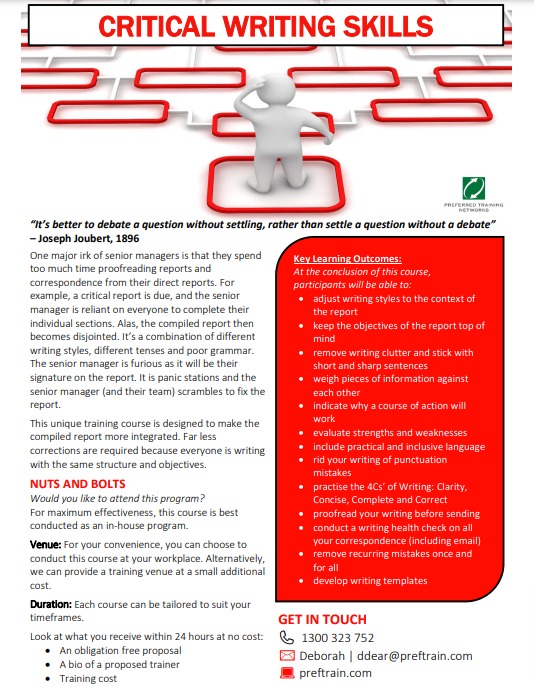
One major irk of senior managers is that they spend too much time proofreading reports and correspondence from their direct reports. For example, a critical report is due, and the senior manager is reliant on everyone to complete their individual sections. Alas, the compiled report then becomes disjointed. It’s a combination of different writing styles, different tenses and poor grammar. The senior manager is furious as it will be their signature on the report. It is panic stations and the senior manager (and their team) scrambles to fix the report.
Would you like to attend this program?
For maximum effectiveness, this course is best conducted as an in-house program.
Venue: For your convenience, you can choose to conduct this course at your workplace. Alternatively, we can provide a training venue at a small additional cost.
Duration: Each course can be tailored to suit your timeframes.
If you would like more information on this training program, please contact us at 1300 323 752 or Email: [email protected]
For maximum effectiveness, this program is best conducted as an in-house program.
Venue: For your convenience, you can choose to conduct this program at your workplace. Alternatively, we can provide a training venue at a small additional cost.
Duration: Each course can be tailored to your timeframes.
Target Audience: Employees who write reports.
Some policies are too long and impossible to understand. Other policies are wafer thin and serve no useful purpose.
So, if you’d like to improve how your policies are written and communicated, then this course is perfect.
For maximum effectiveness, this course is best conducted as an in-house program.
Venue: For your convenience, you can choose to conduct this course at your workplace. Alternatively, we can provide a training venue at a small additional cost.
Duration: Each course can be tailored to suit your timeframes.
Target Audience: Document control teams
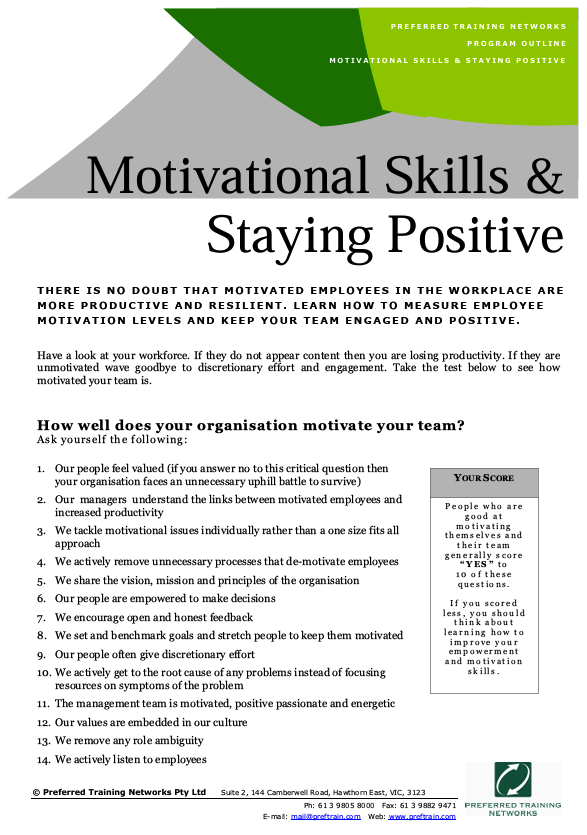
Have a look at your workforce. If they do not appear content, then you are losing productivity. If they are unmotivated, wave goodbye to discretionary effort and engagement. Take the test below to see how motivated your team is.
How well does your organisation motivate your team?
Ask yourself the following:
1. Our people feel valued (if you answer no to this critical question, then your organisation faces an unnecessary uphill battle to survive).
2. Our managers understand the links between motivated employees and increased productivity.
3. We tackle motivational issues individually rather than a one size fits all approach.
4. We actively remove unnecessary processes that demotivate employees.
5. We share the vision, mission and principles of the organisation.
6. Our people are empowered to make decisions.
7. We encourage open and honest feedback.
8. We set and benchmark goals and stretch people to keep them motivated.
9. Our people often give discretionary effort.
10. We actively get to the root cause of any problems instead of focusing resources on symptoms of the problem.
11. The management team is motivated, positive, passionate and energetic.
12. Our values are embedded in our culture.
13. We remove any role ambiguity.
14. We actively listen to employees.
For maximum effectiveness, this program is best conducted as an in-house program.
Ideal group size: 4–12 participants.
Venue: For your convenience, you can choose to conduct this program at your business premises. Alternatively, we can provide a training venue at a small additional cost.
Duration: This program can be adapted to meet your requirements.
Cost: Price on request.
Target Audience: Employees, Supervisors, Team Leaders, Senior Managers or CEOs.
If you would like more information on this training program, please contact: Deborah Dear on 1300 323 752 or email: [email protected] or contact us online today.
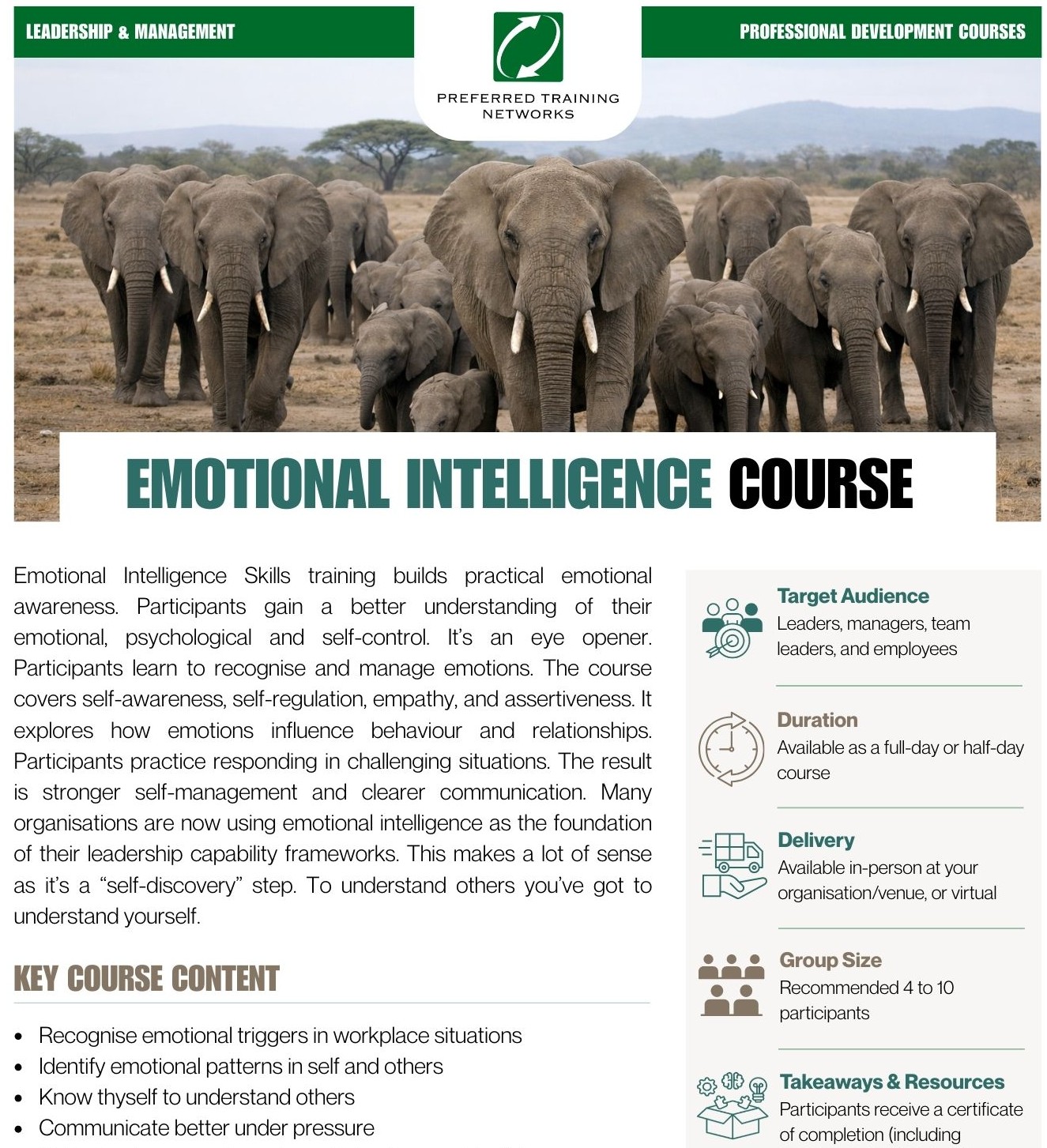
Can your EI really affect your relationship building skills? Research has shown that EI affects team building, leadership, and communication skills. Our Emotional Intelligence Training course helps individuals and teams improve self-awareness, communication, empathy and resilience in the workplace.
If you would like more information on this training program, please contact: Deborah Dear on 1300 323 752 or email: [email protected] or contact us online today.
| Module | Topics | Key Learning Outcomes |
|---|---|---|
| Module 1: Foundations of Emotional Intelligence | Emotional Intelligence (Goleman) |
|
| Key Emotional Intelligence Competencies |
|
|
| Using Emotional Intelligence in Work and Social Settings |
|
|
| Module 2: Building Self-Awareness and Emotional Management | Developing Self-Awareness |
|
| Evaluating Emotional Intelligence Skills |
|
|
| The Emotional Competency Framework |
|
|
| Module 3: Emotional Intelligence in Action | Emotions and Workplace Performance |
|
| Applying the SCARF Model |
|
|
| Module 4: Action Planning and Future Development | Developing a Personal Emotional Intelligence Growth Plan |
|
| Final Reflection and Next Steps |
|
Q: What exactly is emotional intelligence and why is it important at work?
A: Emotional intelligence (EQ) is your ability to recognise, understand and manage emotions in yourself and others. In a work setting, it helps with communication, conflict resolution, leadership, and maintaining psychological safety.
Q: Who should attend this emotional intelligence training course?
A: This course is ideal for team leaders, managers, HR professionals, project leads, and anyone who interacts regularly with others and wants to improve their influence, relationship skills, and self-management.
Q: Can emotional intelligence skills be developed or improved?
A: Yes. Emotional intelligence is not fixed — it can be developed over time using practices like self-awareness, emotional regulation, feedback, and guided training.
Q: How is this course delivered? Is there a virtual option?
A: We offer both in-house face-to-face delivery and virtual delivery. Our virtual sessions are interactive and use tools that simulate real conversations and emotional scenarios.
Q: What will I learn in this emotional intelligence training?
A: Participants will learn to:
Q: How long is the course and what group size works best?
A: The course can be run as a half-day or full-day workshop. We recommend group sizes between 6 to 12 participants to allow for interactive exercises and personalised feedback.
Q: Is emotional intelligence training beneficial for leaders specifically?
A: Absolutely. Leaders with high EQ are better at motivating teams, navigating change, handling conflict, and building trust and engagement within their teams.
Q: What makes this course different from other EQ or soft skills training?
A: Our program is highly tailored to workplace scenarios. We embed role-plays, real organisational challenges, and follow-up reinforcement tools so participants can apply EQ skills immediately on the job.
The influencing skills workshop content is engaging. The course focusses on both internal and external customers too. When you don’t have hierarchical or statutory power, then you really need influencing skills and persuasion techniques.
Questions you might be asking yourself:
How do I influence my manager? How can I persuade customers? How do I influence my peers in the workplace?
For maximum effectiveness, this program is best conducted as an in-house program.
If you would like more information on this training program, please contact: Deborah Dear on 1300 323 752 or email: [email protected] or contact us online today.