A Trusted Learning and Development Advisor
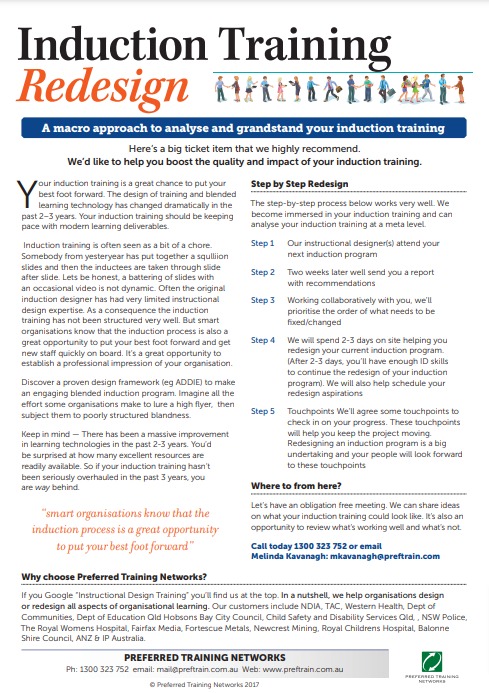
The step-by-step process below works very well. We become immersed in your induction training and can analyse your induction training at a meta level.
| Step 1 | Our instructional designer(s) attends your next induction program. |
|---|---|
| Step 2 | Two weeks later, we will send you a report with recommendations. |
| Step 3 | Working collaboratively with you, we’ll prioritise the order of what needs to be fixed/changed. |
| Step 4 | We will spend 2–3 days on site helping you redesign your current induction program. After 2–3 days, you’ll have enough ID skills to continue the redesign of your induction program. We will also help schedule your redesign aspirations. |
| Step 5 | Touchpoints: We’ll agree on some touchpoints to check in on your progress. These touchpoints will help you keep the project moving. Redesigning an induction program is a big undertaking, and your people will look forward to these touchpoints. |
Where to from here?
Let’s have an obligation free meeting. We can share ideas on what your induction training could look like. It‘s also an opportunity to review what’s working well and what’s not.
If you would like more information on this training program, please contact: Deborah Dear on 1300 323 752 or email: [email protected] or contact us online today.
Why choose Preferred Training Networks?
If you Google “Instructional Design Training” you’ll find us at the top. In a nutshell, we help organisations design or redesign all aspects of organisational learning. Our customers include NDIA, TAC, Western Health, Dept of Communities, Dept of Education QLD Hobson’s Bay City Council, Child Safety and Disability Services QLD, , NSW Police, The Royal Women’s Hospital, Fairfax Media, Fortescue Metals, Newcrest Mining, Royal Children’s Hospital, Balonne Shire Council, ANZ & IP Australia.
Here is your opportunity to learn the traits of great Australian and international leaders. You’ll learn the critical difference between leading a team rather than just managing a team. You’ll also learn about the leadership missteps that can unhinge the greatest of potential careers.
For maximum effectiveness, this course is best conducted as an in-house program.
Venue: For your convenience, you can choose to conduct this course at your workplace. Alternatively, we can provide a training venue at a small additional cost.
Duration: Each course can be tailored to suit your timeframes.
If you would like more information on this training program, please contact Deborah.
Email: [email protected]
Phone: 1300 323 752
Apart from our leadership training, take a look at our other highly recommended courses including instructional design, body language, workplace resilience, and stress management. If you have any queries, contact us today.
Whether you’re looking for help with time management, communication techniques, effective leadership skills, professional or interpersonal development or anything in between, we can help.
Overcoming Recurring Issues training is a course that punches above its weight. Instead of a problem-solving type course, this niche course only focusses on the recurring issues.
And here’s the kicker.
Q. What happens if you don’t fix a recurring problem?
A. It will recur.
Which recurring issues come across your desk time and time again?
Surely it makes sense to solve them once and for all.
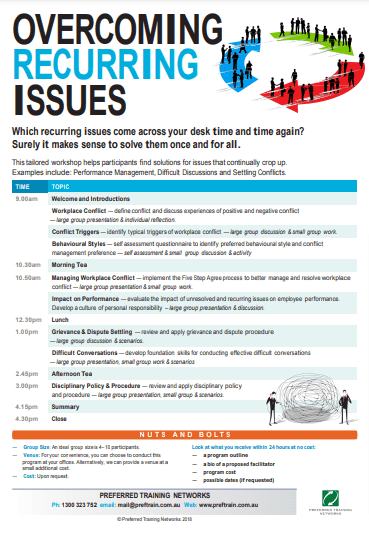
This tailored workshop helps participants find solutions for issues that continually crop up.
Examples include: Performance Management, Land Quarrels, Visitor Vex, Lack of Respect
| TIME | TOPIC |
|---|---|
| 9.00am | Welcome and Introductions Workplace Conflict – define conflict and discuss experiences of positive and negative conflict – large group presentation & individual reflection. Conflict Triggers – identify typical triggers of workplace conflict – large group discussion & small group work. Behavioural Styles – self assessment questionnaire to identify preferred behavioural style and conflict management preference – self assessment & small group discussion & activity |
| 10.30am | Morning Tea |
| 10.50am | Managing Workplace Conflict – implement the Five Step Agree process to better manage and resolve workplace conflict – large group presentation & small group work. Impact on Performance – evaluate the impact of unresolved and recurring issues on employee performance. Develop a culture of personal responsibility – large group presentation & discussion. |
| 12.30pm | Lunch |
| 1.00pm | Grievance & Dispute Settling – review and apply grievance and dispute procedure – large group discussion & scenarios. Difficult Conversations – develop foundation skills for conducting effective difficult conversations- large group presentation, small group work & scenarios |
| 2.45pm | Afternoon Tea |
| 3.00pm | Disciplinary Policy & Procedure– review and apply disciplinary policy and procedure – large group presentation, small group & scenarios. |
| 4.15pm | Summary |
| 4.30pm | Close |
Group Size: An ideal group size is 4–10 participants.
Venue: For your convenience, you can choose to conduct this program at your offices. Alternatively, we can provide a venue at a small additional cost.
Cost: Upon request.
This workplace bullying course is a good opportunity to quickly revisit your bullying policy and procedures. Imagine the difference if you removed all bullying allegations from your workplace. Our course enables participants to effectively deal with workplace bullying.
“Inwardly they are hoping the situation will sort itself out — it almost never does.”
Nuts and Bolts
Would you like to attend this program?
Wondering how to deal with a bully? Our course is ideal for you.
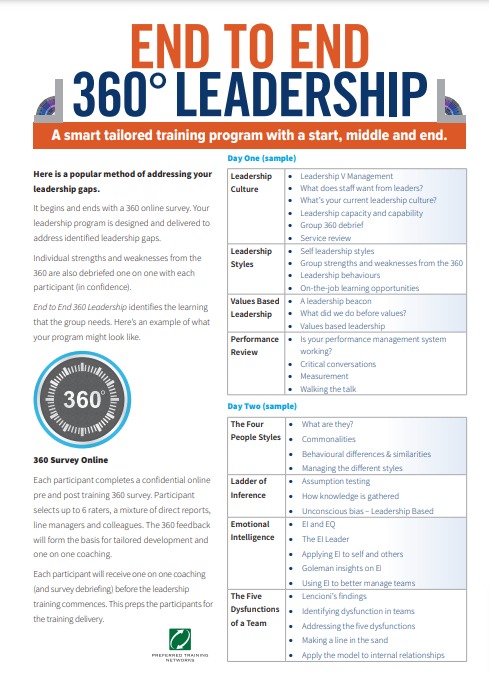
Each participant completes a confidential online pre and post training 360 survey. Participant selects up to 6 raters, a mixture of direct reports, line managers and colleagues. The 360 feedback will form the basis for tailored development and one on one coaching.
Each participant will receive one on one coaching (and survey debriefing) before the leadership training commences. This preps the participants for the training delivery.
Between the workshops, some project work keeps the participants engaged. For example in the above case, the participants were asked to complete a behavioral style survey between day one and two. Participants also had some change leadership reading before Day 3 and a group project to be completed for Day 4
Day One (sample)
| Leadership Culture |
|
|---|---|
| Leadership Styles |
|
| Values Based Leadership |
|
| Performance Review |
|
Day Two (sample)
| The Four People Styles |
|
|---|---|
| Ladder of Inference |
|
| Emotional Intelligence |
|
| The Five Dysfunctions of a Team |
|
Day 3 (sample)
| The Knowing Doing Gap |
|
|---|---|
| Building Innovation Teams |
|
| Leading Change |
|
Day Four (sample)
| Group Project Review |
|
|---|---|
| Project Analysis |
|
| Accountability |
|
| Action Planning |
|
NUTS AND BOLTS
Would you like to attend this program?
For maximum effectiveness, this leadership development program is best conducted as an on-site program.
Venue: For your convenience, you can choose to conduct this program at your workplace. Alternatively, we can provide a training venue at a small additional cost.
Duration: The course can be fitted within your timeframe.
Target Audience: High Potentials, Middle Managers, Supervisors, Leaders.
Cost: Price on request.
If you would like more information on this training program, please contact:
Preferred Training Networks on 1300 323 752
Email: Deborah at [email protected] or visit our website today: www.preftrain.com.au
Clients often get angry and difficult when they perceive a service failure. The unfortunate thing is that the service failure does not even need to be real. If your client thinks it’s real, then it’s real. Fortunately, there are plenty of opportunities with difficult clients if you manage them instead of reacting to them.
This ‘Dealing with Difficult Clients’ program can be conducted as an in-house training at your organisation or virtually.
Venue: For your convenience, you can choose to conduct this program at your offices. Alternatively, we can provide a training venue at a small additional cost.
Recent research carried out as part of the Department of Immigration and Multicultural Affairs’ Productive Diversity Partnerships program indicates that while there is growing awareness of an interest in diversity, there remains a low level of practical action to capitalise on the opportunities afforded by Australia’s new and emerging communities.
A common response to presentations on the benefits of diversity is, “Yes, I understand, but what do we actually do?” This program is designed to help bridge the gap between understanding and action, between rhetoric and reality.
There are four prerequisites to effectively working with diversity in new and emerging communities:
For maximum effectiveness, this program is best conducted as an in-house program.
Ideal group size: 4 – 12 participants.
Venue: For your convenience, you can choose to conduct this program at your business premises. Alternatively, we can provide a training venue at a small additional cost.
Duration: Your Working with New and Emerging Diverse Communities course can be modified to fit in with your timeframe.
Cost: Price on request.
Target Audience: Employees, Supervisors, Team Leaders and Managers.
If you would like more information on this training program, please contact: Deborah Dear on 1300 323 752 or email: [email protected] or contact us online today.
Suitable for anyone who has been asked to take up the role of a mentor, our mentoring training course equips people with outstanding skills. Learn how to establish a meaningful mentoring relationship with our mentor training course.
For maximum effectiveness, this program is best conducted as an in-house program.
Venue: For your convenience, you can choose to conduct this program at your workplace. Alternatively, we can provide a training venue at a small additional cost.
Target Audience: Mentors
Cost: Price on request.
If you would like more information on this training program, please contact:
Preferred Training Networks on 1300 323 752
Email: Deborah [email protected]
or visit our website today: www.preftrain.com
The Manager’s Guide to Reducing Workplace Sickies
Although sickies are often joked about as being an Australian institution, they cost Australia billions of dollars every year. Of course, sick days are inevitable but some sickies are signs of despair and some sickies are discretionary.
Every manager who attends this breakthrough program receives a “managing workplace sickies workbook” written by a psychologist to help reduce the amount of sickies in your organisation.
Signposts of Sickies:
Sick of self
From time to time, people feel low esteem. Self motivation ebbs and tasks become chores. When people are sick of themselves they often feel more isolated and find it difficult to get back on track.
Sick of colleagues and people
You might notice that some of your people are not themselves. They just don’t seem to care about their colleagues. They become indifferent and often focus more on the process than the person.
Sick of work
This is the number #1 cause of discretionary sick days in the workplace. The employee is sick of the workplace. When that alarm goes off in the morning, they groan and look for options to take a sickie. These employees often have a hostage mentality and they are disengaged from your organisation.
Sick of Pressure
Throughout our working lives, we face constant hurdles and struggle points. Occasionally, employees reach crisis points and either bottle up the pressure or explode. Learn proven methods to regulate and release the levels of stress and anxiety in the workplace.
Sick Sick
When you’re sick, you’re sick. That is why the sick days are there. Usually you don’t want sick people in the workplace, and you would much prefer them at home resting and recuperating. However, in this session participants learn ways to avoid and reduce the amount of bacterial based germs in the workplace. And you also learn some ideas on how to keep employees fit and healthy.
Maintaining a fit and healthy workforce – what can you do?
4 Benefits of running this course
THE NUTS AND BOLTS
This program can be conducted as in-house training on site anywhere in Australia.
GUIDELINES
Group Size: An ideal group size is 4?–12 participants.
Venue: For your convenience, you can choose to conduct this program at your offices. Alternatively, we can provide a training venue at a small additional cost
Duration: This program is conducted as a one day course.
Cost: Upon request.
Target Audience: Senior management, middle management, team leaders and supervisors.