A Trusted Learning and Development Advisor
Meetings are a good opportunity to generate creative ideas from a group of people who meet in order to achieve an outcome. Meetings can be extremely valuable and productive if run effectively.
What is the effectiveness level of meetings you attend?
Ask yourself the following:
For maximum effectiveness, this program is best conducted as an in-house program.
If you would like more information on this training program, please contact: Deborah Dear on 1300 323 752 or email: [email protected] or contact us online today.
At Preferred Training Networks, we have a wide range of comprehensive courses for you like: dealing with difficult people, dealing with conflict at work, and change management courses.
One major irk of senior managers is that they spend too much time proofreading reports and correspondence from their direct reports. For example, a critical report is due, and the senior manager is reliant on everyone to complete their individual sections. Alas, the compiled report then becomes disjointed. It’s a combination of different writing styles, different tenses and poor grammar. The senior manager is furious as it will be their signature on the report. It is panic stations and the senior manager (and their team) scrambles to fix the report.
Would you like to attend this program?
For maximum effectiveness, this course is best conducted as an in-house program.
Venue: For your convenience, you can choose to conduct this course at your workplace. Alternatively, we can provide a training venue at a small additional cost.
Duration: Each course can be tailored to suit your timeframes.
If you would like more information on this training program, please contact us at 1300 323 752 or Email: [email protected]
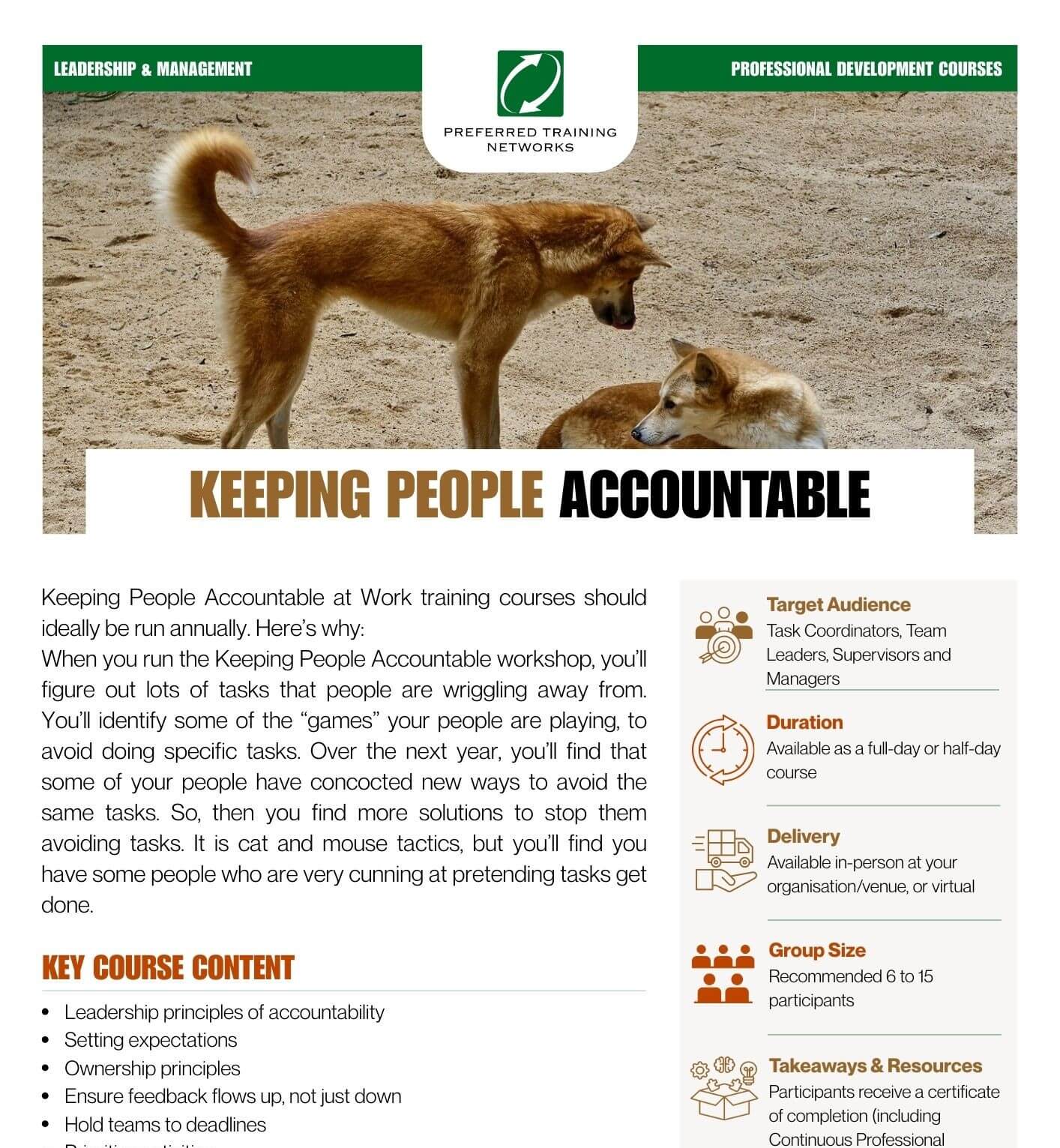
Do some of your people wriggle away from doing tasks? A chain is only as strong as the weakest link, and if the weakest link doesn’t want to pull their weight, it can seriously impact productivity. Workplace behavioural studies concur that some people deliberately misunderstand instructions to avoid completing tasks. You might know the occasional maestro that misunderstands any instruction. That’s where accountability training becomes essential—helping teams build a culture of ownership and ensuring every member contributes consistently.
Faced with this situation, it’s easy to take the path of least resistance. Don’t request from the maestro any tasks, and use the rest of the team to fill in. Or take away all excuses for not completing the tasks. Keep everyone accountable and eliminate the wriggle room. Of course, some reports and peers will still not do what’s instructed. But that will now become a performance management issue rather than an “Oh is that what you meant?” misinterpretation.
It’s also important to explore if your instructions are really clear. Your instructions may be as clear as crystal in your mind and clear as mud at the other end. In this breakthrough course, you’ll learn to give instruction and deadlines that cannot be wriggled out of.
Answer Yes or No to the following questions:
If you’ve answered “Yes” to 2 or more of these questions, this course is ideal for you.
This program can be conducted as in house training at your offices.
Group Size: An ideal group size is 6–10 participants.
Venue: For your convenience, you can choose to conduct this program at your offices. Alternatively, we can provide a training venue at a small additional cost.
Duration: Each course can be tailored to fit your timelines.
Cost: Upon request.
Target Audience: Ideal for Leaders and Managers
If you would like more information on this training program, please contact us at 1300 323 752 or email: [email protected]
Q. Who should attend the Accountability Training course?
A. This course is ideal for team leaders, managers, and professionals looking to build a culture of ownership and follow-through in the workplace.
Q. What outcomes can I expect from this training?
A. You’ll learn strategies to promote responsibility, encourage proactive behaviour, and establish clear expectations and consequences.
Q. Is this course available across Australia?
A. Yes, we offer this training across Australia, including Melbourne, Sydney, Brisbane, Perth, Adelaide, and via virtual delivery.
Q. How long is the course?
A. The course is flexible and can be delivered as a half-day or full-day session, tailored to your organisation’s needs.
The key to “burying the hatchet” is being able to understand difficult issues and have a toolbox of conflict resolution techniques. Employees and management often find themselves in situations where they are forced to work and communicate with people but are unable to make a connection with them. Occasionally negative reactions to others can be a result of value systems, projection, transference, personality types, societal differences, cultural norms and even dysfunctional behaviour.
“Holding on to resentment and engaging in petty conflicts inhibits the machinery of local government.” — J. Richards
Managing conflict in the workplace and positively resolving issues helps to create a productive and harmonious work environment. Many managers and employees have simply not had the training to “bury the hatchet”. And sometimes that is all it takes! Learn some new strategies and you will notice an immediate and positive difference. Our conflict resolution strategies enable you to deal effectively with difficult situations and people. Imagine the difference if all your people were functioning at a level of emotional intelligence that transcends differences of opinion. If you have conflict, why don’t you try this unique approach? As Woody Allen remarked, “80% of success is showing up”.
Conflicts are often inevitable and hard to deal with. However, with the right approach, it is possible to resolve a conflict in the workplace. Our course for conflict resolution in the workplace equips participants with the tips and techniques to calmly deal with problems.
Through an experiential learning process participants will be guided through a journey of understanding as well as specific skill development in the areas of reflective listening, rapport building, developing self-awareness, assertiveness and delighting in diversity.
1.2 KEY HATCHET TRAINING AREAS
| Hatchet Identification |
A puzzle exercise will be used to create an experiential learning environment. Participants will observe behaviours and this will be followed by discussion. |
|---|---|
| Emotional Intelligence |
Interactive presentation and discussion |
| Types of Conflict and how to Overcome Them |
Practical group exercises and discussion. |
| Listening Without Generating Solutions |
Practical group exercises and discussion. |
| Setting Boundaries and Creating Psychological Safety |
A practical exercise with explanation and discussion. |
| Diversity of Values |
Practical group exercise followed by discussion. |
| Delighting in Differences and Action Planning |
Group exercise with observation and discussion. |
Our Local Government customers include: Bass Coast, Boroondara, Brimbank, Casey, Fairfield, Frankston, Gladstone, Glen Innes, Hobsons Bay, Manningham, Maroondah, Nillumbik, Port Phillip, Rockhampton, Somerset Regional Sydney, Towoomba, Whitehorse, Whittlesea, Wyndham, Wodonga, Yarra Ranges.
THE NUTS AND BOLTS
GUIDELINES
Group Size: An ideal group size is 4–12 participants.
Venue: For your convenience, you can choose to conduct this program at your offices. Alternatively, we can provide a training venue at a small additional cost.
Cost: Upon request.
This unique course covers the critical skills that contract managers need including consultation advocacy, influence, negotiation and conflict resolution which are critical to the role. The course does not cover sourcing, tendering or writing contracts as it is assumed that the participants already have these skills.
This course was designed as a reflection and action workshop for the contract management team. What’s working well? What could be improved?…
Would you like to attend this program?
For maximum effectiveness, this program is best conducted as an in-house program.
Venue: For your convenience, you can choose to conduct this program at your workplace. Alternatively, we can provide a training venue at a small additional cost.
Duration: Each course can be tailored to your timeframes.
Target Audience: LG Contract Management teams
Email: Deborah | [email protected] or phone 1300 323 752
This truly unique course was designed by an organisational psychologist to help your people feel more comfortable saying “No”. “No” can be omnipotent and is often under-used for a variety of reasons including cultural, personality and cognitive differences.
The course can be very valuable at home too. Do you ever say “yes” to something you don’t want to do? Small children are the world’s best negotiators, and what about family and friends who expect you to follow their every whim.
What happens when people can’t say “no”
This program can be conducted as in house training at your offices.
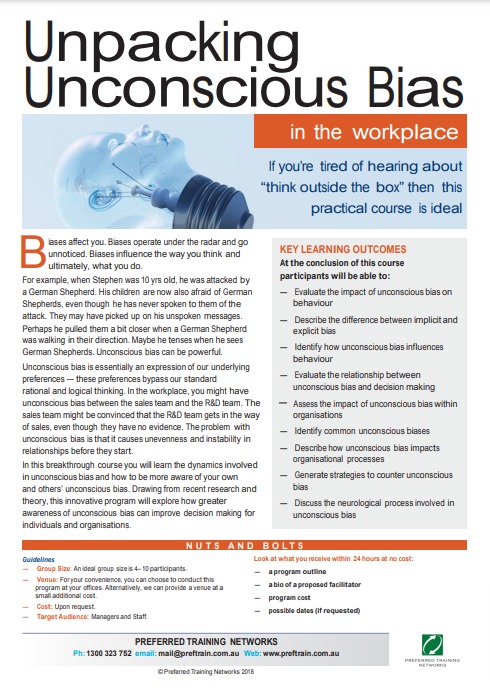
Here’s an example; when Stephen was 10 yrs old, he was attacked by a German Shepherd. His children are now also afraid of German Shepherds, even though he has never spoken to them of the attack. They may have picked up on his unspoken messages. Perhaps he pulled them a bit closer when a German Shepherd was walking in their direction. Maybe he tenses when he sees German Shepherds. Unconscious bias can be powerful.
For maximum effectiveness, it is recommended that this course be conducted as an in-house program.
Venue: For your convenience, you can choose to conduct this program at your offices. Alternatively, we can provide a venue at a small additional cost.
Check out some of our other popular training programs: workplace resilience training, strategic thinking and conflict in the workplace.
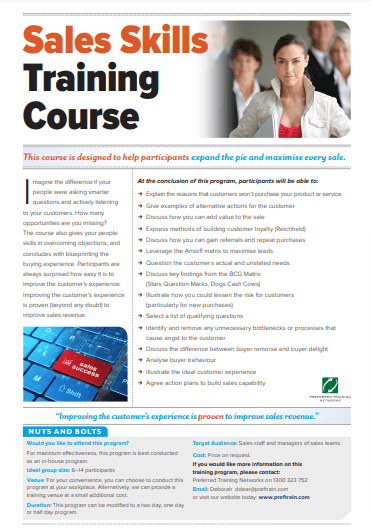
If you are eager to maximise your sales performance, this course is ideal for you. This course is designed to help participants expand the pie and maximise every sale.
Imagine the difference if your sales people were asking smarter questions and actively listening to your customers. How many opportunities are you missing? This bespoke sales training course also gives your people skills in overcoming objections and concludes with blueprinting the buying experience. Participants are always surprised how easy it is to improve the customer’s experience. Improving the customer’s experience is proven (beyond any doubt) to improve sales revenue.
At the conclusion of this program, participants will be able to:
1. Explain the reasons that customers won‘t/can’t purchase your product or service
2. Give examples of alternative actions for the customer
3. Discuss how you can add value to the sale
4. Express methods of building customer loyalty (Reichheld)
5. Discuss how you can gain referrals and repeat purchases
6. Leverage the Ansoff matrix to maximise leads
7. Question the customer’s actual and unstated needs
8. Discuss key findings from the BCG Matrix (Stars Question Marks, Dogs Cash Cows)
9. Illustrate how you could lessen the risk for customers (particularly for new purchases)
10. Select a list of qualifying questions
11. Identify and remove any unnecessary bottlenecks or processes that cause angst to the customer
12. Discuss the difference between buyer remorse and buyer delight
13. Analyse buyer behaviour
14. Illustrate the ideal customer experience
15. Agree on action plans to build sales capability
“Improving the customer’s experience is proven to improve sales revenue.”
Would you like to attend this program?
For maximum effectiveness, this program is best conducted as an in-house program.
Ideal group size: 6–14 participants
Venue: For your convenience, you can choose to conduct this program at your workplace. Alternatively, we can provide a training venue at a small additional cost.
Duration: This program can be modified to a two day, one day or half day program.
Target Audience: Sales staff and managers of sales teams.
Cost: Price on request.
If you would like more information on this training program, please contact:
Preferred Training Networks on 1300 323 752
Email: Deborah? [email protected]
or visit our website today: www.preftrain.com.au
Q. Who is this sales skills training course designed for?
A. This course is ideal for new and experienced sales professionals, account managers, customer-facing staff, and anyone looking to sharpen their selling techniques. It’s also well-suited for those in non-sales roles who want to improve persuasion and communication skills in business settings.
Q. What sales techniques will participants learn?
A. Participants will explore a range of modern sales techniques including consultative selling, objection handling, solution-based selling, and closing strategies. The course also highlights the psychology of decision-making to help build stronger customer connections.
Q. Is the training customised to suit our industry?
A. Absolutely. Like all our in-house training workshops, this course is tailored to reflect your industry, product types, sales cycle, and team experience. We work with you to create a practical, relevant learning experience.
Q. Does this course include roleplays or real-life scenarios?
A. Yes. Our facilitators use interactive roleplays, real-world examples, and feedback loops to simulate live sales conversations. This helps participants practise new techniques in a safe environment before applying them in the field.
Q. Can this course help with upselling and cross-selling skills?
A. Definitely. We cover strategies that teach participants how to spot upselling and cross-selling opportunities without sounding pushy — essential for increasing customer value and satisfaction.
Q. How long is the training session?
A. Most of our sales skills training programs run as a one-day workshop, but we can deliver half-day or multi-session formats depending on your team’s needs and availability.
Q. Will the course improve communication and confidence?
A. Yes. Many participants also take part in our business communication course to further enhance their ability to influence and build rapport.
Q. Can we combine this training with other leadership or soft skills programs?
A. Certainly. You may wish to pair this course with related programs like emotional intelligence or presentation skills training to create a well-rounded development path.
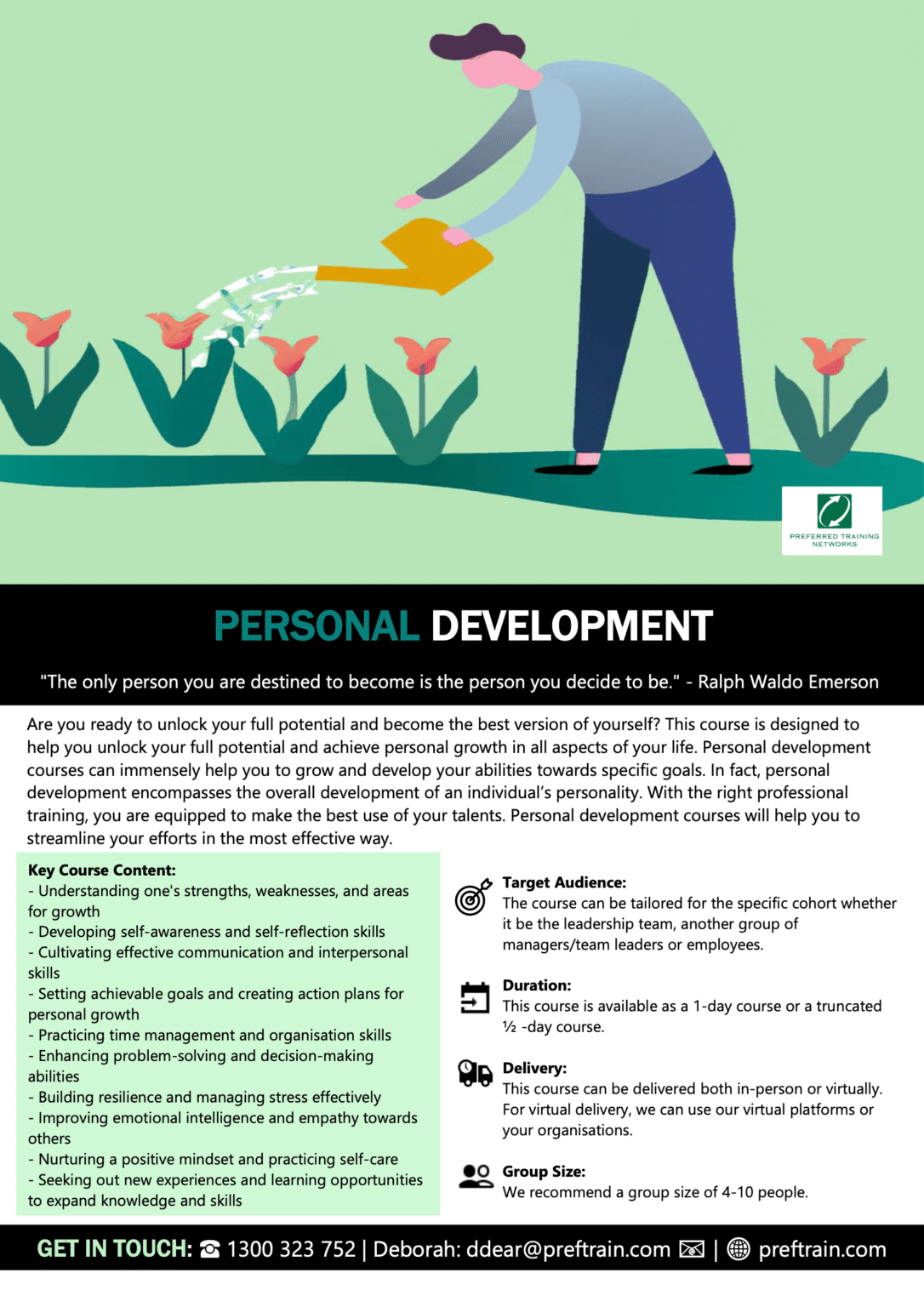
Personal development courses can immensely help you to grow and develop your abilities towards specific goals. In fact, personal development encompasses the overall development of an individual’s personality. With the right professional training, you are equipped to make the best use of your talents.