A Trusted Learning and Development Advisor
An opportunity to boost the cultural intelligence of your team.
This cultural intelligenec tailored workshop also explores how our negative reactions to others can be as a result of value systems, projection, transference, personality types, societal differences in behaviour, cultural norms and conditioning. So, here’s an opportunity to boost the cultural intelligence of your team.
NUTS AND BOLTS
Would you like to attend this program? For maximum effectiveness, this program is best conducted as an in-house program.
Venue: For your convenience, you can choose to conduct this program at your workplace. Alternatively, we can provide a training venue at a small additional cost
Duration: This bespoke cultural intelligence program can be modified to suit your timeframe.
Cost: Price on request.
If you would like more information on this cultural intelligence training program, please contact:
Preferred Training Networks on 1300 323 752
Email: Deborah : [email protected]
or visit our website today: www.preftrain.com.au
Communicating with people from different cultures is very common in today’s workplace. This can involve dealing with a culturally diverse population of stakeholders. With cultural diversity cultural diversity skills training, you will be equipped with strategies and techniques to deal with and understand people who are different.
How good are you at dealing with different cultures in the workplace?
Ask yourself the following:
Your Cultural Diversity Skills program focuses upon the cultural nuances, which occur when dealing with individuals from different cultures and countries. Our cultural diversity training program will enable participants to learn the skills and knowledge to build successful cross-cultural business interactions.
Would you like to attend this program?
If you would like more information on this training program, please contact:
Deborah Dear – Marketing Manager
PH: 1300 323 752
Email: [email protected] or visit our website today.
Achieving a cultural change is not a “click of the fingers” exercise. It needs a well thought out, communicated and executed plan. The challenge is that organisations can skip the planning stage, as cross-cultural activities are often intangible and subjective. You might have the best plan and intentions, but your people will perceive the information differently. Clarity of purpose is essential. In this course, participants will learn how to be change agents. Participants will discover how to leverage emotional intelligence to influence and champion change. “Nearly there” isn’t good enough, as any advances can unwind quickly unless they are embedded and fully understood. This course will also help participants stay focused and motivated to achieve their objectives.
Would you like to attend this program?
For maximum effectiveness, this program is best conducted as an on-site program.
Venue: For your convenience, you can choose to conduct this program at your workplace. Alternatively, we can provide a training venue at a small additional cost.
Target Audience: Managers and Staff
Cost: Price on request.
If you would like more information on this training program, please contact:
Preferred Training Networks on 1300 323 752
Email: Deborah at [email protected]
or visit our website today: www.preftrain.com.au
At some stage we all have to engage in a conversation that can be both difficult and controversial. ‘How to have critical conversations’ is a program designed to equip you to resolve critical issues and accelerate performance
What are Critical Conversations? A discussion between people when:
Learn the tools to build your confidence & capability to hold these conversations and how to increase performance by 30%.
How comfortable am I to have the conversations I know I have to have? Ask yourself the following:
If you would like answers to these questions, attend this interactive and practical workshop.
“Half the world is composed of people who have something to say and can’t and the other half who have nothing to say and keep on saying it.” – Robert Frost
Would you like to attend this program?
For maximum effectiveness, this program is best conducted as an in-house program.
Ideal group size: 4 – 12 participants.
Venue: For your convenience, you can choose to conduct this program at your business premises. Alternatively, we can provide a training venue at a small additional cost.
Duration: This program can be adapted to meet your requirements.
Cost: Price on request.
Target Audience: Supervisors, Team Leaders, Middle, Senior Management & CEO’s.
If you would like more information on this training program, please contact: Deborah Dear on 1300 323 752 or email: [email protected] or contact us online today.
Q. Who should attend the Critical Conversations Training?
A. This course is ideal for managers, team leaders, HR professionals, and anyone looking to enhance their communication skills in challenging workplace situations.
Q. What topics are covered in the training?
A. The training covers techniques for handling difficult conversations, active listening, emotional intelligence, and strategies to foster open and effective communication.
Q. Is the course available across Australia?
A. Yes, we offer the Critical Conversations Training in major cities including Sydney, Melbourne, Brisbane, Perth, and Adelaide, as well as virtual sessions.
Q. How long is the course?
A. The course can be delivered as a half-day or full-day workshop, tailored to your organization’s needs.
Our conditioning and cultural backgrounds influence our thoughts, beliefs, attitudes and behaviours. We tend to see the world through our own limited cultural experiences. This perspective is short-sighted as we now operate in a more culturally diverse society. This makes cultural awareness in the workplace essential to improve work relationships and prevent cultural conflicts. By being culturally aware, employees will be able to engage better with colleagues and treat differences with respect.
In fact, culture is often misunderstood. It is not merely different ethnicities, but in fact is much wider. Consider different age groups, different religious beliefs, sexual preferences, indigenous cultures and more. The LGBTQI movement is helping shed light on the impact of culture
Designed by a team of organisational psychologists, change managers and cross-cultural experts this course will help springboard your cultural ambitions. The course is a wakeup call to participants that culturally diversity is everywhere.
The tide of cultural change has never been bigger and it will continue to grow. By understanding what is cultural awareness in the workplace, it will be possible for businesses to increase the productivity, communication and unity in the workplace.
“The single greatest barrier to business success is the one erected by culture.”
— Edward T. Hall and Mildred Reed Hall
NUTS AND BOLTS
This program can be facilitated at your office.
Guidelines
The program works best if it is split over 2 sessions.
1st session
The first session is an experiential learning session taking participants through world’s best performance management practices. This includes managing reactions, preparing a plan, being assertive and being impartial.
2nd Session
This session has a practical ‘hands on’ approach. Participants are taken out of their comfort zones and conduct demo courageous conversations. The conversations are critiqued and the feedback helps participants continuously improve and simultaneously gain confidence in their abilities to have tough conversations.
Would you like to attend this program?
If you would like more information on this training program, Please contact:
Deborah Dear – Marketing Manager
PH: 1300 323 752
Email: [email protected]
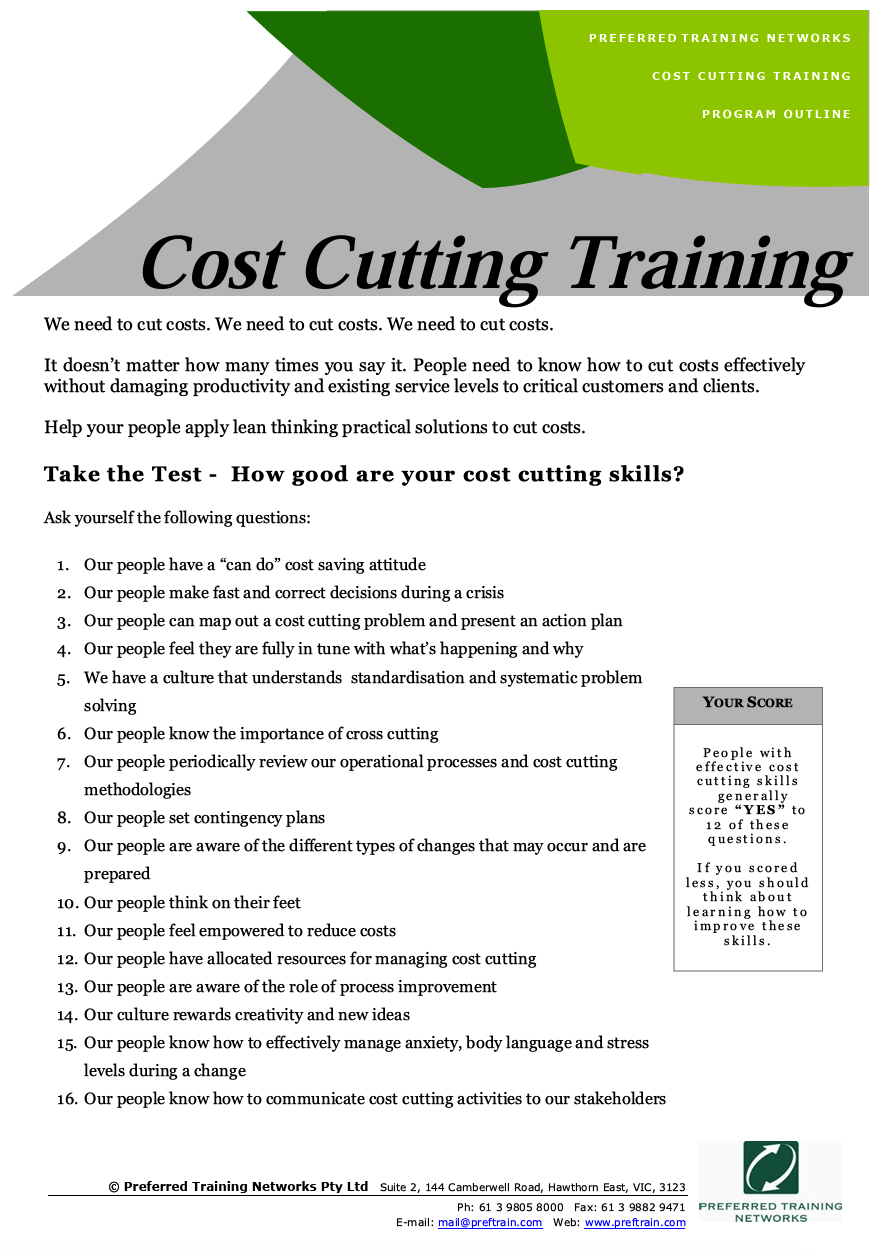
We need to cut costs. We need to cut costs. We need to cut costs.
It doesn’t matter how many times you say it. People and organisations need to know how to cut costs effectively without damaging productivity and existing service levels to critical customers and clients.
Help your people apply lean thinking practical solutions to cut costs.
Take the Test – How good are your cost cutting skills?
Ask yourself the following questions:
Would you like to attend this program?
If you would like more information on this training program, please contact:
Deborah Dear – Marketing Manager
PH: 1300 323 752
Email: [email protected] or visit our website today.
There are times when unexpected situations disrupt organisational functionality. This program is designed to give you and your people the skills to deal with a crisis that may occur at any time. Some organisations excel in periods of crisis because their people know what to do. Other organisations implode every time a crisis occurs. Our expert crisis management course will help you and your team prepare for and manage the unexpected.
Ask yourself the following questions:
For maximum effectiveness, this program is best conducted as an in-house program.
Ideal group size: 4-12 participants.
Venue: For your convenience, you can choose to conduct this program at your organisation premises. Alternatively, we can provide a training venue at a small additional cost.
Duration: This program can be adapted to meet your requirements.
Cost: Price on request.
Target Audience: Employees, supervisors, team leaders, senior managers or CEOs.
If you would like more information on this training program, please contact:
Deborah Dear – Marketing Manager
PH: 1300 323 752
Email: [email protected]
Whether you’re looking for help with time management, communication techniques, effective leadership skills, conflict resolution skills training, interpersonal or professional development courses or anything in between, we can help.
| Module | Topics | Key Learning Outcomes |
|---|---|---|
| Module 1: Fundamentals of Crisis Management | Understanding Crisis Management |
|
| Developing a Crisis Response Team |
|
|
| Risk Management and Crisis Identification |
|
|
| Module 2: Effective Crisis Response Strategies | Executing Crisis Response Steps |
|
| Maintaining Flexibility in Crisis Situations |
|
|
| Incident Management and Control |
|
|
| Module 3: Decision Making Under Pressure | Psychological and Cognitive Factors in Crisis Situations |
|
| Cognitive Behavioural Loop and Decision-Making Models |
|
|
| Module 4: Communication and Interactive Crisis Skills | Responding to Conflict and Disagreement |
|
| Effective Questioning and Communication Strategies |
|
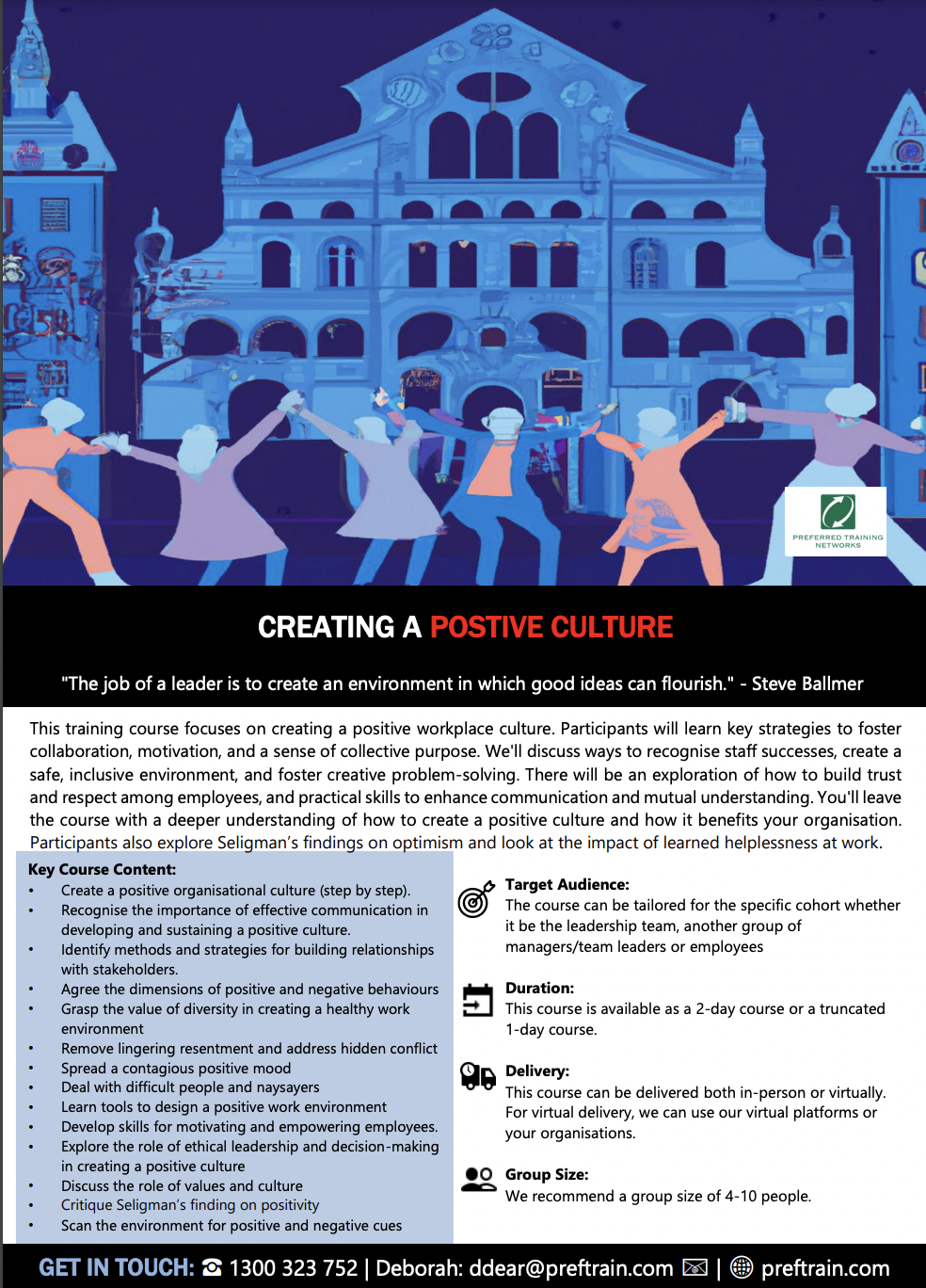
The creating a positive culture training course focuses on lifting the vibe of the organisation. Participants will learn key strategies to foster collaboration, motivation, and a sense of collective purpose. We’ll discuss ways to recognise staff successes, create a safe, inclusive environment, and foster creative problem-solving. There will be an exploration of how to build trust and respect among employees, and practical skills to enhance communication and mutual understanding. You’ll leave the course with a deeper understanding of how to create a positive culture and how it benefits your organisation. Participants also explore Seligman’s findings on optimism and look at the impact of learned helplessness at work.
| Module | Topics | Key Learning Outcomes |
|---|---|---|
| Module 1: Understanding Workplace Culture | Creating a Positive Workplace Culture |
|
| Cultural Fit |
|
|
| Applying Deal and Kennedy’s Cultural Model |
|
|
| Module 2: Developing Positive Strategies for Success | Shaping a Contagious Positive Mood |
|
| Life Conditioning and Balance |
|
|
| Goal Setting for a Fulfilling Workplace |
|
|
| Module 3: Interpersonal Skills and Emotional Intelligence | Enhancing Interpersonal Skills |
|
| Components of Emotional Intelligence |
|
|
| Module 4: Creating and Maintaining Positivity in the Workplace | Reducing and Removing Negative Workplace Behaviours |
|
| Cognitive Restructuring for Workplace Positivity |
|
The Consultative Selling Skills workshop helps participants to focus upon the client or customer rather than your product or service. It is a process which creates rapport, builds trust and focuses on creating sustainable relationships. Being a consultant you’re going to truly find the client’s stated and unstated needs. This creates more and more tailored sales opportunities.
How would you rate your Consultative Selling skills?
Ask yourself the following:
Your Consultative Selling Skills program is custom designed to teach participants how to position themselves as a valuable resource to their clients. The program will illustrate the importance of clearly defining a client’s needs and objectives and developing sustainable relationships. The program will provide practical techniques to improve the selling skills of your people. Participants will learn that Consultative Selling can assist them to deliver value to their clients through effective questioning techniques. This in turn sets the scene for mutually beneficial relationships and allows clients to communicate their needs.
Would you like to attend this program?
If you would like more information on this training program, please contact:
Deborah Dear
Ph: 1300 323 752
Email: [email protected] or visit our website today.