A Trusted Learning and Development Advisor
If you would like more information on this training program, please contact: Preferred Training Networks on 1300 323 752 Email: [email protected]
The key to dealing with difficult patients and carers is to focus on the immediate behaviour. Then defuse the situation as quickly as possible and remain safe.
For maximum effectiveness, this course is best conducted as an in-house program.
For your convenience, you can choose to conduct this course at your workplace. Alternatively, we can provide a training venue at a small additional cost.
Each course can be tailored to suit your timeframes.
If you would like more information on this training program, please contact: Preferred Training Networks on 1300 323 752 Email: [email protected]
Dealing with Difficult Patients & Carers 4.5 out of 5 based on 56 user ratings.
Of course, parents have a right to air their views. But they don’t have a right to menace and cause unpleasantness to staff. Participants will also discover techniques to diffuse a situation quickly before it escalates. Make sure you prevent parents from phoning teachers as it’s a growing school harassment workplace hazard too.
Because of their size, parents may be difficult to discipline properly. — P. J. O’Rourke
When you become a parent, or a teacher, you turn into a manager of this whole system. You become the person controlling the bubble of innocence around a child, regulating it. — Kazuo Ishiguro
Working here at Preferred Training Networks means we’re always chatting to psychologists who help us with unusual training requests. Anyway, I was having a coffee the other day and I asked the psychologist who was currently sitting in the chair. And he replied it was “teachers”. And I asked who else is sitting in the chair. And he replied, “It’s just a conveyor belt of teachers,” so I’ll give you the conversation from there; Me – What’s the main concern with teachers Psych – Parents. Me – What else? Psych – It’s 90% struggling to cope with parents. Me – Who is paying? Psych – They pay themselves as they don’t want to admit to the school that they are struggling, particularly in the high-end schools as they feel they won’t ever get promoted if the school knows they are struggling. Me – That’s pretty sad. Psych – Yep. But what do teachers do if they find themselves in this situation. More broadly, what does anyone do? From our business perspective, we’ve noticed similar issues with engineers and financial/professional services employees. They just don’t want to admit that they are struggling to their employer. Unfortunately, the queue to see a psychologist is long in Australia. But if you’re struggling, we can always deliver one-on-one psych coaching or deliver a tailored course for the group. Anyway, if you’re in that position, give us a call, and we’ll try and give you some ideas that you may not have considered. Or if you’d like a quote for a group for dealing with difficult people or parents, please get in touch.
Q. Who should attend the Dealing with Difficult Parents training?
A. This course is ideal for principals, teachers, administrative staff, and school leaders who regularly interact with challenging or confrontational parents. It focuses on building effective communication strategies to manage difficult interactions and foster positive relationships.
Q. What are the key learning outcomes of this course?
A. Participants will learn strategies to manage difficult parent behaviours, resolve conflicts, build rapport, set boundaries, and effectively communicate to achieve positive outcomes for students and staff.
Q. Is this training available across Australia?
A: Yes, we offer this training in all major cities and regional areas across Australia, with options for in-person or virtual delivery.
Q. How long is the course?
A. The course can be tailored to your needs, with options ranging from 60-minute microlearning sessions to full-day workshops.
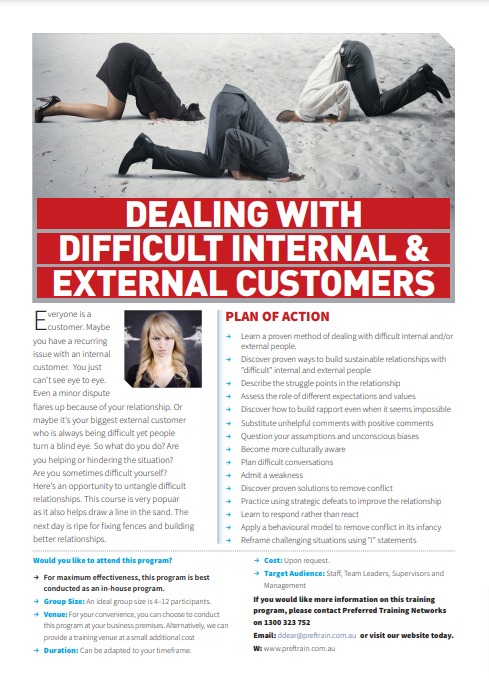
Everyone is a customer. Maybe you have a recurring issue with an internal customer. You just can’t see eye to eye. Even a minor dispute flares up because of your relationship. Or maybe it’s your biggest external customer who is always being difficult, yet people turn a blind eye. So, what do you do? Are you helping or hindering the situation? Are you sometimes difficult yourself? Here’s an opportunity to untangle difficult relationships. This tailored ‘Dealing with Difficult Internal and External Customers’ course is very popular as it also helps draw a line in the sand. The next day is ripe for fixing fences and building better relationships.
Here are some questions you might be asking yourself?
How do I manage difficult customers? Why are some customers more difficult than others? What should I do when dealing with a difficult customer?
For maximum effectiveness, this program is best conducted as an in-house program.
Group Size: An ideal group size is 4–12 participants.
Venue: For your convenience, you can choose to conduct this program at your business premises. Alternatively, we can provide a training venue at a small additional cost.
Duration: Can be adapted to your timeframe.
Cost: Upon request.
Target Audience: Staff, Team Leaders, Supervisors and Management
If you would like more information on this training program, please contact Preferred Training Networks on 1300 323 752.
We have more amazing trainings lined up for you like: customer service management training, negotiation skills training, and performance management training. You can get in touch with us if you have any queries. We will be delighted to hear from you.
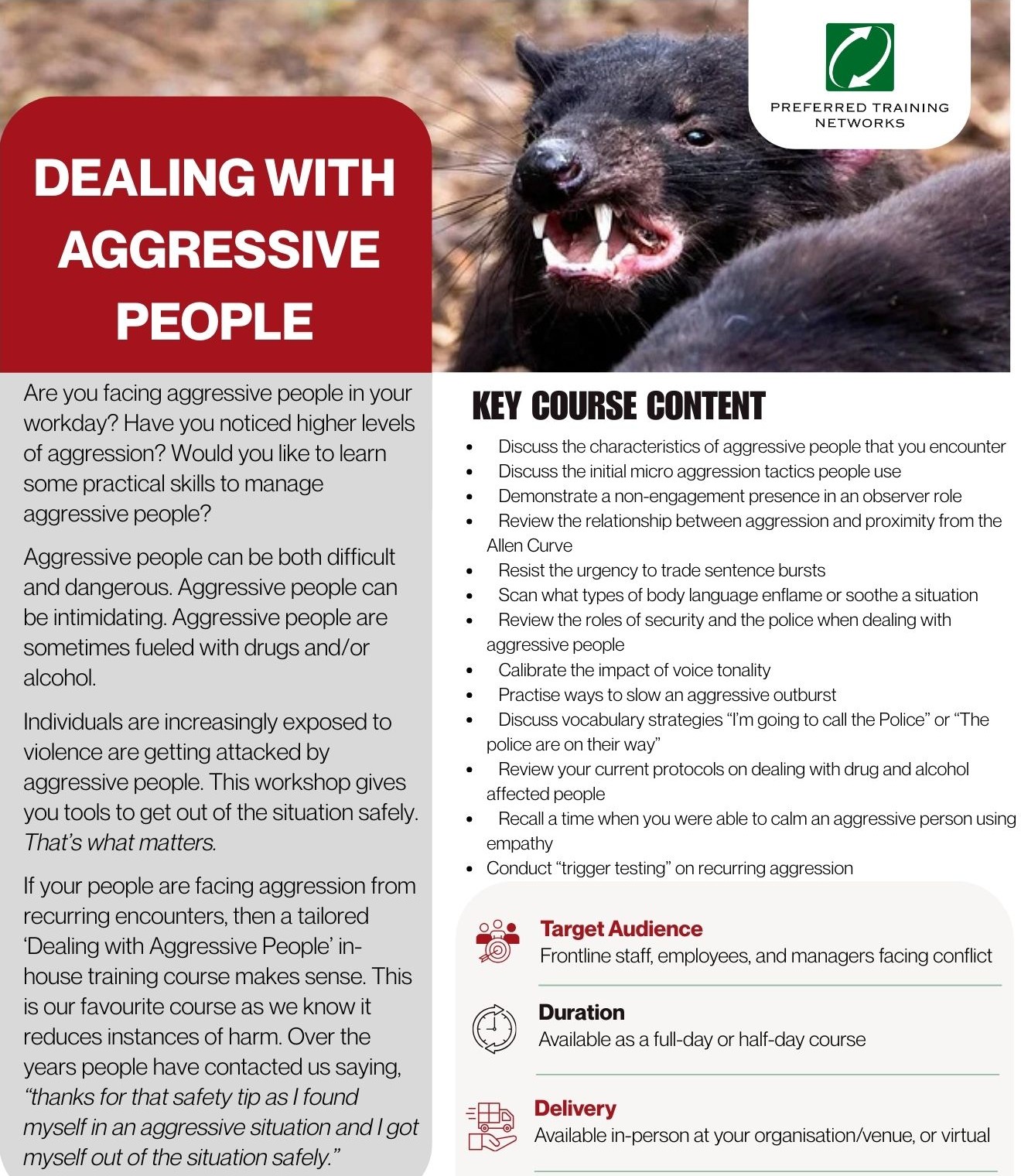
Our skilled experts discuss the characteristics of aggressive people and the initial micro-aggression tactics these people tend to use. Maybe they are badgering you? They want “aggro” and if that happens, you’re likely to lose. You don’t want aggression.
Aggressive people don’t have a pattern of aggression. Sometimes they are opportunistic and will wait till they have worn you down. You’re being badgered and baited. It’s not easy knowing what to do.
| Module | Topics | Key Learning Outcomes |
|---|---|---|
| Module 1: Personal Safety and Risk Awareness | Safety Risk Assessment |
|
| Fundamentals of Staying Safe |
|
|
| Recognising Danger Signs and Behavioural Triggers |
|
|
| Module 2: Understanding Aggressive Behaviours | Body Language and Non-Verbal Cues |
|
| Behavioural Triggers and Aggression in Different Settings |
|
|
| Profiling and Understanding Challenging Behaviours |
|
|
| Module 3: Communication and De-escalation Techniques | Managing Anger and Deflecting Aggression |
|
| De-escalation Strategies for Aggressive Situations |
|
|
| Module 4: Assertive Communication and Resolving Conflict | Communicating with Clarity and Confidence |
|
| Handling Aggressive Interactions Over the Phone |
|
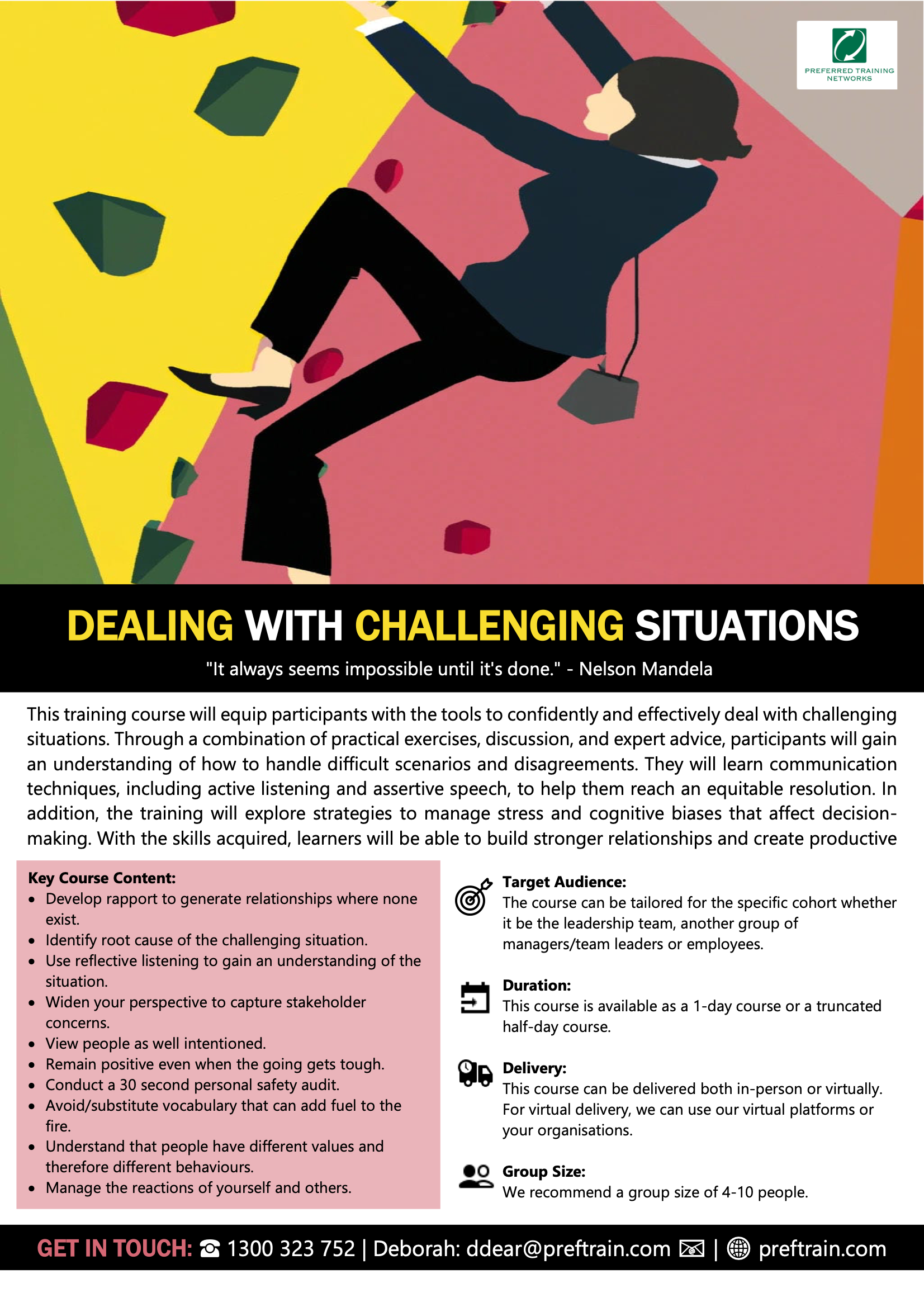
This program is designed to assist participants to cope effectively with situations which could be classified as ‘challenging’. Through an experiential learning process, participants will be guided through a journey of understanding as well as specific skill development in the areas of reflective listening, rapport building, developing self-awareness, assertiveness and delighting in diversity.
For maximum effectiveness, this program is best conducted as an in-house program.
Ideal group size: 4–12 participants.
Venue: For your convenience, you can choose to conduct this program at your business premises. Alternatively, we can provide a training venue at a small additional cost.
Duration: This program can be adapted to meet your requirements.
Cost: Price on request.
Target Audience: Employees, Supervisors, Team Leaders, Senior Managers or CEOs.
For more information about this training program, please contact Deborah Dear, Marketing Manager, on 1300 323 752 or email us at [email protected]
Plan of action
Participants will learn proven skills to build relationships with internal and external customers. Participants are often surprised how moments of truth impact both transactional and relationship based interactions. This course helps blueprint the customers experience and highlight opportunities to improve your level of service and customer relations.
This course captures the behaviours that build relationships with customers. By developing some key mentoring skills, your workplace champions will be able to embed these behaviours to your newer recruits or inexperienced representatives.
Would you like to attend this program?
If you would like more information on our customer relations training program, please contact: Preferred Training Networks on 1300 323 752 Email: [email protected]
MANAGING THE PLASTICITY OF YOUR SERVICE DELIVERY
Your customers continually form perceptions of your services. The key is to make as many positive perceptions as possible through positive customer experiences. Often you can’t control the outcome for the customer but you can control the experience the customer receives.
For maximum effectiveness, this program is best conducted as an in-house program.
Target Audience: Public Sector Staff and Management
Cost: Price on request.
Timeframe: This course can be modified to fit with your timeframe.
Venue: For your convenience, you can choose to conduct this program at your workplace. Alternatively, we can provide a training venue at a small additional cost.
If you would like an obligation free quote, Please contact:
Preferred Training Networks on 1300 323 752
Email: Deborah at [email protected]
or visit our website today: www.preftrain.com
It is critically important to deliver exceptional customer service consistently. Even when a customer’s needs cannot be met, it is crucial that their expectations be managed. Participants will also learn how to set positive experiences for customers which are proven to increase customer retention and boost loyalty levels
Common queries we hear:
How do I improve customer service? How can I make our customers more loyal? How do I deliver exceptional service to the customer? How do I stop customers from being so price sensitive?
| Module | Topics | Key Learning Outcomes |
|---|---|---|
| Module 1: Learning Outcomes | Introduction to Customer Service |
|
| “Moments of Truth” |
|
|
| Improve Current Levels of Customer Service |
|
|
| Module 2: Customer Loyalty and Satisfaction | Customer Loyalty Drivers |
|
| Why Customers Become Dissatisfied? |
|
|
| Module 3: Communication Skills for Customer Service | Active Listening Skills |
|
| Questioning Skills |
|
|
| Module 4: Handling Difficult Customer Interactions | Handling Customer Complaints |
|
| Dealing with Difficult Customers |
|
|
| Committing to Behaviour Change |
|
This program can be facilitated in-house or virtually.
At Preferred Training Networks, we have more comprehensive courses like: workplace resilience, strategic planning courses, and business report writing. If you have any queries pertaining to any of these courses, feel free to contact our team today.
Customer experience mapping is a methodology used to discover how customers (and potential customers) feel as they experience your services. Customer experience mapping will allow your organisation to identify the required skills and knowledge to deliver a positive customer experience.
These professional workshops are designed to map the customer experience. Using a visual/process mapping process, participants will analyse and map the touch points with the customer. This proven process is also known as journey mapping. You can also identify moments of truth to enhance the customer’s experience. Don’t make the overcomplicating this process as you could get lost in Stage 1 for years (with no actual result).
Participants will then use this information to analyse the skills that staff would require to ensure a positive customer experience. This process involves identifying how and when staff can positively influence the customer experience and the role that learning and development can play. This information will form the basis of the learning content and format. It is recommended to run up to 3 Customer Experience workshops with key stakeholders and internal influencers. There is also a debrief session with management at the end of Stage 1 with key findings and recommendations.
Stage 2 will involve designing and developing a learning program based on the outcomes of the Customer Experience Mapping workshops which means that the learning program will focus on developing staff to deliver on the customer experience. This stage will include developing a range of learning and activities and formats that will allow you to build individually focused learning programs based on staff needs.
The next stage is delivering the learning programs. Learning programs can be arranged as stand-alone activities or as part of an agreed development plan or curriculum for individual staff. This means that staff can either focus on very specific development needs (e.g. Challenging Conversations) or a development program that includes a range of learning programs and activities. During the execution phase, we will work closely with the learning and development team to evaluate the learning programs to ensure relevance and effectiveness. During the execution stage we will employ a rapid design process to design and develop learning programs as the need arises.
Other complementary activities include sales training programs, training for dealing with difficult or angry customers, persuasion skills training, customer service skills training and other soft skills development training.
For a no obligation free consultation please contact our offices 1300 323 752