A Trusted Learning and Development Advisor
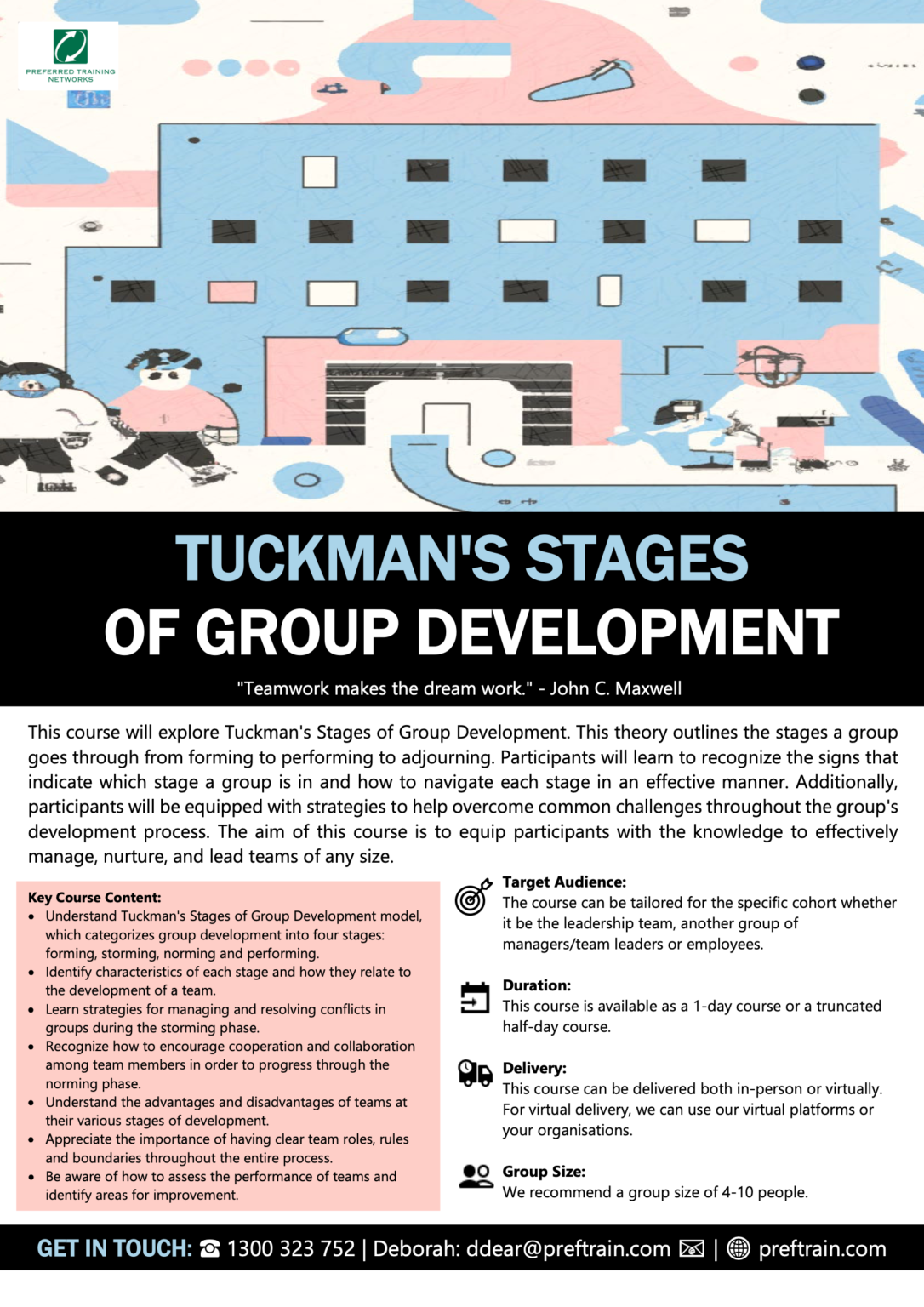
Tuckman’s stages of group development describe the four different stages of a group as they get together to operate collectively. The stages of group development by Tuckman enable people to gather a better understanding of how groups work.
Forming: This stage is marked by the desire of people to be accepted by others without any conflict. People avoid issues and focus on understanding team structures. However, people are gathering information about each other.
Storming: People can remain polite to each other only as long as issues are being addressed. This stage is marked by the presence of minor confrontations and, depending upon the organisation’s culture, most of the issues are suppressed.
Norming: This stage marks the establishment of ‘rules of engagement’. People understand each other better and learn to appreciate skills.
Performing: This is the stage of interdependence and flexibility. People know each other well and are able to trust them to make way for independent activity. Group identity and morale are high and people are able to direct their efforts towards desired goals.
Adjourning: This phase marks the completion of the task and dissolution of the team. Following this stage, team members may either become less focused or highly focused. The behaviour at this stage varies.
If you are looking for professional development course in Australia, get in touch with Preferred Training Networks. We have the best trainers, facilitators and instructional designers in Australia. We offer a wide range of courses to meet your specific requirement. To know more about our courses, get in touch with us. You can contact us through our online form or call us to receive a free quote.
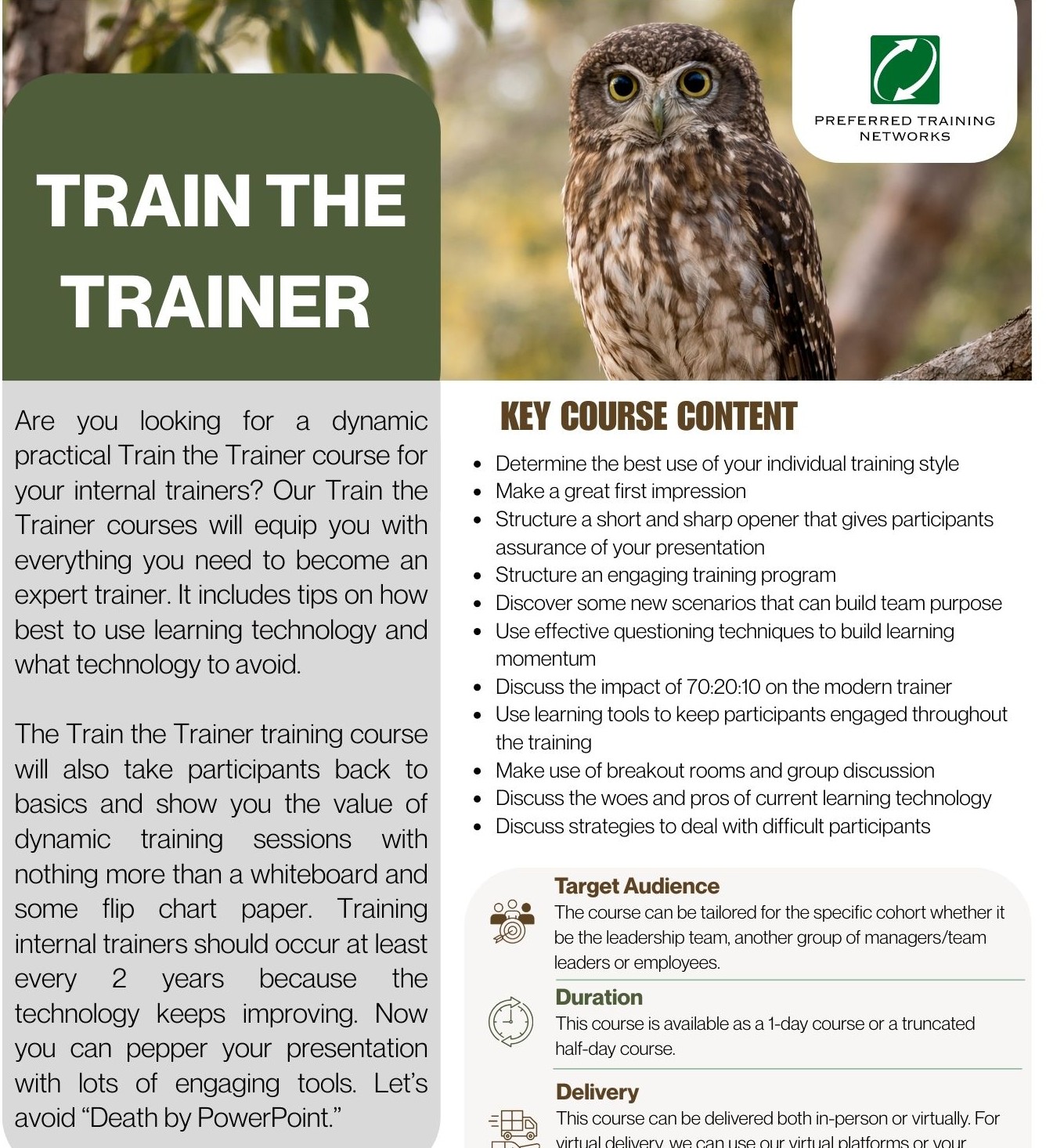
This Train the Trainer workshop pivots around the 70:20:10 model. Participants discover tools to help embed organisational learning. So, if you would like to boost levels of audience engagement and learning, then this course is perfect. This training has been designed for new and experienced trainers. Your experienced trainers will learn some new skills to engage the newer generations entering the workplace. Previous participants have found that the course helps them to move away from “slide decks” and “stand and deliver” formats.
Key elements of this course include people management workshops, communication training, front-line management and supervisor training, and general soft skills development.
For maximum effectiveness, this course is best conducted as an in-house program.
Venue: For your convenience, you can choose to conduct this course at your workplace. Alternatively, we can provide a training venue at a small additional cost.
Duration: Each course can be tailored to suit your timeframes.
Target audience: New and existing trainers and facilitators
Explore some of our other highly recommended courses including presentation skills training, dealing with conflict at work, strategic thinking and workplace conflict resolution training.
Whether you’re looking for help with time management, communication techniques, effective leadership skills, professional or interpersonal development or anything in between, we can help.
Pre-requisites
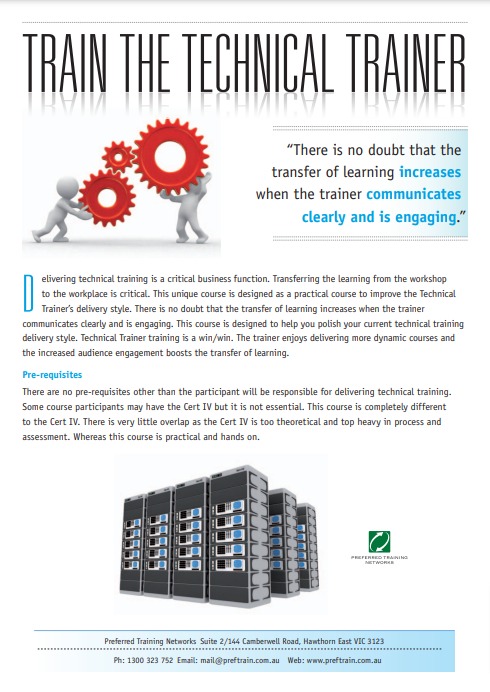
There are no prerequisites other than the participant will be responsible for delivering technical training. Some course participants may have the Cert IV, but it is not essential. This course is completely different to the Cert IV. There is very little overlap, as the Cert IV is too theoretical and top-heavy in process and assessment. Whereas this course is practical and hands on.
This program can be conducted as in house training at your offices.
Group Size: An ideal group size is 6–10 participants.
Venue: For your convenience, you can choose to conduct this program at your offices. Alternatively, we can provide a training venue at a small additional cost.
Duration: Each course can be conducted as a one-day program.
Cost: Upon request.
Target Audience: Specialist Technical Trainers, e.g. technical, subject experts, OH&S trainers looking to improve on delivery.
If you would like more information on this training program, please contact: Deborah Dear on 1300 323 752 or email: [email protected] or contact us online today.
Different types of mentoring
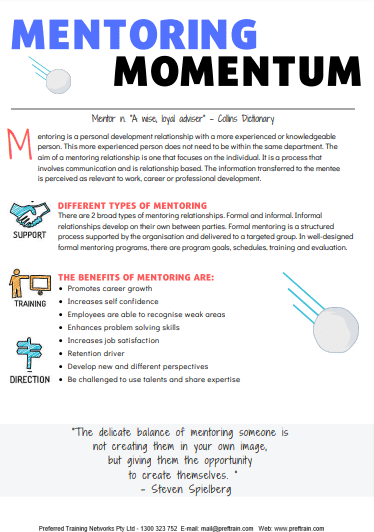
There are 2 broad types of mentoring relationships. Formal and informal. Informal relationships develop on their own between parties. Formal mentoring is a structured process supported by the organisation and delivered to a targeted group. In well-designed formal mentoring programs, there are program goals, schedules, training, and evaluation.
“The delicate balance of mentoring someone is not creating them in your own image, but giving them the opportunity to create themselves.”
– Steven Spielberg
Proposed Mentoring Approach
| Step 1: Mentor the Mentor and Setting Expectations for Mentees Learning Sessions |
To start your mentoring project, we would recommend a learning session for both Mentors and Mentees. These two sessions would be run separately. Ideally, mentors and mentees understand individual roles. Some organisations question the need to prep the mentees. But we would recommend that your initial project does include the mentee workshop too. |
|---|---|
| Step 2: 90-minute Launch Event |
A 60 – 90 minute launch event creates enthusiasm for the project. This can be a lunch, afternoon tea, after work drinks or some such “gathering” event that you deem appropriate. During this launch event, the whole group is introduced to each other. We would ask one of your Senior Leadership team to introduce the program. Our Mentoring Expert would then facilitate a mentoring discussion. |
| Step 3: Allocation of Teams, Organising Goals and Meetings |
At the conclusion of the facilitated discussion, the mentors, and mentees would be paired and spend 30 minutes looking at goals as well as mapping out their meetings moving forward. Our Mentoring Expert is close by to help structure each pairing mentorship plan. The Mentoring Expert also helps each pairing to set standards and expectations. |
| Step 4: Autonomous Mentor and Mentee Meetings |
Individual meetings usually occur face-to-face. Building a regular mentoring schedule works best (e.g. fortnightly meetings). Speak to your consultant about what logistics work best for you. We can manage the entire project, or you may prefer to run part of the project. |
| Step 5: Conclusion |
A conclusion is very important in a mentoring project. The conclusion includes a project completion date. Without a conclusion, the project fizzes out and misses the opportunity of making an impact. We recommend that we design a conclusion that is appreciative of everybody’s inputs. Our conclusion wraps up the key learnings from the mentoring project. Our conclusion also motivates the mentors to nominate as mentors again. |
Where to from here?
If building a dynamic internal mentoring program is on your radar, please let your consultant know. We can work collaboratively with you to design a world best practise mentoring program.
CALL TODAY 1300 323 752 or email us [email protected]
Preferred Training Network offers a variety of courses at affordable rates. Training courses are an effective means to enhance the productivity of your workforce. Business training is vital for the growth of any company as it can equip your employees with certain key skills. The most important resource of any company is its employees. Helping employees to perform better and discover new abilities can immensely help your company to grow.
If you are looking for training course professionals in Australia, get in touch with Preferred Training Networks. We offer various courses for personal and professional development of employees. Our courses are specifically designed to help people effectively achieve professional goals. We give you access to the best trainers, instructors and instructional designers in Australia. The fact that you can avail various types of training from a single source helps your company to save time. We understand that requirements vary. To ensure that we are precisely able to cater to the needs of our clients, we offer tailored courses so that you can make the most of our training.
If you wish to get training quotes, get in touch with us. We will provide you with a free quote. You can either fill our online form or call us. Our team will be happy to help you select the best course for your need.
You can call us on 1300 323 752
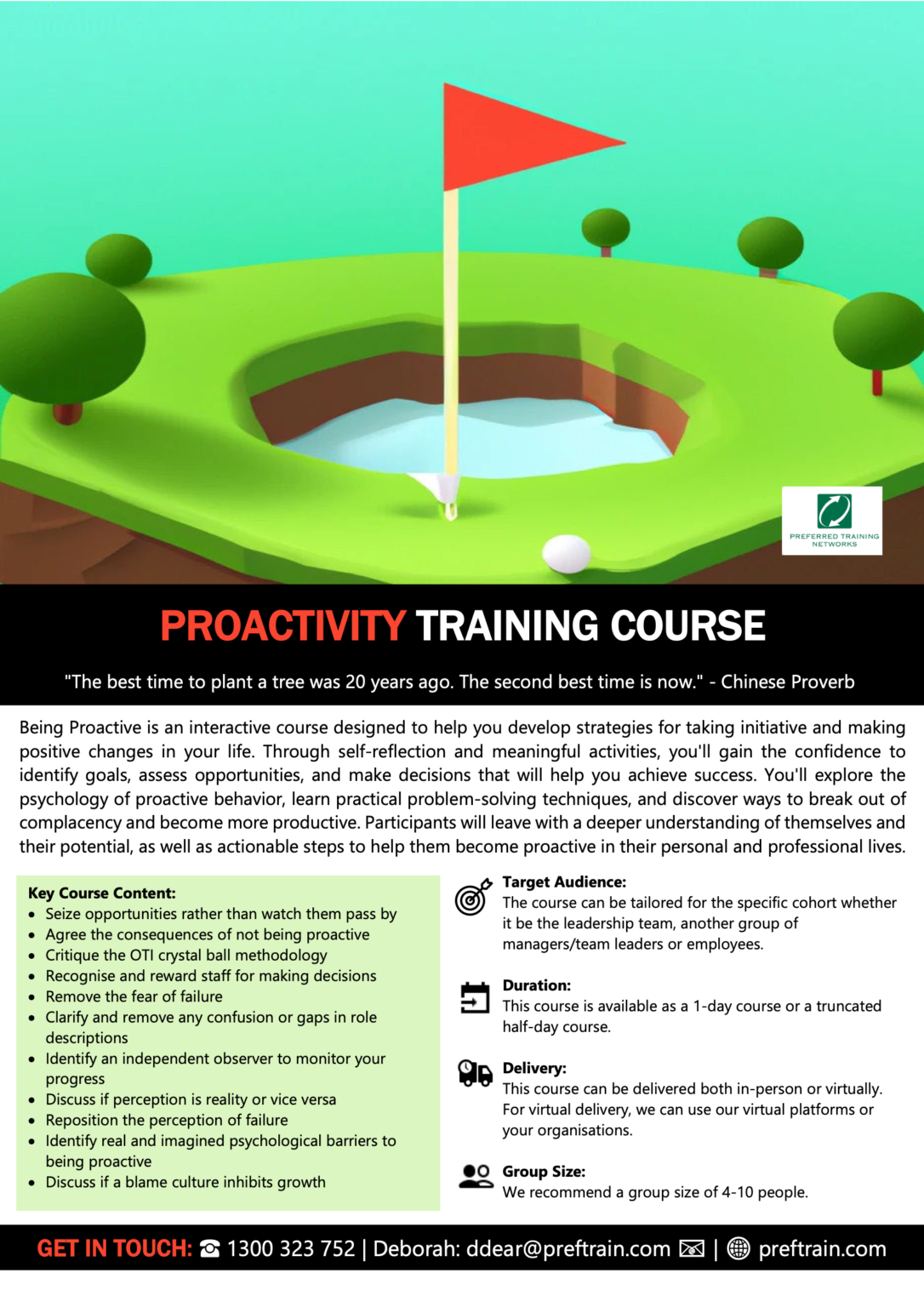
Conditioning is related to taking initiative. So are cultural differences. So are decision-making styles. In fact, you’d be amazed at how many aspects can blinker your focus and initiative. However, at the same time, it’s critically important to adapt to your role. If you are not taking enough initiative and being proactive, you can stifle the organisation’s opportunities.
Ideal group size: 4–12 participants.
Venue: For your convenience, you can choose to conduct this program at your business premises. Alternatively, we can provide a training venue at a small additional cost.
Duration: This program can be conducted as a one day or half day program.
Cost: Price on request.
Target Audience: Supervisors, Team Leaders and Management.
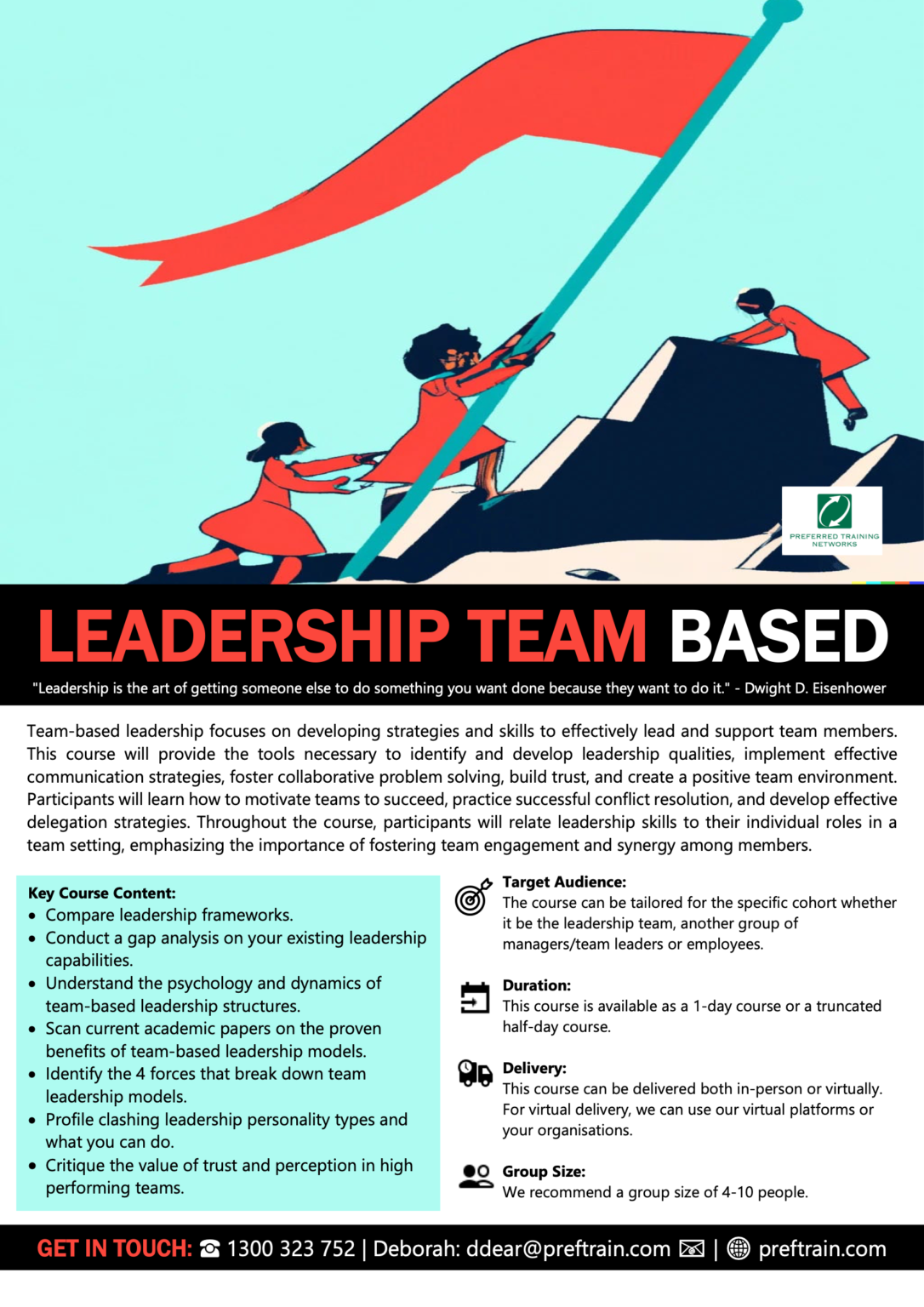
Many organisations have some great leaders. However, they are often not working in the same direction and are not working synergistically. Clashing leadership styles sometimes hamper productivity and dampen morale. Progressive organisations utilise team based leadership tools to get blocks of people moving en masse behind the organisation’s strategic objectives.
For maximum effectiveness, this program is best conducted as an in-house program.
Ideal group size: 4–9 participants.
Venue: For your convenience, you can choose to conduct this program at your business premises. Alternatively, we can provide a training venue at a small additional cost.
Duration: This program can be adapted to meet your requirements.
Cost: Price on request.
Target Audience: Employees, Supervisors, Team Leaders, Senior Managers or CEO’s.
If you would like more information on this training program, please contact: Deborah Dear on 1300 323 752 or email: [email protected] or contact us online today.
Most people have regrets and disappointments in their lives. Many people get fixated chasing dreams. Once the dream is achieved, they lose interest and chase another dream. This program looks at what’s really important for you to achieve in your life. It might be that you want to enjoy your job more or to enjoy your children more. For whatever reason, you want to derive more pleasure from life. How many people do you know are wishing part of their lives away in the hope that “next year will be better?” This course taps into the minds of the wisest people who have ever lived and gives you some of the world’s best ideas to enjoy your life.
Many people go through life without ever smelling the roses. However, you can’t just sniff a rose. You have to learn how to enjoy the rose. You have to see the rose for its own beauty. You have to become immersed in its beauty without being bothered by other thoughts.
For maximum effectiveness, this program is best conducted as an in-house program. This program has alternative titles to ‘How to smell the roses’. It’s designed to help your employees increase their life satisfaction levels, which academics agree will make your workplace more productive, more enjoyable and less stressful.
Ideal group size: 4–12 participants.
Venue: For your convenience, you can choose to conduct this program at your business premises. Alternatively, we can provide a training venue at a small additional cost.
Duration: Your How To Smell The Roses Course can be modified to fit inside your timeframe.
Cost: Price on request.
Target Audience: Employees, Supervisors, Team Leaders, Senior Managers or CEO’s
If you would like more information on this training program, please contact: Deborah Dear on 1300 323 752 or email: [email protected] or contact us online today.
Effective Presentation Skills
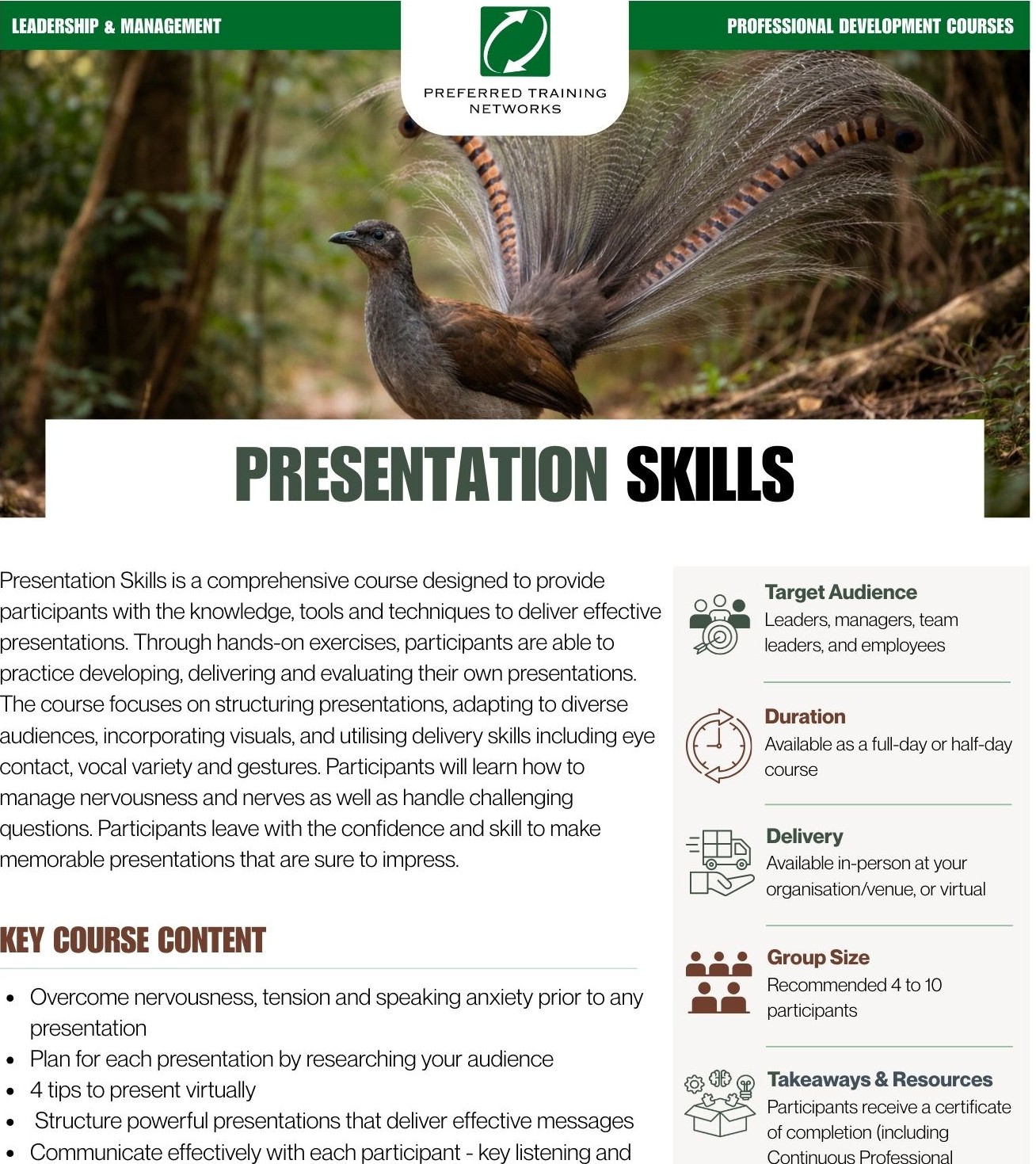
Learn how to deliver an effective business presentation that will bring about the results your organisation is looking for. Learn to structure your presentation to meet the audience’s expectations. Learn how to engage the audience no matter what the subject is. Presentations are often used as a formal method to plan and progress any business idea. They can be fun as they give people a chance to hold the stage and speak their mind. Organisations can use effective presentation skills to raise issues and find solutions to problems. An effective business presentation delivers a clear, concise impression on the audience.
Advanced Presentation Skills Training
If your people are already experienced presenters then we can jump straight into developing their presentation styles. We can critique their presentations. Each presentation can be videotaped too. Depending on the existing skill level of the audience we will customise a program that brings your people to the next level. Professional presentation skills training can often be the difference between clinching the outcome and missing the outcome. Don’t let your organisation miss out. For advanced training and effective business presentation techniques training, enrol in one of our professional courses. Download the Presentation Skills Training full course outline and submit your training request online.
How good are you at presenting?
Ask yourself the following:
Would you like to attend this program?
For maximum effectiveness, this program is best conducted as an in-house program.
Ideal group size: 4 – 10 participants
Venue: For your convenience, you can choose to conduct this program at your business premises. Alternatively, we can provide a training venue at a small additional cost.
Duration: Your Presentation Skills Course can be modified to fit inside your timeframe.
Cost: Price on request.
Target Audience: Employees, Supervisors, Team Leaders, Senior Managers or CEO’s
If you would like more information on this training program, please contact: Deborah Dear on 1300 323 752 or email: [email protected] or contact us online today.