A Trusted Learning and Development Advisor
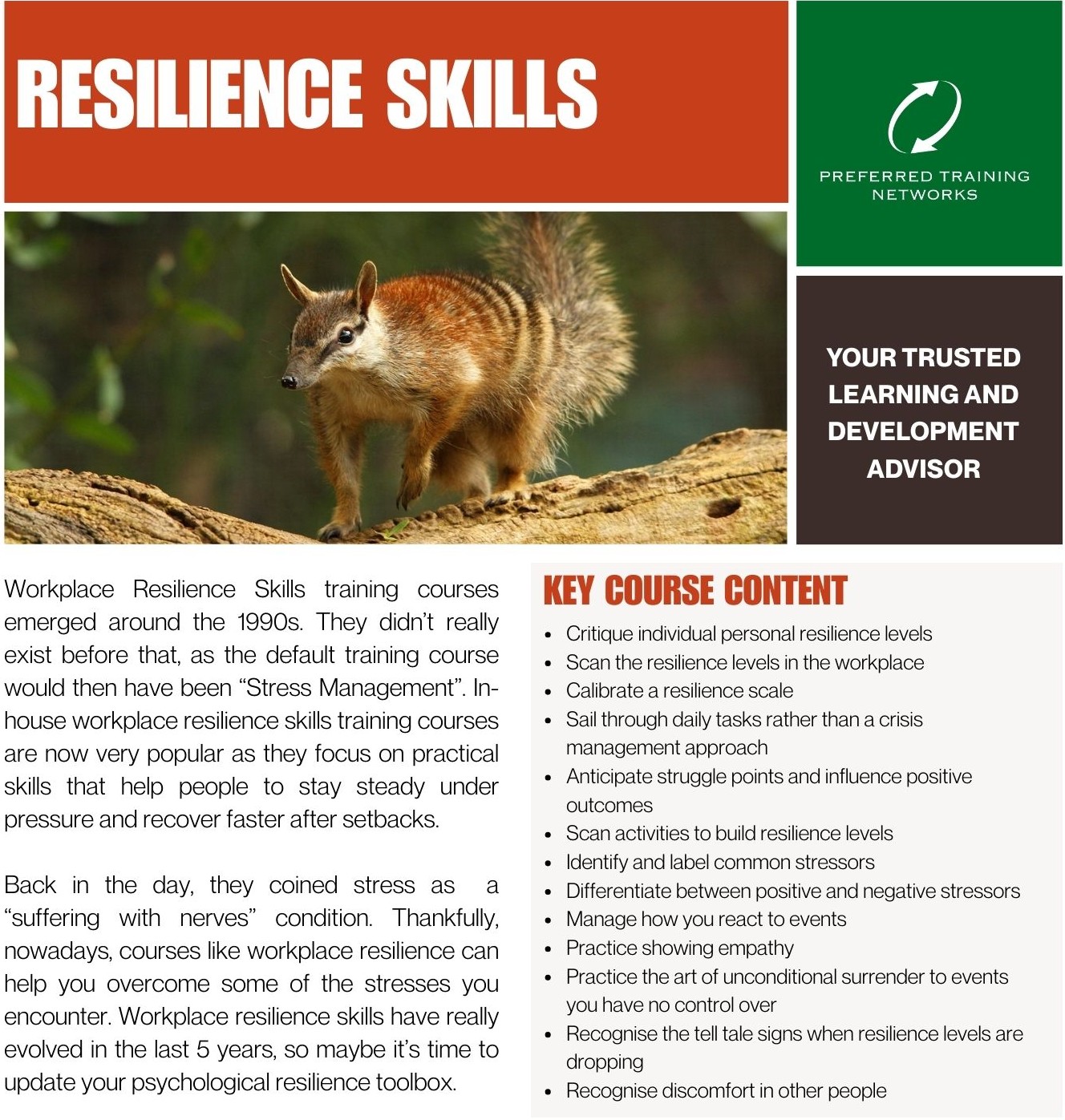
Being resilient means having a positive mindset and approach to these challenges. Resilience isn’t just a reactive skill that kicks in when you face obstacles; it requires practice. Our Resilience Skills Training course equips professionals across Australia with the tools to stay composed, adaptable, and productive under pressure
Whether at work or in your personal life, our resilience training courses help you develop fortitude. Build the skills to confidently handle difficult situations, including managing abuse and threats, while learning to organise your time effectively.
By the end of this course, you’ll learn to maintain a positive mindset, even in tough situations, by applying emotional intelligence, managing stress effectively, and supporting workplace mental health—helping you overcome obstacles with greater ease.
Q: What is resilience skills training?
A: It’s a workplace training program that helps employees manage stress, adapt to change, and stay productive in high-pressure environments.
Q: Where is this training delivered?
A: We offer resilience training Australia-wide, including Sydney, Melbourne, Brisbane, Perth, and online for remote teams.
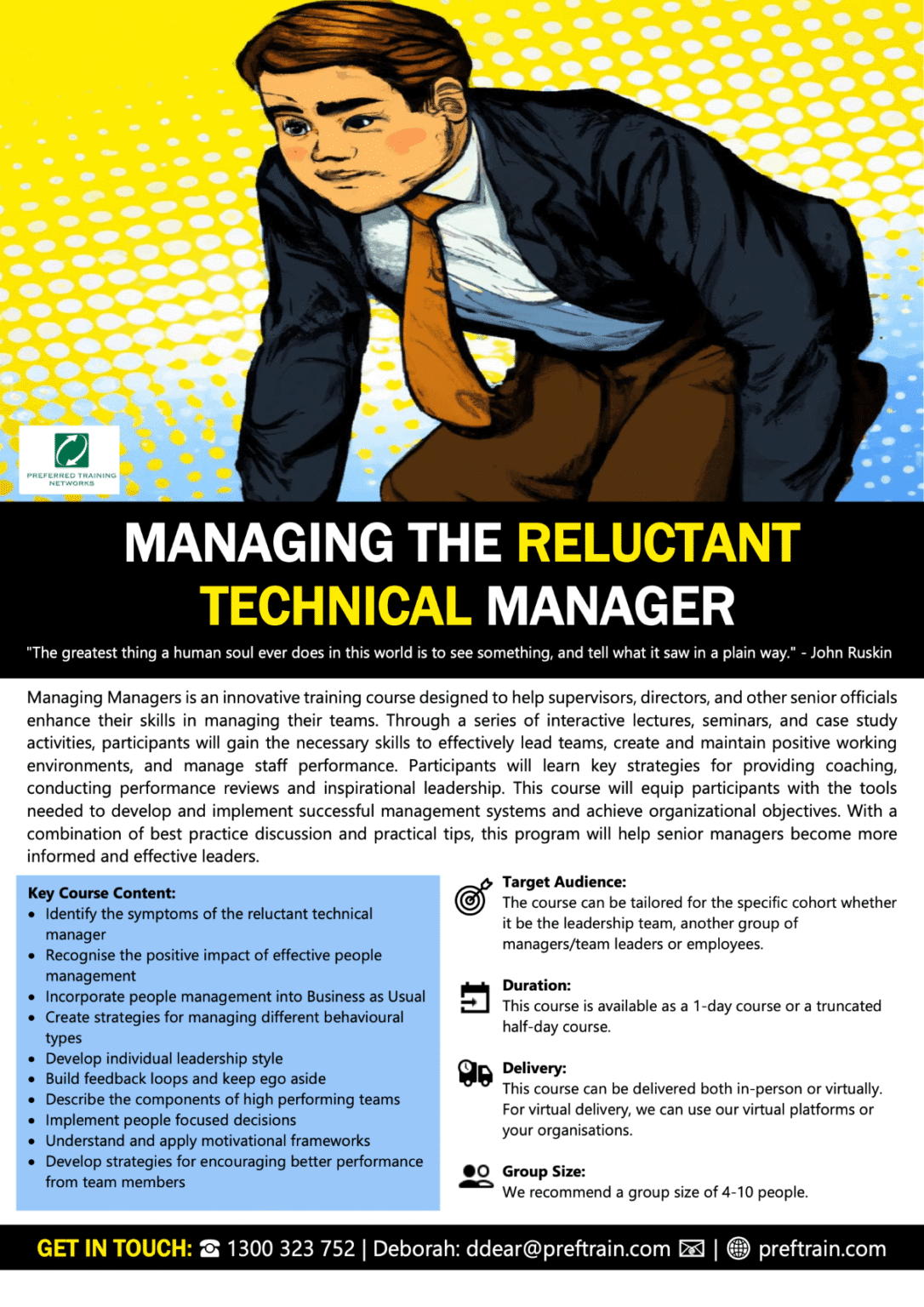
Spotting Reluctant Technical Managers in the Workplace
Look for the signs which include; more likely to focus on their own work, ignore staff issues until they explode, lack direction and vision for their team, won’t delegate, don’t provide feedback, micromanage, separate themselves from team performance issues, expect the team to sort things out themselves.
For maximum effectiveness, this program is best conducted as an in-house program.
Ideal group size: 4 – 10 participants
Venue: For your convenience, you can choose to conduct this program at your premises. Alternatively, we can provide a training venue at a small additional cost
Duration: This program can be conducted as a one day or half day program
Cost: Price on request.
If you would like more information on this training program, please contact: Deborah Dear on 1300 323 752 or email: [email protected] or contact us online today.
For maximum effectiveness, this program is best conducted as an in-house program.
Ideal group size: 4–10 participants.
Venue: For your convenience, you can choose to conduct this program at your premises. Alternatively, we can provide a training venue at a small additional cost
Duration: This program can be conducted as a one day or half day program
Cost: Price on request.
If you would like more information on this training program, please contact: Deborah Dear on 1300 323 752 or email: [email protected] or contact us online today.
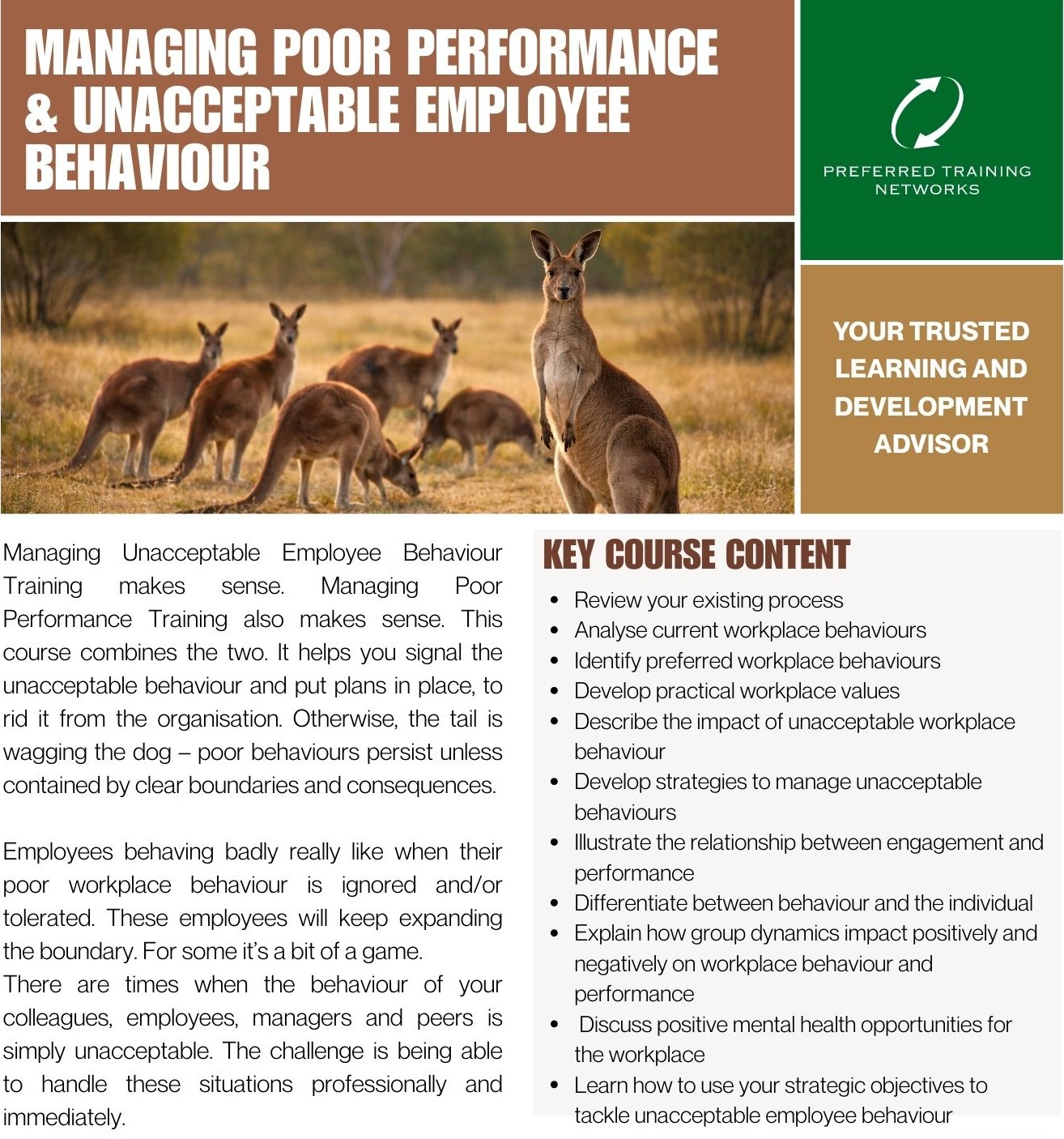
When an unacceptable behaviour is not addressed, it sends a message that misbehaviour is OK. Workplaces need to ensure that unacceptable behaviour is challenged and managed effectively. The vast majority of people want to come to work to do their job, enjoy the workplace and get along with their fellow employees and managers.
The first step is to get rid of unacceptable behaviours by establishing a strong functional workplace culture. Current workplace studies indicate that you need seven good employees, to counter the impact of one errant employee. In the current tight workplace conditions, you simply cannot afford poor workplace behaviour. This program will provide you with the tools and insights to better manage unacceptable behaviour whilst at the same time developing a positive workplace culture.
Which behaviours are prevalent in your workplace?
Imagine the difference if you had no boxes to tick! Believe it or not some workplaces operate seamlessly where employees actually look forward to coming to work! When employees are engaged and feel valued they are more likely to contribute productively to the workplace and their work.
Case Study
Your organisation should have existing processes in place to manage unacceptable employee behaviour. However, a recurring problem is that managers try and shortcut the process. Here is a commonplace scenario:
Manager: “Liam is absolutely useless. We need to get rid of him today. He is driving everyone nuts and since he started, the team has become dysfunctional.”
HR: “That doesn’t sound good, what conversations have you had with him?”
Manager: “None – I’m letting you know now. How about you get rid of him next week.”
HR: “What have you done so far to manage the situation?”
Manager: “Nothing”
HR: “You need to manage it locally. Follow the process and if that doesn’t work then please come back to me.”
Manager: “But that’s not fair, I don’t have time. Isn’t HR’s job to look after the people stuff?”
HR: “It’s also your job to manage your people. Our process is that you need to try and resolve these issues locally before coming to HR. That’s the process. You’ll find its robust enough to help you but you need to try and manage it locally and get more involved. Please don’t think you can simply dump the problem on HR. It simply doesn’t work that way. I know this might be hard to believe but your understanding of the situation might be completely wrong. The process will help us discover what’s really happening and will give us strategies to manage the situation”
If this sounds familiar, then this course will certainly help participants to manage unacceptable employee behaviour.
“When employees are engaged and feel valued, they are more likely to contribute productively to the workplace and their work.”
This program can be conducted as in-house training at your offices.
Guidelines
Group Size: An ideal group size is 6 – 14 participants.
Venue: For your convenience, you can choose to conduct this program at your offices. Alternatively, we can provide a training venue at a small additional cost.
Duration: This course can be adapted to your time frame
Cost: Upon request.
Target Audience: Supervisors, Team Leaders and Managers
Some parents can be very difficult when there’s a gap between what they expect and their perception of your service delivery. Surely it makes sense to understand how parents form expectations of your school. If you know how the expectations are formed in parents’ minds, then you can mould and reset them.
Businesses invest heavily in bridging the gap between customer expectations and the service delivery. It is time for schools to learn how to identify unrealistic expectations. In this breakthrough course, participants discover a proven method of resetting parent expectations.
For maximum effectiveness, this program is best conducted as an in-house program.
Options: For 10–25 people, we recommend the half day or full day version. For 25–100 people, we recommend a truncated keynote presentation (90 mins – 2 hours)
Venue: For your convenience, you can choose to conduct this program at your school. Alternatively, we can provide a training venue at a small additional cost
Target Audience: Education Professionals (and non-teaching staff)
Cost: Price on request.
If you would like more information on this training program, please contact: Deborah Dear on 1300 323 752 or email: [email protected] or contact us online today.
| Module | Topics | Key Learning Outcomes |
|---|---|---|
| Module 1: Understanding Parent Expectations | How Expectations Are Formed |
|
| Recognising Unrealistic Parental Expectations |
|
|
| Module 2: Effective Communication Strategies | Handling Challenging Parental Interactions |
|
| Improving Communication to Reduce Conflict |
|
|
| Encouraging Respectful Communication Through I Statements |
|
|
| Module 3: Standardising Expectations Within the School Community | Developing a School-Wide Approach to Managing Expectations |
|
| Strategies for Reinforcing Expectations |
|
|
| Module 4: Building Resilience and Well-Being Strategies | Developing Resilience in the Face of Parental Demands |
|
| Stress Management Techniques for Educators |
|
|
| Practical Well-Being Strategies for Educators |
|
Review the best tools to understand expectations
This program can be facilitated at your office.
Ph: 1300 323 752, Email:[email protected]
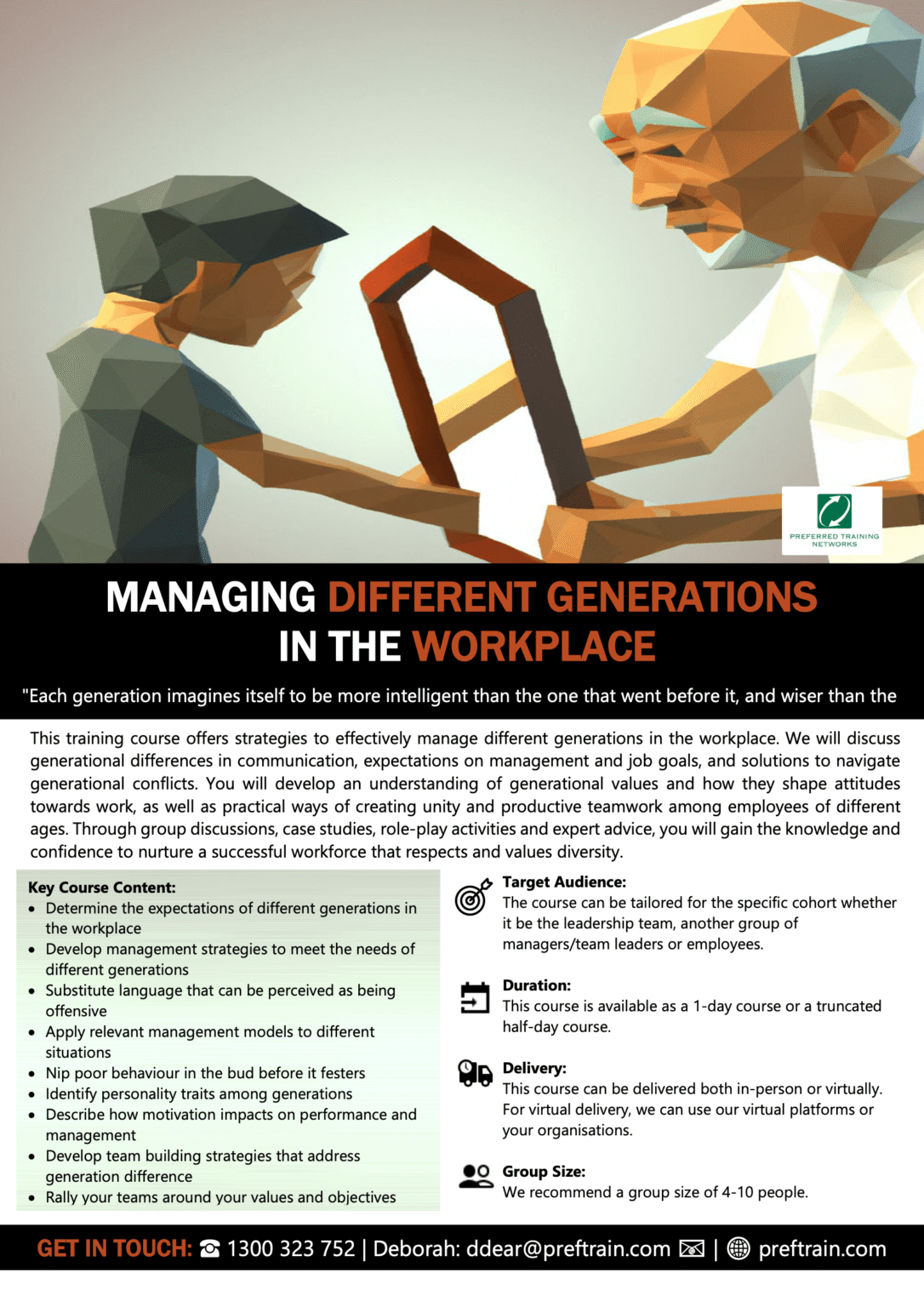
The workplace of older staff telling younger staff what to do is gone. Back in the day, the longer your tenure, determined your rank in the organisation. There is a great opportunity now to harmonise and harness the expertise of a range of generations that is inclusive and exciting.
For maximum effectiveness, this program is best conducted as an in-house program.
If you would like more information on this training program, please contact: Deborah Dear on 1300 323 752 or email: [email protected] or contact us online today.
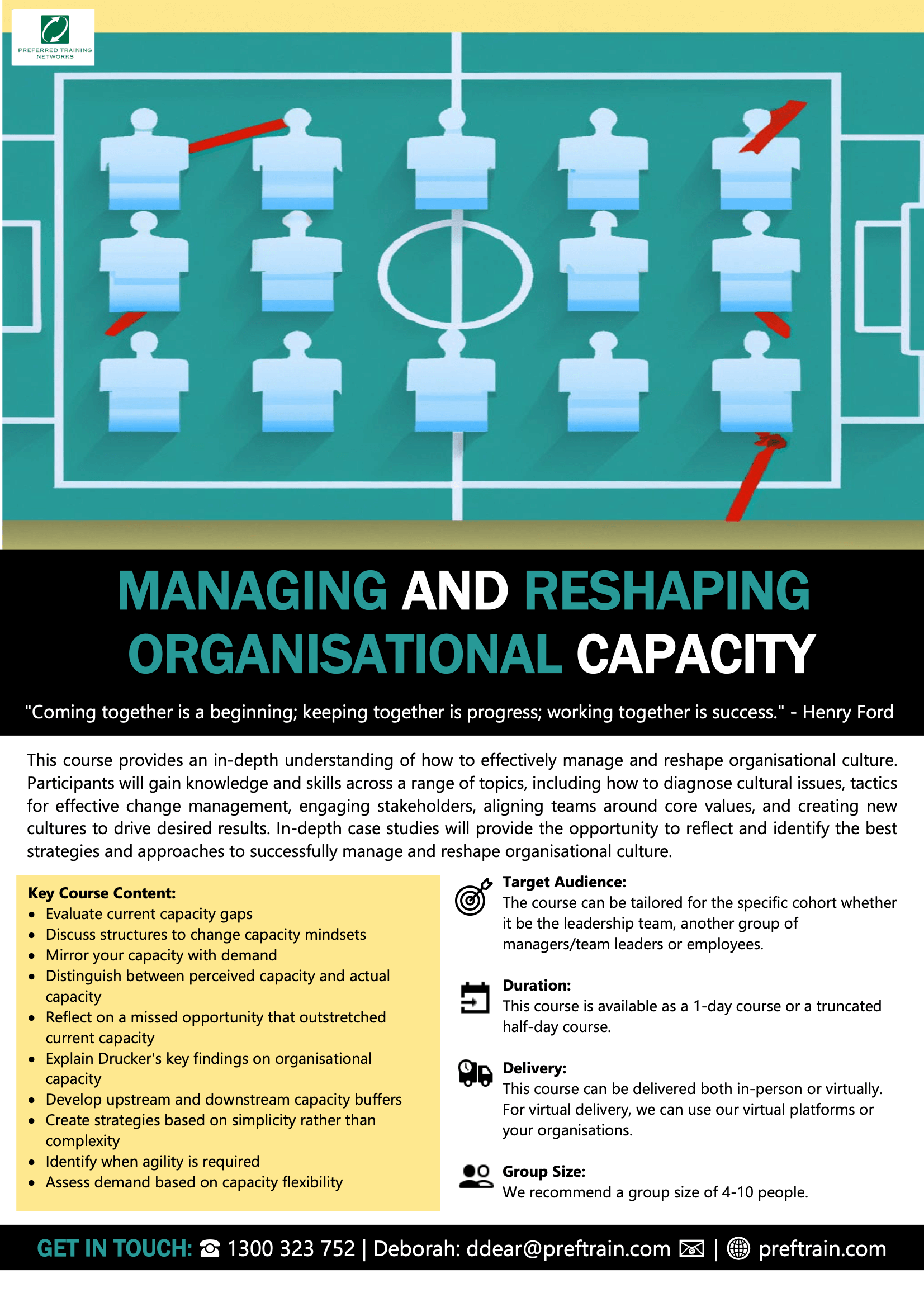
This short Managing Organisational Capacity course will show you how to change the mindset about how your people view your existing capacity. Participants will also learn how to change your service model to meet capacity. This Organisational Capacity course is perfect for you if your people keep repeating that the demand on their time and resources is too great. Rethinking your capacity is a proven method to delivering greater value with the same resources.
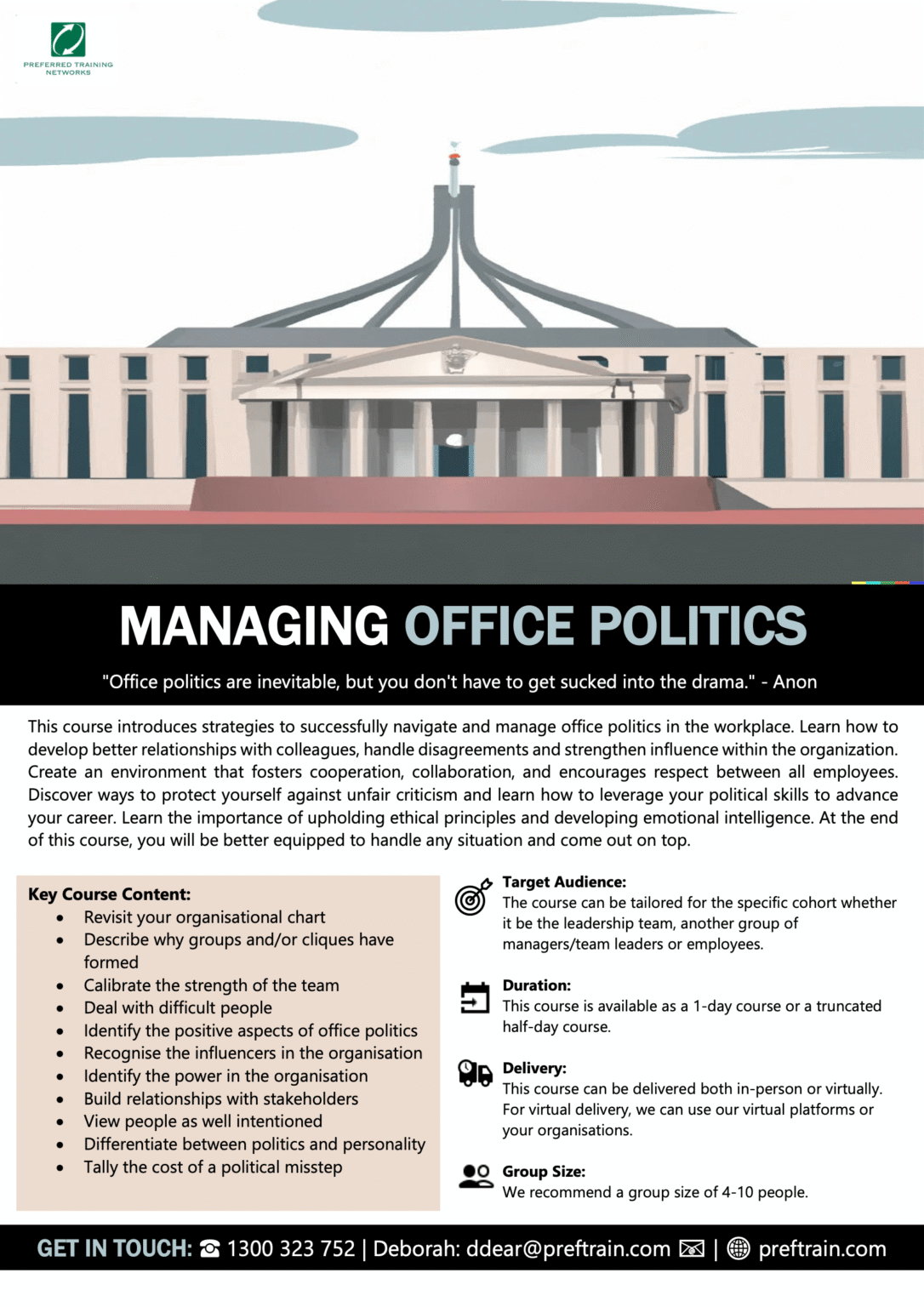
If you don’t see any politics in your office then maybe you are not looking hard enough. Once you have as little as three people, you are likely to have politics. People in the workplace jostle for a variety of perceived benefits and resources such as ego, promotion, status, image, and even desks and offices! Office politics is not necessarily a hindrance, indeed managed properly it can boost the effectiveness of the organisation by harnessing the energy and using it to drive performance and even morale.
Questions you might ask yourself
How do I manage office politics? How does office politics work? How do I cope with workplace politics?
For maximum effectiveness, this program is best conducted as an in-house program.
If you would like more information on this training program, please contact: Deborah Dear on 1300 323 752 or email: [email protected] or contact us online today.
Do you know any organisation that places too much emphasis on technical training and allows the people management skills to ebb away? It’s the people management skills that keep the organisation lubricated with a positive attitude and a “can do approach”. In this course, participants discover the 7 Modes of Modern Management:
“Every manager needs to be a strategist.
If your managers are not pursuing your strategic objectives, then what are they doing?”
Manager as Strategist
Every manager needs to be a strategist. If your managers are not pursuing your strategic objectives, then what are they doing? Too many managers make their own department objectives which bear little resemblance to the organisation’s objectives. C-R-A-Z-Y
Manager as Production Director
What movie are you the production director of? Do you know what your audience (customer) wants? Can you make a better movie more effectively and efficiently? It’s time to learn some dramaturgy disciplines. It’s interesting how many managers get stuck in silos and never see the greater picture, Ready…Set…Action…
Manager as Change Champion
Staff will often fear change. If your organisation isn’t constantly undergoing change, then you’ll soon be a dinosaur. Managers need to permeate change through the organisation. Doomed change initiatives usually get bottlenecked at management level. Organisations need change champions.
Manager as Validator
Too many organisations made a hard landing because they rely on data delivered by other people. Managers need to be validators too. For example, “we managed to reduce our purchase of paper by 20%”. Sounds great, but by validating the information you find out that they’ve outsourced all printing.
Manager as Coach
Some managers are excellent coaches, and some struggle or ignore coaching altogether. Coaching is an essential part of being a manager. Follow a proven framework, and it is not as daunting as it sounds. In fact, it’s often regarded as the most fulfilling part of being a manager.
Manager as Performance Consultant
A critical function of management is to ensure you get optimal performance from your people. Your team might consist of high potentials, slackers and people who have quit and stayed. You need to learn how to performance manage to deliver your objectives.
Manager as Organisational Psychologist
Have you noticed a culture of entitlement building internally or externally? Customers can be irrational. A colleague carrying resentment and a poor attitude can dampen the morale of an entire office. So you need to be an organisational psychologist on top of all your other roles. You’ll enjoy this module as you discover human behavioural patterns and understand how people tick.
CASE STUDY: Widget Inc
Picture this. Widget Inc. has the top technology in the world to deliver widgets to the customer. The machinery and technology can convert a customer order into a widget and have it dispatched to the customer’s premises within 2 hours. Yet, customers are leaving in droves. New technology is ordered. Manager’s upgrade to a brand-new level of technical expertise, and the widget delivery time improves by 2.4%. Managers congratulate themselves, yet customer dissatisfaction continues to grow.
The mistake that the management made at Widget Inc. is all too common. Managers didn’t know what the customers really wanted. They assumed that speed of delivery was critical. In reality, the customers just couldn’t bear dealing with the people at Widget Inc. Customers found the staff, rude, disorganised, unhelpful and pushy. It is not rocket science to figure out that Widget Inc. should have been focussing resources on fixing the people side of the organisation rather than improving the speed of delivery by 2.4%. Further analysis of Widget Inc. found that the senior management team was dysfunctional, silos had built in the organisation and staff morale was zip.
Group Size: An ideal group size is 6– 12 participants.
Venue: For your convenience, you can choose to conduct this program at your offices. Alternatively, we can provide a venue at a small additional cost.
Cost: Upon request.
Target Audience: Team Leaders Supervisors and Managers