A Trusted Learning and Development Advisor
Don’t miss out on this breakthrough course in managing poor behaviours in the workplace training workshop. This course is an opportunity to audit and label positive and negative workplace behaviours. Help your people learn behaviour strategies to optimise behaviours at work.
This course focuses on recognising and rewarding positive workplace behaviours and removing unacceptable workplace behaviours at work.
Review the positive and negative behaviours in your workplace. This course was designed by a team of behavioural psychologists and leaders from Top 500 Companies. The day explores negative workplace behaviours and positive workplace behaviours. As one of our psychologists remarked, “Negative workplace behaviours are like two rats sneaking into your house before you go on holiday – they can multiply very quickly and literally bring the house down”. It’s an experiential type learning course and your facilitator has over 15 years experience dealing with workplace behaviours.
Testimonials
“What I really like about your company is the fact that I can come to you with a need, and you come back very quickly with a high quality trainer or facilitator, who will customise and deliver a tailored program to suit our needs.”
– A Wright, Manager Learning & Development, Department of Health
“We always enjoy the creativity and new ideas your people have. And your level of service is so professional.”
– J Rogers Learning and Development, Department of Transport
“Preferred Training Network developed a coaching training package that really met our needs and they made the contextualizing process so easy. Their customer service before and after was excellent and their trainer was refreshing and innovative and really knew his stuff. A pleasure to do business with.”
– A Martin Manager, SA Ambulance Service
The Nuts and Bolts
This program can be conducted as in-house training at your offices anywhere in Australia.
Guidelines
Group Size: An ideal group size is 6 – 12 participants.
Venue: For your convenience, you can choose to conduct this program at your business premises. Alternatively, we can provide a training venue at a small additional cost.
Duration: This program can be adapted to fit your timeframe. (We recommend a one day course)
Cost: Upon request. Target
Audience: Staff, supervisors, team leaders and management.
If you would like more information on this training program, please contact: Deborah Dear on 1300 323 752 or email: [email protected] or contact us online today.
Take a look at the other popular courses that we offer at Preferred Training Networks: train the trainer training, conflict resolution workplace, customer service training, and employee engagement training.
3 Steps to getting your Occupational Stress management action plan:
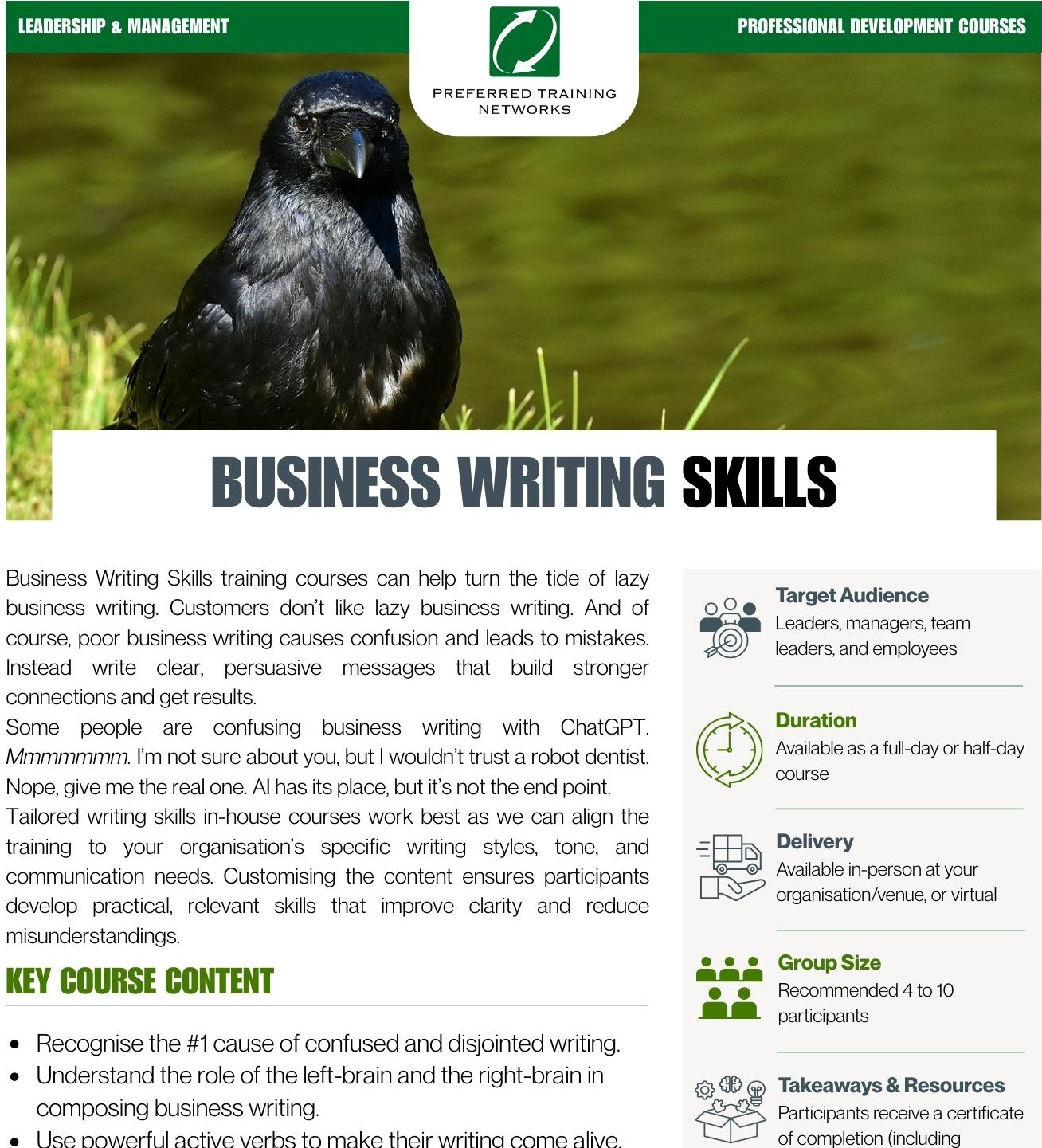
Writing well is indispensable, particularly when working closely with clients. Though it may not seem evident at first glance, your interpersonal connections are impacted by the way you write. Whether you’re producing proposals or reports, strong writing abilities not only make your point clear but also build credibility with colleagues and clients.
PrefTrain provides an easy-to-learn business writing skills course that will help improve your writing abilities. Discover useful strategies to improve the way you communicate with clients and produce letters that persuade and deliver outcomes.
Effective communication is the backbone of any successful organisation, and our business writing course equips you with the skills needed to thrive. Our business writing course is best offered in-house, either at your office or a nearby location we can arrange at a minimal cost. This creates a warm and informal training atmosphere that fosters engagement. For your convenience, virtual training is also available.
If your goal is to fully utilise your staff’s potential, check out our complementary writing skills training classes. Check out our programs to enhance your ability to write business reports, communicate verbally and in writing, and give keynote speeches.
Join our effective writing skills course to enhance your communication skills and boost your professional impact. This course is made with you in mind, whether you’re new to business writing, a new boss, or just want to improve your customer interactions.
Don’t pass up the chance to improve your professional writing abilities in corporate settings. You will become an expert in written composition with Preferred Training Networks (PrefTrain). Invest in your team and empower them to write with ease and fluency.
Come participate in our online and live training programs offered throughout Australia. Learn more about our in-depth courses for professional development and micro-learning options to help your company achieve significant outcomes. Get an instant quote today by contacting us!
We recommend our business writing course for junior staff, new managers, and anyone in your organisation looking to improve their professional writing and communication abilities.
Coherent and consistent communication is essential in all professional contexts. Gaining writing proficiency at work boosts your impact and effectiveness in your role, opening up opportunities for professional advancement.
Your ability to write clear, compelling communications will improve with our business writing skills course. Learn to communicate more effectively with clients and higher management so that your ideas are recognised and valued.
Every participant will get a “Certificate of Completion” upon completion of the program, which attests to your attendance and lists the number of Continuing Professional Development (CPD) hours you have accrued.
It is possible to tailor the business writing course to your organisation’s needs, whether for senior managers, team leaders, or junior employees.
The 4 models covered are:
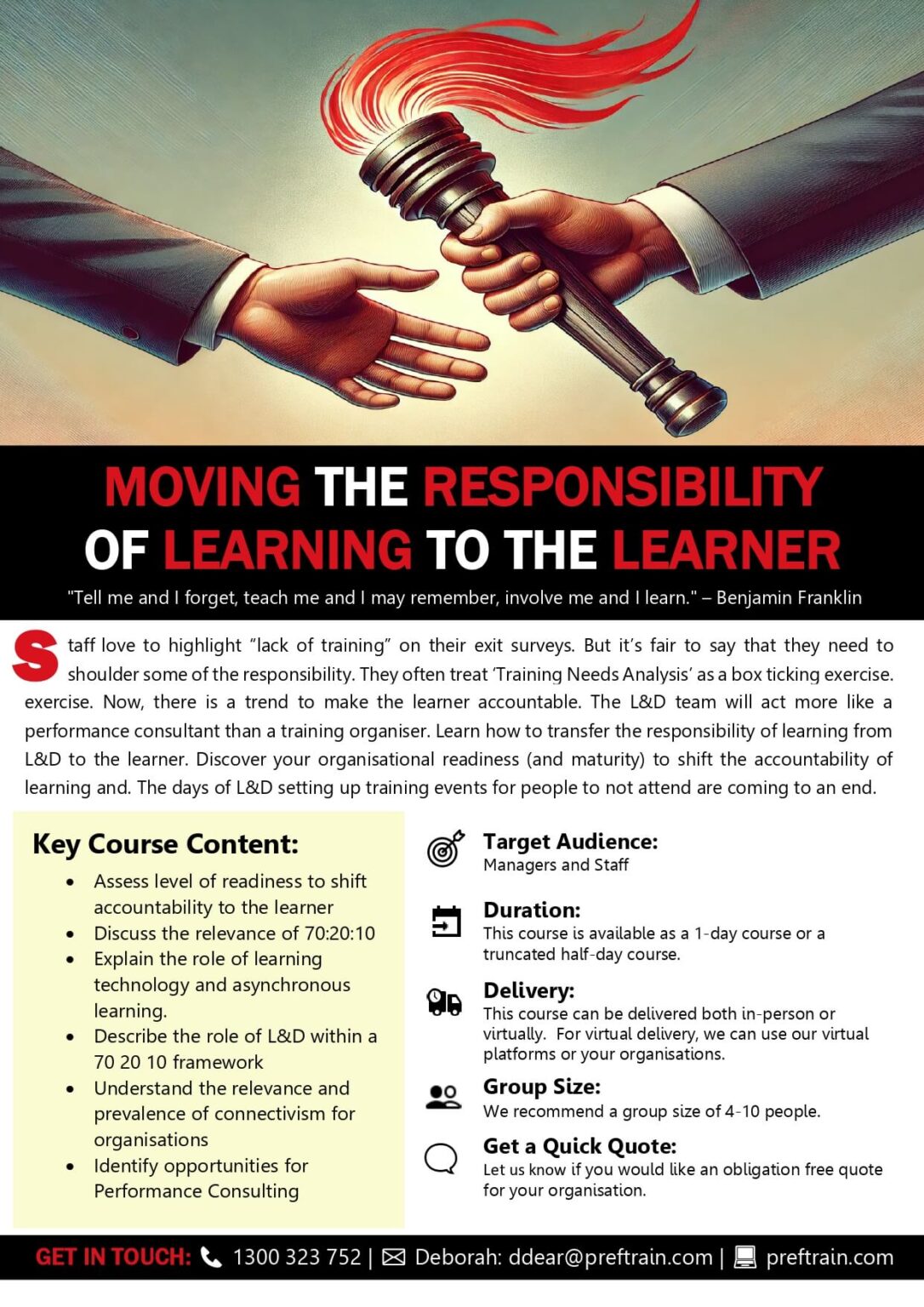
Staff love to highlight “lack of training” on their exit surveys. But it’s fair to say that they need to shoulder some of the responsibility. They often treat Training Needs Analysis as a tick box exercise. They complain that they need some upgrades. And quite often they don’t even bother to show up on the day of the training. Now there is a trend to make the learner accountable. The L&D team will act more like a performance consultant than a training organiser. In this presentation, you’ll discover your organisational readiness (and maturity) to shift the accountability of learning.
What do previous participants thing about the tailored minute taking inhouse training course?
ACCURATE MINUTES PROMOTE ACTION
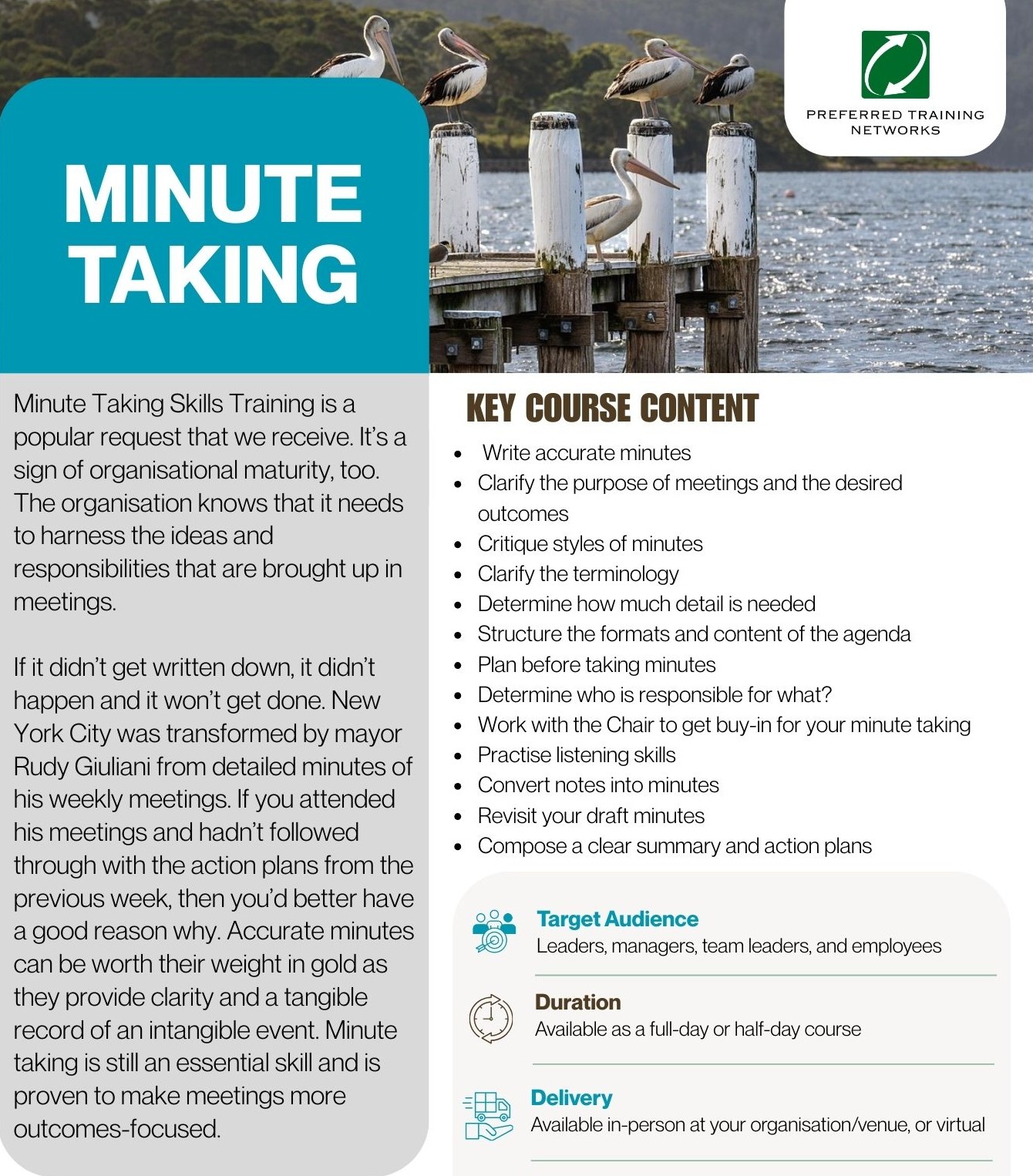
Minutes, also known as protocols, are the instant written record of a meeting. They typically describe the events of the meeting, starting with a list of attendees, a statement of the issues considered by the participants, and related responses or decisions for the issues. Accurate minutes can be worth their weight in gold, as they provide clarity and a tangible record of an intangible event.
NUTS AND BOLTS
Guidelines
Group Size: An ideal group size is 4– 10 participants.
Venue: For your convenience, you can choose to conduct this program at your offices. Alternatively, we can provide a venue at a small additional cost.
Look at what you receive within 24 hours at no cost: At the conclusion of this tailored minute taking training course, participants will be able to:
If you would like more information on this training program, please contact: Ph: 1300 323 752 Email: [email protected]
In addition to our minute taking course, we can assist you with more inclusive training like: courses in strategic planning, time management courses, and train the trainer courses.
This program will help your organisation in:
For maximum effectiveness, this program is best conducted as an in-house program.
If you would like more information on this training program, please contact: Deborah Dear on 1300 323 752 or email: [email protected] or contact us online today.
Managers often report they’re frustrated when the same reporting problems keep reoccurring. Quite often it’s the same issue being delivered by the same person on a different day. The #1 cause of workplace conflict is role ambiguity, and roles are further complicated within the matrix framework. Traditional reporting lines are scrambled, tensions build as deadlines get tighter and confusion can reign over who was meant to do what!
Smart managers don’t accept that matrix mayhem is inevitable. Instead, they fence off and solve the problems that will occur within the matrix beforehand. Forward matrix planning is a proven productivity tool. This breakthrough course will provide you and your staff with the skills and knowledge to manage and perform within the matrix.
WHAT IS MATRIX MANAGEMENT?
Matrix management is a structure that uses specialist staff from different functional areas to work on projects or assignments being led by project managers. Staff in the matrix structure have two managers – their functional manager and their project manager. The functional manager maintains the line of authority over the day-to-day issues such as work allocation, performance, sign-offs, etc while the project manager has authority over the issues related to the project.
| Marketing | Information Technology (IT) | Human Resources (HR) | Sales & Service (S&S) | |
| Project 1 — Tony | Jim — Marketing | Jane — IT | Steve — HR | Tina — S&S |
| Project 2 — Simon | Sally — Marketing | Mario — IT | Jenny — HR | Marc — S&S |
| Project 3 — Kate | Stefan —Marketing | Deb — IT | Carrie — HR | Bruce — S&S |
| Project 4 — Naomi | Renae — Marketing | Greg — IT | Dom — HR | Ali — S&S |
WHAT DOES IT LOOK LIKE?
The figure below shows an example of a basic matrix structure. Across the top are the typical organisational functions of marketing, information technology, human resources and sales & service. Down the left-hand side are the various projects being undertaken by the firm. Each project has a project leader and is staffed by a person from each of the functional areas.
A unique dynamic of matrix management is that it creates a dual line of command, as the project team leaders report to their functional manager as well as their project manager. Jim from Marketing is part of Project 1, so his project manager is Tony, however he still reports to his functional manager. Our matrix management workshop enables participants to effectively work in matrix-managed teams with a matrix reporting structure.
DISADVANTAGES
The disadvantages of matrix management are caused by the dual line of command, and this typically plays out as a conflict around resource allocation between the line or functional manager and the project manager. Staff then find themselves lost in the matrix as their functional manager is demanding or refusing one thing while their project manager is demanding something else. The challenge for matrix management is to work through the role clarity issues and providing staff and managers with clear guidelines to address role ambiguity.
“Matrix management is a structure that uses specialist staff from different functional areas to work on projects or assignments being led by project managers.”
This program can be conducted as in house training at your offices.
Group Size: An ideal group size is 6 – 10 participants.
Venue: For your convenience, you can choose to conduct this program at your offices. Alternatively, we can provide a training venue at a small additional cost.
Duration: Each course can be tailored to your timeframe.
Cost: Upon request.
Target Audience: Project Managers, Project Leads, Stream Leads and Line Managers.
A program outline:
Want to know more about our matrix training? Look at what you receive within 24 hours at no cost:
If you would like more information on this training program, please contact: Deborah Dear on 1300 323 752 or email: [email protected] or contact us online today.
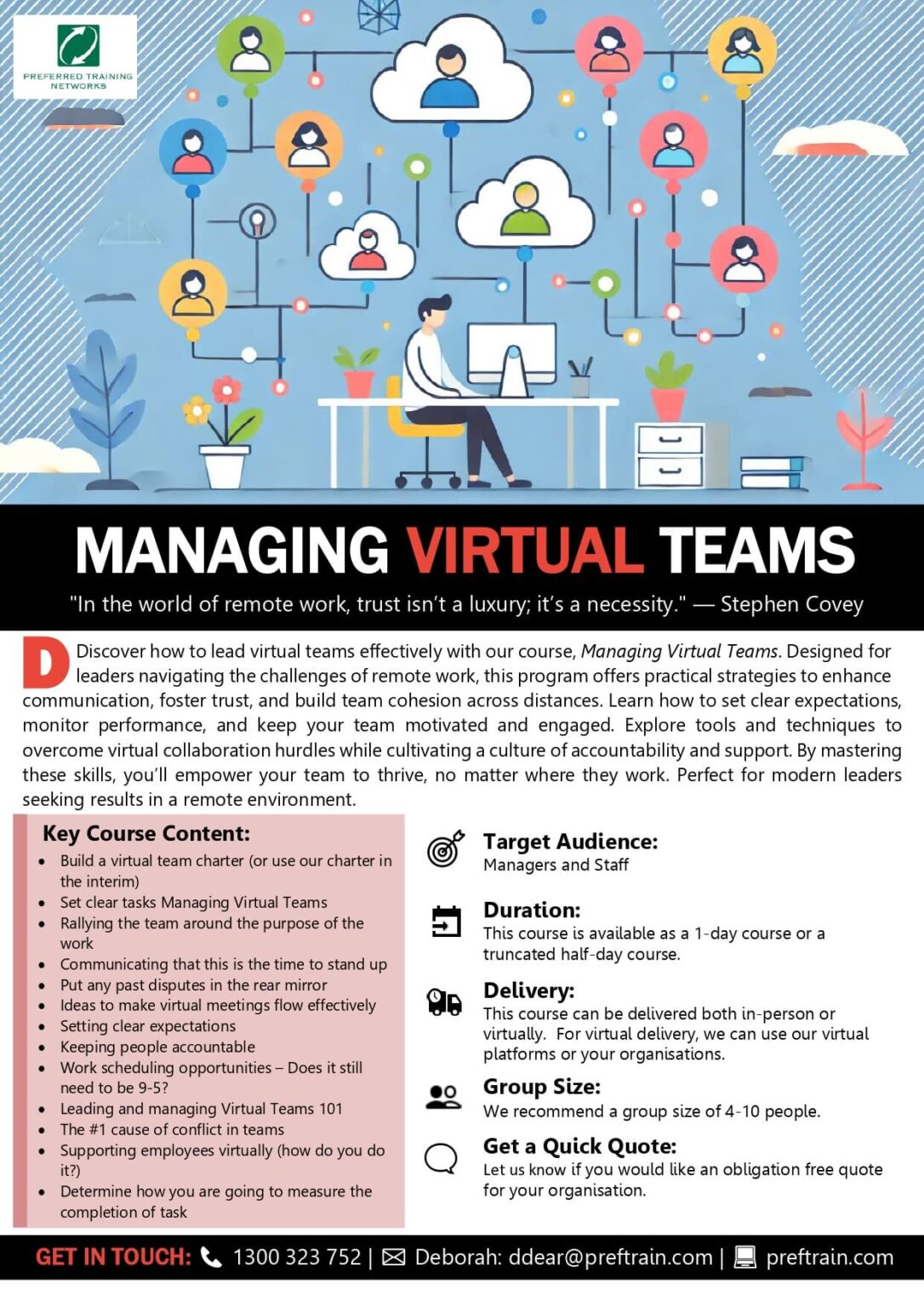
Managing virtual teams training courses became popular in the 20s. The lockdowns across the world meant overnight virtual teams. Some virtual teams excel and others implode. What’s the DNA of the ideal virtual team. Well, that’s the purpose of this workshop!
For maximum effectiveness, this program is best conducted as an in-house program.
Ideal group size: 4 – 12 participants.
Venue: This course can be delivered in-person, virtually or both (hybrid). For virtual delivery, we can use our virtual platforms or your organisations.
Duration: This program can be adapted to meet your requirements.
Cost: Price on request.
Target Audience: Supervisors, Team Leaders and Management
If you would like more information on this training program, please contact: Deborah Dear on 1300 323 752 or email: [email protected] or contact us online today.
In this managing upwards in-house training course, participants will learn that a one size fits all style will not work. Managing upwards needs flexibility, creativeness and an understanding of human psychology.
How good are you at delegating?
Ask yourself the following:
Your Managing Upwards program can be custom designed. The program provides participants with the practical techniques and tools to be better at managing upwards, thereby reorganising the workflow.
For maximum effectiveness, this program is best conducted as an in-house program.
Ideal group size: 4–12 participants.
Venue: For your convenience, you can choose to conduct this program at your business premises. Alternatively, we can provide a training venue at a small additional cost.
Duration: This program can be adapted to meet your requirements.
Cost: Price on request.
Target Audience: Employees, Supervisors, Team Leaders and Senior Managers.
If you would like more information on this training program, please contact: Deborah Dear on 1300 323 752 or email: [email protected] or contact us online today.
Negotiating win-win outcomes is proven to increase morale and productivity. Your people will learn universal negotiating skills and become more confident in their day-to-day negotiations.
If you’re a CEO, in sales or a manager/supervisor, the ability to negotiate is a vital skill. For some people, negotiating comes naturally. For others, however, it can be an uncomfortable process. Training those involved on the periphery of negotiations can also deliver significant value and cost savings.
It is vital to enable people to have more control of the negotiation process. It is important to understand that by developing effective negotiation skills and effective influencing skills, you will deliver better outcomes for your organisation.
If your team has not received professional negotiation skills training, then your team is going to struggle. Think of all the unnecessary concessions they will give away, and the cost comes straight off the bottom line. In today’s competitive world, it’s lunacy not to train your people to negotiate better outcomes.
How good are your negotiation skills?
Ask yourself the following:
Your Negotiation Skills program is a one-day program custom designed to help participants be better prepared to apply negotiation strategies in order to achieve desired outcomes.
This training program examines simple strategies that will enable your people to have more control of the negotiation process. This challenging training program uses short presentations, role-plays and team activities to provide participants with the confidence to negotiate better.
For maximum effectiveness, this program is best conducted as an in-house program.
Ideal group size: 4 – 12 participants.
Venue: For your convenience, you can choose to conduct this program at your business premises. Alternatively, we can provide a training venue at a small additional cost.
Duration: Your Negotiation Skills course can be modified to fit inside your timeframe.
Cost: Price on request.
Target Audience: Employees, Supervisors, Team Leaders, Senior Managers or CEO’s.
If you would like more information on this training program, please contact: Deborah Dear on 1300 323 752 or email: [email protected] or contact us online today.