A Trusted Learning and Development Advisor
Looking at the Australian economy, a major challenge will be to keep key people. A major opportunity will be to lure key, brilliant employees from your competitors. If you are keen on improving your retention strategy and wondering how to retain talented people, this course is ideal for you.
For maximum effectiveness, this program is best conducted as an in-house program.
Ideal group size: 4–12 participants.
Venue: For your convenience, you can choose to conduct this program
Duration: This program can be adapted to meet your requirements.
Cost: Price on request.
Target Audience: Employees, Supervisors, Team Leaders, Senior Managers or CEOs.
If you would like more information on this training program, please contact: Deborah Dear on 1300 323 752 or email: [email protected] or contact us online today.
Appreciative Enquiry is a proven methodology. It deeply explores the impact of your organisational culture. Your organisation is likely doing so many things correctly, so why focus on the negatives. Mixing and sounding your concepts and positive thoughts with an Appreciative Enquiry facilitator is powerful. Your management team will unearth so many opportunities for your organisation. You will have a retention strategy. You will have a solid understanding of a framework to fence in your key employees. You will also know the motivations and thinking styles of your current key employees, and you will reap the benefits of being proactive.
How does it work and how long does it take?
Initially, it is a short workshop with a facilitator with a proven track record facilitating sessions with managers in your Industry. Your initial time investment for your management team is a facilitated 60 -90 minute session.
What outcomes could come out of an Appreciative Enquiry retaining key staff session?
We’ll send you a report highlighting how your organisation can retain your key employees. The report will also highlight the struggles that you’ll face. The report will also give the telltale signs to look for when your employees are about to leave. A report will be sent 1 week after the workshop.
Here are some findings that have arisen from Appreciative Enquiry sessions regarding the retention of key personnel…
“Our high achievers lose interest. They do a very good job but we do not stretch them enough”
“We thought Gen Y high performers were transient and we did not realise we could keep them if we had individual career plans”
“We know how to keep key staff and we are now aware of telltale signs when they begin to think about leaving”
“We place too much focus on capturing external key players and we don’t pay enough attention to our internal talent that never lets us down”
“We get used to internal high achiever metrics and we forget to acknowledge the superb work they do”
If you would like more information on this training program, please contact: Preferred Training Networks 1300 323 752 Email: [email protected]
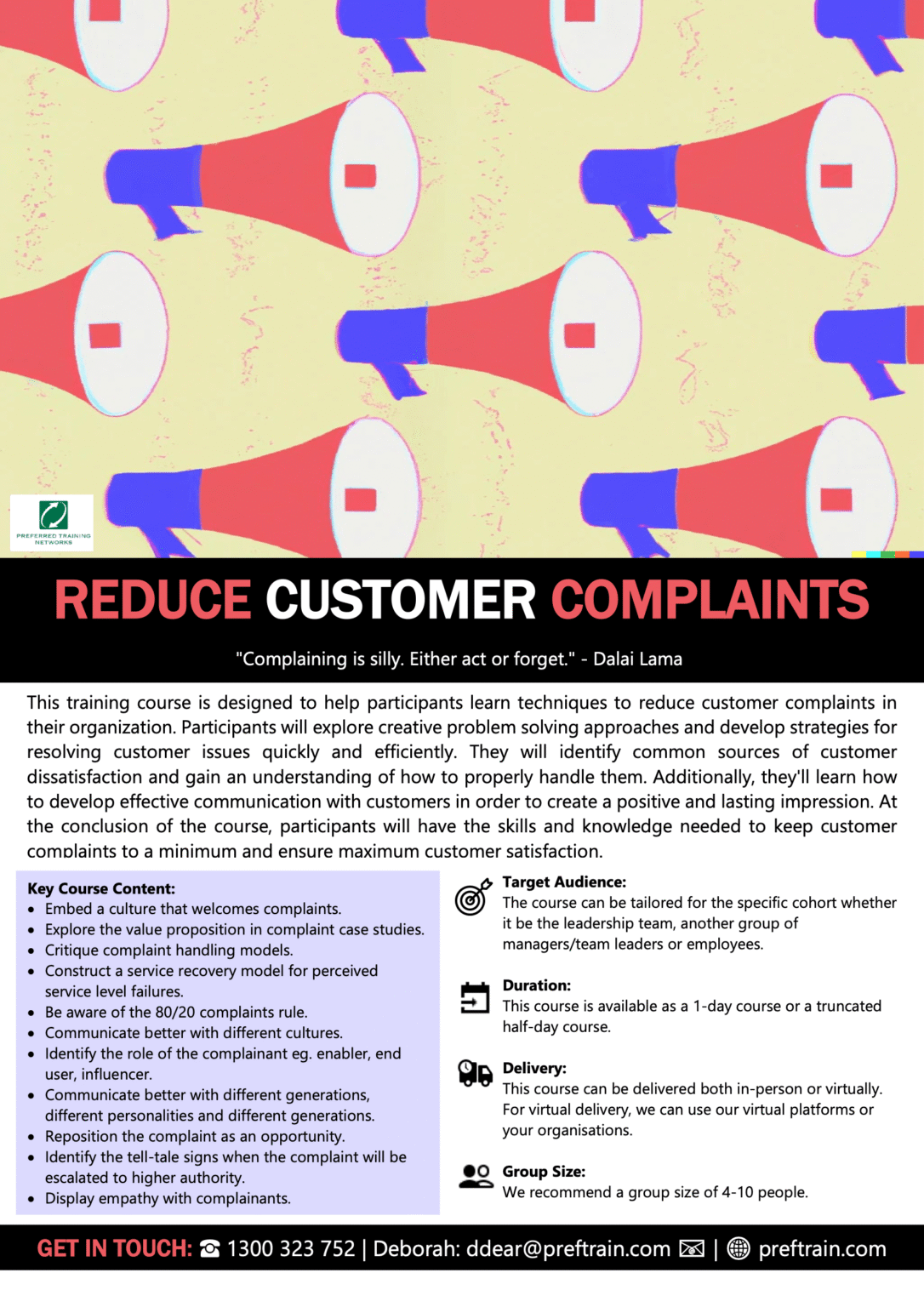
Here are 7 reasons to welcome complaints as an opportunity rather than an annoyance:
For maximum effectiveness, this program is best conducted as an in-house program.
Ideal group size: 4–12 participants.
Venue: For your convenience, you can choose to conduct this program at your business premises. Alternatively, we can provide a training venue at a small additional cost.
Duration: This program can be adapted to meet your requirements.
Cost: Price on request.
Target Audience: Employees, Supervisors, Team Leaders, Senior Managers or CEO’s.
If you would like more information on this training program, please contact: Deborah Dear on 1300 323 752 or email: [email protected] or contact us online today.
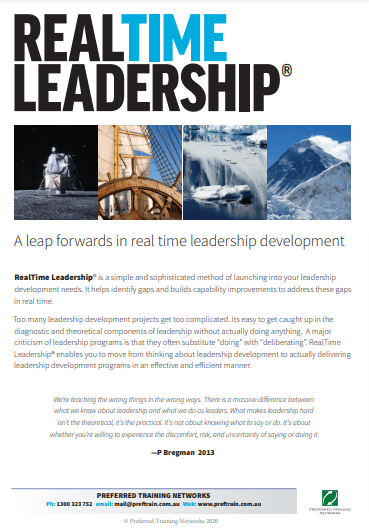
Too many leadership development projects get too complicated. It’s easy to get caught up in the diagnostic and theoretical components of leadership without actually doing anything. A major criticism of leadership programs is that they often substitute “doing” with “deliberating”. RealTime Leadership® enables you to move from thinking about leadership development to actually delivering leadership development programs in an effective and efficient manner.
Are you an authentic leader?
We’re teaching the wrong things in the wrong ways. There is a massive difference between what we know about leadership and what we do as leaders. What makes leadership hard isn’t the theoretical, it’s the practical. It’s not about knowing what to say or do. It’s about whether you’re willing to experience the discomfort, risk, and uncertainty of saying or doing it.
—P Bregman 2013
LEADERSHIP CLUSTERS
To get an idea of what clusters are available to you, the examples below are categorised by number of employees. The clusters can alternatively be sorted by
Contact your consultant to discuss the ideal cluster categories for your organisation.
STEP 1 — LEADERSHIP NEEDS IDENTIFIED
(Plus beginning the leadership training)
A facilitated session with your leadership group to prioritise leadership gaps and identify your leadership capabilities.
This session is conducted by a highly qualified facilitator, and will quickly focus your leadership group on identifying and prioritising your leadership gaps.
The facilitated session is immediately followed by leadership training of the group’s identified highest priority. This means that you’ve actually started the leadership skills delivery piece.
TENSILE STRENGTH OF THE COURSE
The capability and content can be tightened or loosened depending on the combined strengths of the leadership group. There will be some areas of leadership where you just need a refresher and then there will be other areas that will need to be explored in depth. The leadership development is very similar to an acrobat’s performance. It looks easy. But as every great acrobat will tell you, it takes years and years of refinement to achieve a perfect 10.
STEP 1 (A) — LEADERSHIP GAPS REPORTED BACK
(Cluster of targeted leadership programs recommended)
The identified leadership gaps are reported back to the group together with a suggested cluster of targeted leadership programs. Your leadership programs can be delivered in module, half day and full day formats. This flexibility means that the RealTime Leadership® program can be delivered with minimal operational disruption and maximum impact. The report will outline the recommended program content that will address your leadership gaps. Preferred Training Networks will tailor the content to ensure that it has the right mixture of theory and practical. The practical components will be aligned to your organisation, industry and context.
Your leadership programs can be delivered in module, half day and full day formats.
STEP 2 — CLUSTER DELIVERY
RealTime Leadership® is delivered as a cluster to the leadership group. On the previous pages, you’ll see some examples of training clusters.
REALTIME LEADERSHIP® CORE CAPABILITIES
WHERE TO FROM HERE:
If you would like to move your leadership development from “deliberating” to “doing” then this course is perfect. If you’d like to initiate (obligation free) RealTime Leadership® discussions then contact us to arrange a consultation and assessment of your RealTime Leadership ® readiness.
Ph: 1300 323 752 Email: [email protected]
Public speaking is an essential skill for success in many professional and social settings. This course will teach you the fundamentals of successful public speaking, including how to write and deliver a speech, handle difficult questions and situations, and analyse your audience’s reactions. You will gain hands-on experience by creating, practicing, and delivering your own speeches using various types of media. You will also learn about important topics such as body language and vocal delivery. By the end of the course, you will have the confidence to communicate your ideas and engage with any group of people.
For maximum effectiveness, this program is best conducted as an in-house program.
Ideal group size: 4 – 10 participants.
Venue: For your convenience, you can choose to conduct this program at your business premises. Alternatively, we can provide a training venue at a small additional cost. For virtual delivery, we can use our virtual platforms or your organisation’s.
Duration: This course is available as a 1-day course or a truncated half-day course.
Cost: Price on request.
Target Audience: Employees, Supervisors, Team Leaders, Senior Managers or CEO’s.
If you would like more information on this training program, please contact: Deborah Dear on 1300 323 752 or email: [email protected] or contact us online today.
A process is no more than a series of steps and decisions involved in the way a task is accomplished. “Process improvement” means making things better, not just fighting fires or managing crises. It means setting aside the customary practice of blaming others for work that hasn’t been done and identifying how work can be done more efficiently. It is a way of looking at how the workplace can complete tasks smarter.
When we engage in true process improvement, we seek to learn what causes things to happen in a process and to use this knowledge to remove activities that contribute no value to the service produced. A standardised process improvement methodology allows us to look at how we perform work. When all the team members are involved in process improvement, they can collectively focus on eliminating waste of money, people, materials, time and opportunities. The ideal outcome of process improvement training is to learn techniques to make sure that jobs can be done cheaper, quicker, easier and safer.
For maximum effectiveness, this program is best conducted as an in-house program.
If you would like more information on this training program, please contact: Deborah Dear on 1300 323 752 or email: [email protected] or contact us online today.
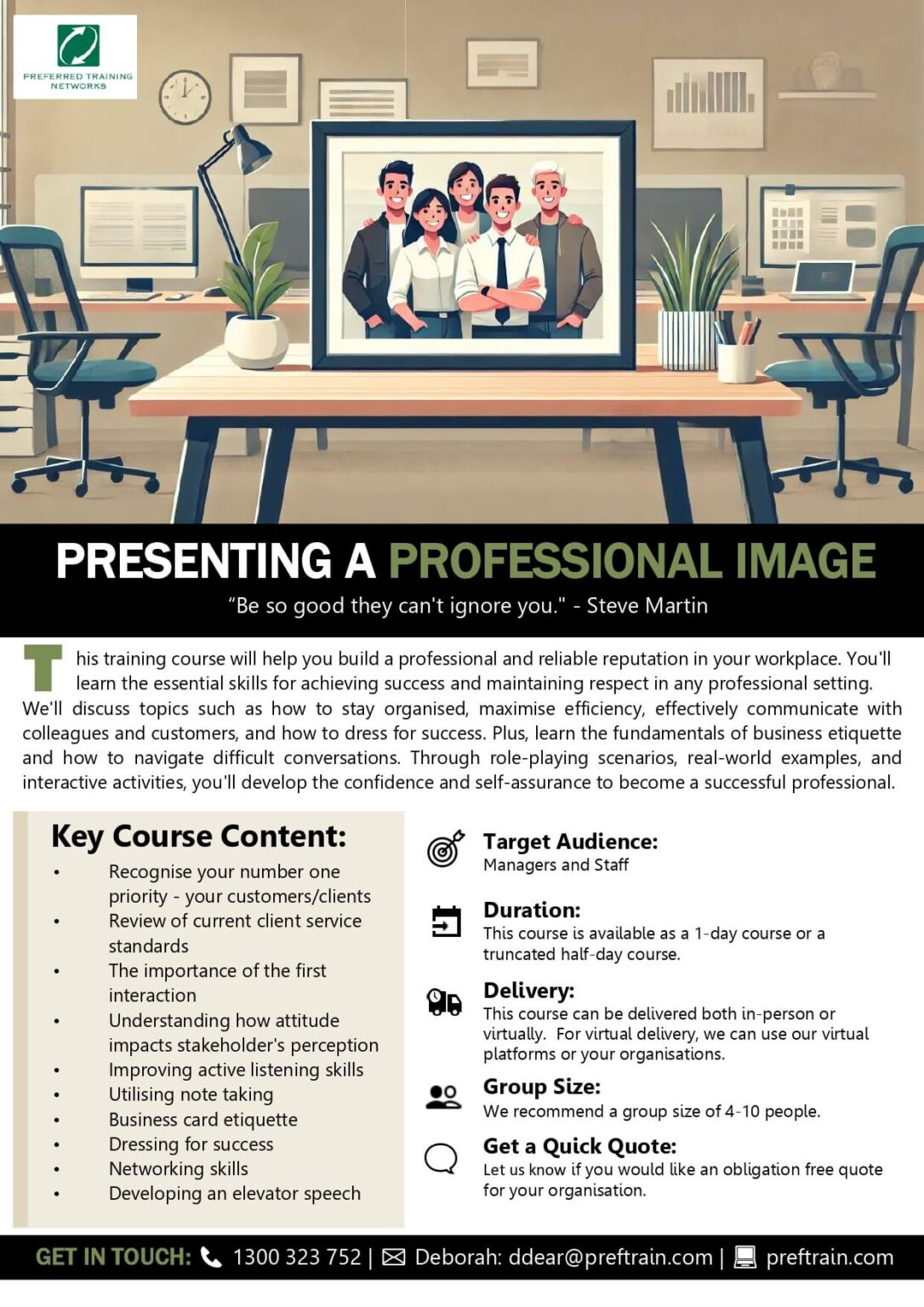
Have a look around your workplace. If you don’t see a well presented group of people then neither do your customers or clients.
Program outline
Would you like to attend this program?
For maximum effectiveness, this program is best conducted as an in-house program.
Ideal group size: 4 – 12 participants (usually a half-day or full-day program)
Venue: For your convenience, you can choose to conduct this program at your business premises. Alternatively, we can provide a training venue at a small additional cost.
Duration: Your Presenting a Professional Image Course can be modified to fit inside your timeframe.
Cost: Price on request.
Target Audience: Employees, Supervisors, Team Leaders, Senior Managers or CEOs
If you would like more information on this training program, please contact: Deborah Dear on 1300 323 752 or email: [email protected] or contact us online today.
At Preferred Training Networks, we can also assist you with professional training programs like: strategic thinking courses, people management courses, and high performance work practices.
Would you like to attend this program?
For maximum effectiveness, this program is best conducted as an in-house program.
Ideal group size: 4 – 12 participants.
Venue: For your convenience, you can choose to conduct this program at your business premises. Alternatively, we can provide a training venue at a small additional cost
Duration: This program can be conducted as a one day or half day program
Cost: Price on request.
Target Audience: Health Managers and Staff
If you would like more information on this training program, please contact: Preferred Training Networks on 1300 323 752
Email: Deborah at [email protected]
Action Plan
Who Should Attend
This program is aimed at human resources teams, design teams, trainers, facilitators who are inexperienced and instructional designers who are not overly experienced in putting together a Training Needs Analysis (TNA).
Training Areas and Learning Outcomes
Understand the business – job analysis before getting started
Get started
Process, needs and roles
Design the program
Design the workbook
Design PowerPoint and visuals
30 minute makeover
Benchmark and provide evidence of the quality of the design
Present your Program
“Being busy does not always mean real work. The object of all work is production or accomplishment and to either of these ends, there must be forethought, system, planning, intelligence, and honest purpose, as well as perspiration. Seeming to do is not doing. – Thomas Edison“
Would you like to attend this program?
For maximum effectiveness, this program is best conducted as an in-house program.
Ideal group size 4 – 10 participants.
Venue: For your convenience, you can choose to conduct this program at your premises. Alternatively, we can provide a training venue at a small additional cost
Duration: This program can be conducted as a one day or half day program
Cost: Price on request.
If you would like more information on this training program, please contact: Preferred Training Networks on 1300 323 752 Email: [email protected]