A Trusted Learning and Development Advisor

All Leadership and Management Courses

Generic selectors
Exact matches only
Search in title
Search in content
Post Type Selectors
Categories

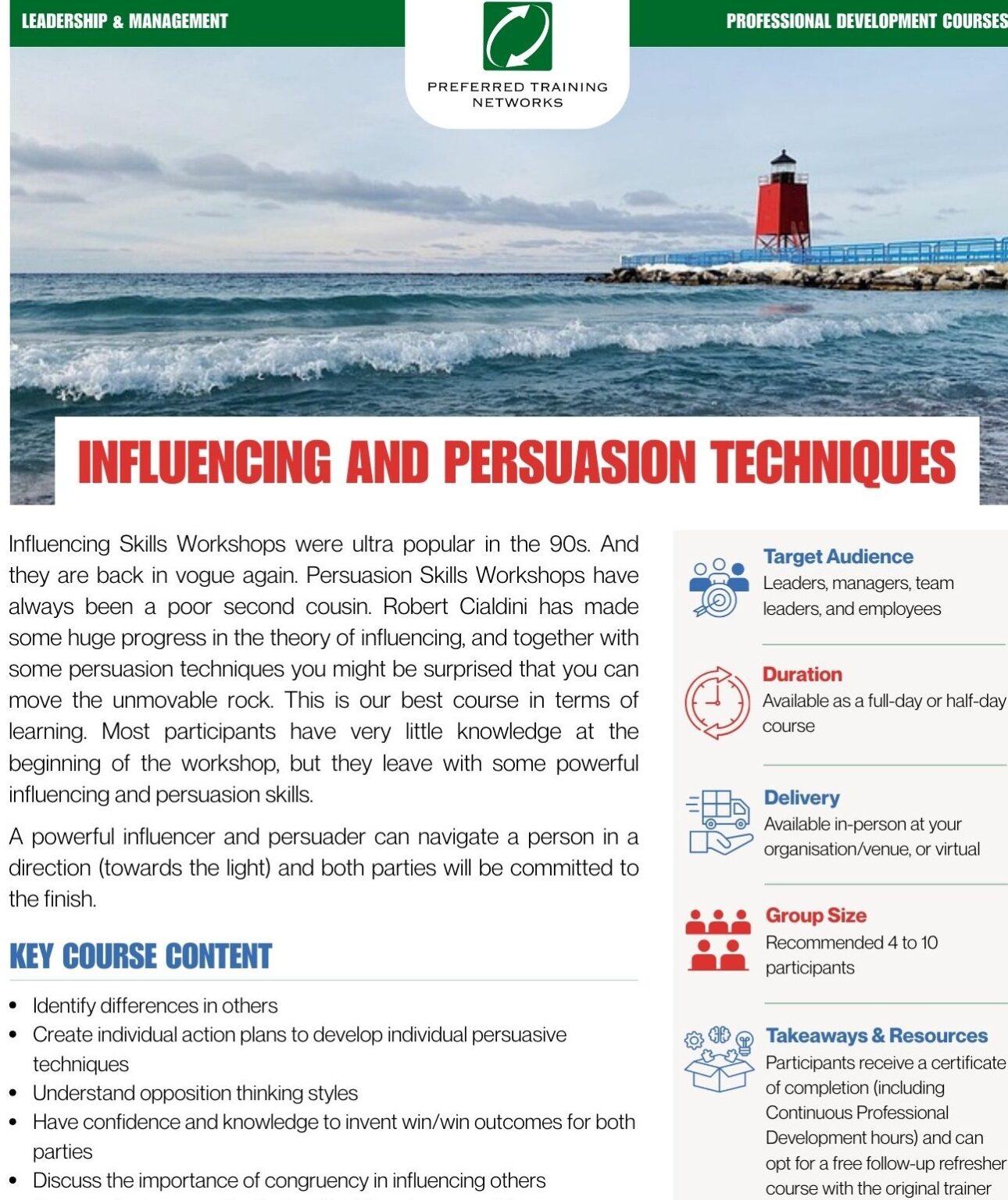
The influencing skills workshop content is engaging. The course focusses on both internal and external customers too. When you don’t have hierarchical or statutory power, then you really need influencing skills and persuasion techniques.

Questions you might be asking yourself:

How do I influence my manager? How can I persuade customers? How do I influence my peers in the workplace?

  1. Understanding the difference between influencing and manipulating
  2. Establishing positive attitude and commitment from your colleagues and employees
  3. Profiling your persuasion style
  4. Creating a road map to establish your influencing skills
  5. Learning the different approaches of influencing
  6. Understanding that a one size fits all approach is not effective
  7. Accepting the diversity in personalities
  8. Learning to actively solve problems and interpret information
  9. Strategies to improve decision-making and influencing in crisis situations
  10. Be mindful of myopic influencing styles and do not get lost in detail
  11. Identify the person of power quickly in any meeting
  12. What works and what doesn’t
  13. Acknowledging your strengths
  14. Opposition thinking styles
  15. Preparing for the unexpected
  16. Tell-tale signs of an experienced persuader
  17. Dealing with dirty tricks and gambits

Influencing Skills In-House Program Details

For maximum effectiveness, this program is best conducted as an in-house program.

  • Ideal group size: 4–12 participants.
  • Venue: For your convenience, you can choose to conduct this program.
  • Duration: This program can be adapted to meet your requirements.
  • Cost: Price on request.
  • Target Audience: Employees, Supervisors, Team Leaders & Senior Managers

If you would like more information on this training program, please contact: Deborah Dear on 1300 323 752 or email: [email protected] or contact us online today.
Influencing Skills Training Workshop and Persuasion Techniques 3.8 out of 5 based on 34 user ratings.

Benefits of Tailored Project Management Training Courses

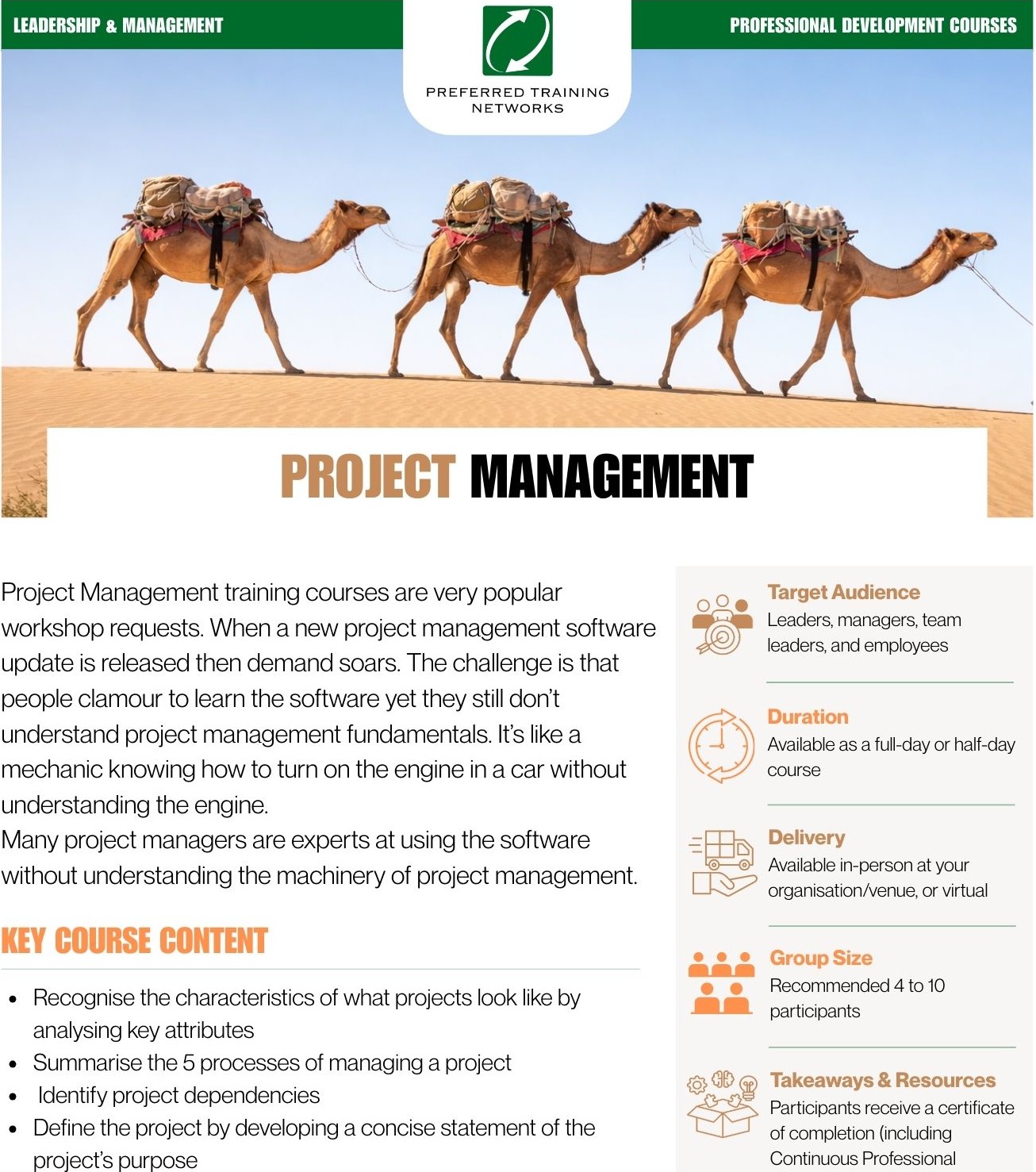
Learn effective project management training skills with this new project management course. Project management skills such as developing new project strategies and a better project focus will bring about the results your organisation is looking for by equipping the people in your organisation with the tools to complete projects efficiently and effectively.

Help your team discover essential project management skills. These courses are custom designed to enable anybody responsible for projects to complete almost any task or project on time, on budget and within the project specifications. The program also enhances leadership and problem solving skills that are critical for managing complex projects and navigating team challenges.

Project Management Training In-House Program Details

For maximum effectiveness, this program is best conducted as an in-house program.

Venue: For your convenience, you can choose to conduct this program at your workplace. Alternatively, we can provide a training venue at a small additional cost.

Options: This can be tailored to fit your timeframe.

Target Audience: Project Teams

Cost: Price on request.

If you would like more information on this training program, please contact Preferred Training Networks on 1300 323 752

Email: Deborah at [email protected]

Complementary and aligned courses and programs include: 

  • Management Skills Workshop
  • Facilitation Courses
  • Supervisor Training Courses
  • Account Management Training
  • Staff Development and Training

Frequently Asked Questions

Q: What does your Project Management Training cover?

A: We cover essential skills such as project scoping, scheduling, risk management, communication, and team leadership.

Q: Where is this training available?

A: We offer in-house delivery across Sydney, Melbourne, Brisbane, Perth, Adelaide, Canberra, and regional locations, as well as virtual options.

If you answered “Yes” to any of the above questions, you are a CREDIDIOT®. How’s your personal financial awareness? Credit companies make billions of dollars every year from CREDIDIOTS. Not long ago, people prided themselves with how little debt they had, whereas nowadays, marketers have made it almost trendy to be severely in credit card debt (to large organisations). Personal banking behaviour is now a huge industry. Below are the 11 golden rules to reduce credit card expenditure and interest rates.

Follow these credit card rules, and you will stop wasting valuable dollars paying inflated interest payments. Do yourself and your family a favour and don’t be a CREDIDIOT®. Learn how to reduce credit card debt and make sure you attend this credit card reduction training program.

  1. The best number of credit cards to own is zero. Credit cards are too tempting, and the cash is far too available.
  2. The only other acceptable amount of credit cards is one. Refer to all other credit cards in your possession as credidiot® cards.
  3. Phone all the major credit card companies and ask for their current credit card interest rates.
  4. Ignore the enticement offers of low interest credit card rates as once the honeymoon period expires these rates are likely to rise
  5. Ask competing credit card companies if they are interested in taking on the debt from an existing card. This “Balance Transfer” is standard practice, and a competing bank will often offer you a very low balance transfer rate. The bank will transfer the debt to your card but will charge you a far lower interest rate on the transferred amount.
  6. Enquire at your bank about a term loan to pay off your credit card. You can get a term loan at a far lower interest rate. Write a promise to yourself that if you get the loan then you will cut up the credit card. Otherwise, you will have increased your credidiot® behaviour by getting more lines of credit.
  7. Pay your debts according to the highest interest rates. Identify the highest interest rate and make it a goal to rid yourself of this millstone.
  8. Call your credit card institution and tell them you want a reduced interest rate. You will be surprised how willing they will be. Credidiots are always very profitable, and credit institutions are very smart businesses.
  9. Fight back against the people that make credit seem trendy. Every time you hear the word credit, think Credidiot®.
  10. Don’t get overexcited about collecting credit points. If you really want that trip overseas, cut the credit, and you will be able to afford it at its normal price very soon. You will also enjoy the trip more as you know you haven’t been saddled with extra debt.
  11. Avoid annual charges, call your bank and tell them that you don’t pay annual credit card fees. You might be surprised how willing they might be to waive these fees for you.

How’s Your Financial Awareness In-House Program Details

For maximum effectiveness, this program is best conducted as an in-house program.

Ideal group size: 4–20 participants.

Venue: For your convenience, you can choose to conduct this program at your business premises. Alternatively, we can provide a training venue at a small additional cost.

Duration: Usually conducted as a 60 minute or 90-minute session.

Cost: Price on request.

Target Audience: All staff.

If you would like more information on this training program, please contact: Deborah Dear on 1300 323 752 or email: [email protected] or contact us online today.
Note: Credidiot® is a Registered Trademark of Niall Kennedy. All rights reserved.

To securely think and stand on your own feet, you need to be very well-read and be up-to-date with breakthroughs and contrasting concepts.

Help your people think on their toes and thirst for more knowledge.

  • How to set aside reading and thinking time.
  • How to securely stand on your own feet.
  • How to understand oppositional thinking styles.
  • Develop a self development action plan.
  • How to jumble up learning styles to keep the mind open to diverse ideas.
  • How to learn to want to learn more.
  • How to develop intellect and wisdom.
  • How to interpret information and read between the lines.
“Never tell people how to do things. Tell them what to do, and they will surprise you with their ingenuity.” – George S Patton

Thinking On Your Toes In-House Program Details

For maximum effectiveness, this program is best conducted as an in-house program.

Ideal group size: 4–12 participants.

Venue: For your convenience, you can choose to conduct this program at your business premises. Alternatively, we can provide a training venue at a small additional cost.

Duration: This program can be adapted to meet your requirements.

Cost: Price on request.

Target Audience: Supervisors, Team Leaders and Management.

If you would like more information on this training program, please contact: Deborah Dear on 1300 323 752 or email: [email protected] or contact us online today.

Boost productivity levels with this tailored in-house workshop. Designed in Australia, this practical program develops skills to streamline tasks, reduce friction and sharpen attention to KRA’s.

Taking a meta-approach, the workshop targets mindset, habits, and systems to improve how work gets completed seamlessly, without burnout. Productivity levels in Australia have nosedived. And people are unaware of the consequences if productivity levels don’t improve. Australia will fall down a slippery slope. Participants develop action plans to get your organisation back on track with productivity improvements

Ask yourself the following:

  1. We often set achievable productivity targets that do not get met.
  2. Our people are not highly motivated to achieve targets.
  3. Whenever we fail to meet a target, there is always an excuse.
  4. Our people are not proactive.
  5. We have poor performance management systems.
  6. We often accept less than optimal poor performance.
  7. Our managers are not confident at having tough performance management conversations.
  8. Our people tackle spot fires daily rather than organisational objectives.
  9. We have communication silos in the organisation.
  10. Morale is low.
  11. People think and work individually rather than as a team.
  12. There is often conflict among the employees.
  13. Role ambiguity causes boundary disputes.
  14. Our organisation has a lower than industry average employee retention rate.

Productivity Improvement Workshop In-House Program Details

For maximum effectiveness, this program is best conducted as an in-house program.

  • Ideal group size: 4–12 participants.
  • Venue: For your convenience, you can choose to conduct this program at your business premises. Alternatively, we can provide a training venue at a small additional cost.
  • Duration: This program can be adapted to meet your requirements.
  • Cost: Price on request.
  • Target Audience: Employees, Supervisors, Team Leaders, Senior Managers or CEOs.

If you would like more information on this training program, please contact: Deborah Dear on 1300 323 752 or email: [email protected] or contact us online today.

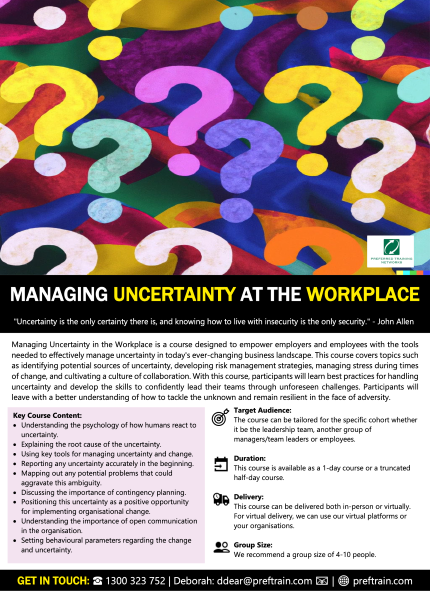
How good are you at avoiding uncertainty?

Ask yourself the following questions:

  1. We communicate often with the employees to keep them informed of how the change is being implemented.
  2. We have a communication plan of more than 2 pages.
  3. We always explain the effect of change to our team.
  4. Our people can read the signals of any uncertainty.
  5. Our people have a proven platform to work calmly during any uncertainty.
  6. We have a culture that acknowledges intuition and interpretation.
  7. Our people know the importance of risk management.
  8. Our people set contingency plans.
  9. Our people think on their feet.
  10. Our people know how to effectively manage anxiety, body language and stress during any uncertainty.
  11. We set clear short and long-term goals which can be easily achieved.
  12. We take time to understand the people who strongly resist uncertainty and help them become more positive about it.

Would you like to attend this program? For maximum effectiveness, this program is best conducted as an in-house program.

  • Ideal group size: 4 – 12 participants.
  • Venue: For your convenience, you can choose to conduct this program at your business premises. Alternatively, we can provide a training venue at a small additional cost.
  • Duration: This program can be adapted to meet your requirements.
  • Cost: Price on request.

If you would like more information on this training program, please contact: Deborah Dear on 1300 323 752 or email: [email protected] or contact us online today.

This in-house program is designed to assist participants to effectively deal with people facing difficult situations. Through an experiential learning process participants will be guided through a journey of understanding as well as specific skill development in the areas of reflective listening, rapport building, developing self awareness, assertiveness and delighting in diversity. Participants will leave with a greater understanding of how their performance and behaviour can make a huge difference to people in tough situations.

‘Dealing with Emotional People’ Workshop Action Plan

  1. Communicate with style.
  2. Display empathy with the person.
  3. Deflect and/or redirect anger and stay positive.
  4. Practice transactional analysis techniques.
  5. Keep the conversation focussed and reposition suggestions to hit the mark.
  6. Use interruption techniques to reduce venting.
  7. Practice active listening and questioning skills.
  8. Practice voice control and tonality techniques.
  9. Search for easy concessions that are of high value to other parties.
  10. Set behavioural boundaries.
  11. Understand the different roles the person is assuming.

‘Dealing with Emotional People’ In-House Program Details

  • For maximum effectiveness, this program is best conducted as an in-house program.
  • Ideal group size: 4–12 participants.
  • Venue: For your convenience, you can choose to conduct this program at your business premises. Alternatively, we can provide a training venue at a small additional cost.
  • Duration: This program can be adapted to meet your requirements.
  • Cost: Price on request.
  • Target Audience: Employees, Supervisors and Managers.

If you would like more information on this training program, please contact: Deborah Dear on 1300 323 752 or email: [email protected] or contact us online today.
Dealing with Emotional People Course 4.4 out of 5 based on 43 user ratings.

A major challenge for Australian organisations will be to keep critical personnel. A major opportunity will be to lure key employees from your competitors. The last 2 recessions lasted 8 months each. Don’t let your organisation make the mistake of losing your key people and then find yourself in an abyss next year without them.

Are you keeping your people in the picture?

  1. Our people are aware of how our organisation intends to deal with current uncertainties.
  2. Our people feel they have an open platform to ask questions.
  3. Our managers spend time reassuring our employees.
  4. Our critical people have been identified and fenced off to thwart off any external luring attempts.
  5. Our management team uses active listening and questioning skills.
  6. Our people are aware of what is expected of them.
  7. Our people are aware that change in an inevitable part of business.
  8. Our people are motivated to cut costs and save money.
  9. Our people will give discretionary effort when needed.
  10. Our people know the importance of process improvement during economic uncertainty.
  11. Our people know the organisation values.
  12. Our management team knows what motivates each employee.
  13. Everybody has been primed to look for opportunities.
  14. Our culture embraces creative solutions to existing problems.
  15. Our people remain focused.
  16. Our people are empowered and have a ‘can do’ attitude.
  17. Our management team ‘walks the talks’.
  18. Our people are aware of their role boundaries, thus removing role ambiguity.

Keeping Your People In The Picture In-House Program Details

For maximum effectiveness, this program is best conducted as an in-house program.

  • Ideal group size: 4–12 participants.
  • Venue: For your convenience, you can choose to conduct this program
  • Duration: This program can be adapted to meet your requirements.
  • Cost: Price on request.
  • Target Audience: Team Leaders, Middle Managers, Senior Managers or CEOs.

If you would like more information on this training program, please contact: Deborah Dear –  1300 323 752 Email:[email protected] or visit our website today.

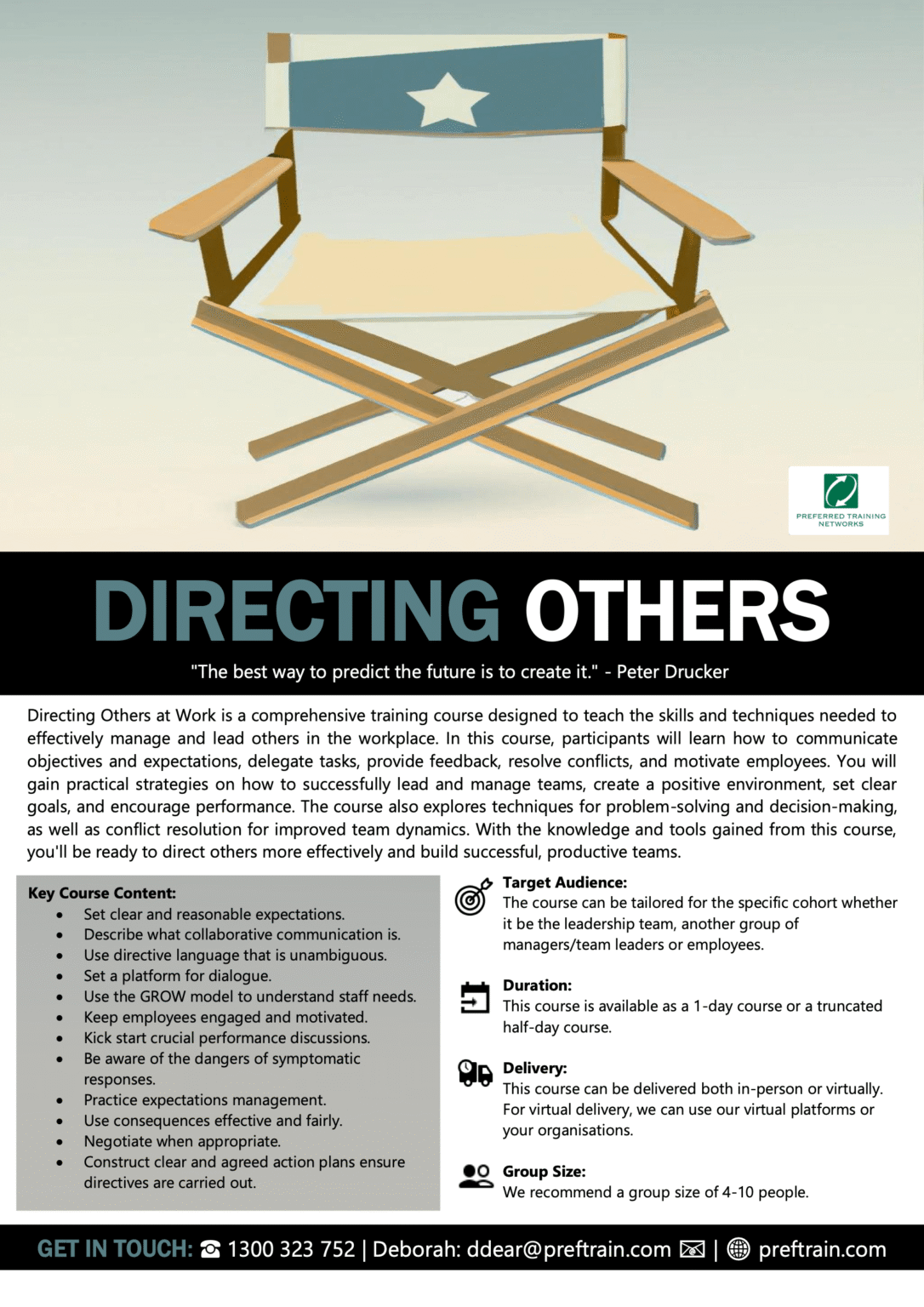
Workshop Action Plan to Direct Employees

Managers and leaders balance the need to be directive and supportive. It is also important to be caring and compassionate; however, there are situations which do require a directive style.

  • How to be more directive in the workplace.
  • How to use different situational communicative styles.
  • How to identify your unique directive style.
  • How to maintain open communication in the workplace.
  • How to create rapport.
  • How to anticipate opposition thinking styles.
  • How to reduce information leaks and rumours.
  • How to set expectations and keep people informed.
  • How to manage people who don’t want to be directed.
“A leader takes people where they want to go. A great leader takes people where they don’t necessarily want to go, but ought to be.” – Rosalyn Carter 

‘Directing Employees’ In-House Program Details

For maximum effectiveness, this program is best conducted as an in-house program.

Ideal group size: 4–12 participants.

Venue: For your convenience, you can choose to conduct this program at your business premises. Alternatively, we can provide a training venue at a small additional cost.

Duration: This program can be adapted to meet your requirements.

Cost: Price on request.

Target Audience: Supervisors, Team Leaders and Management.

If you would like more information on this training program, please contact: Deborah Dear on 1300 323 752 or email: [email protected] or contact us online today.

‘How to make better decisions’ workshops

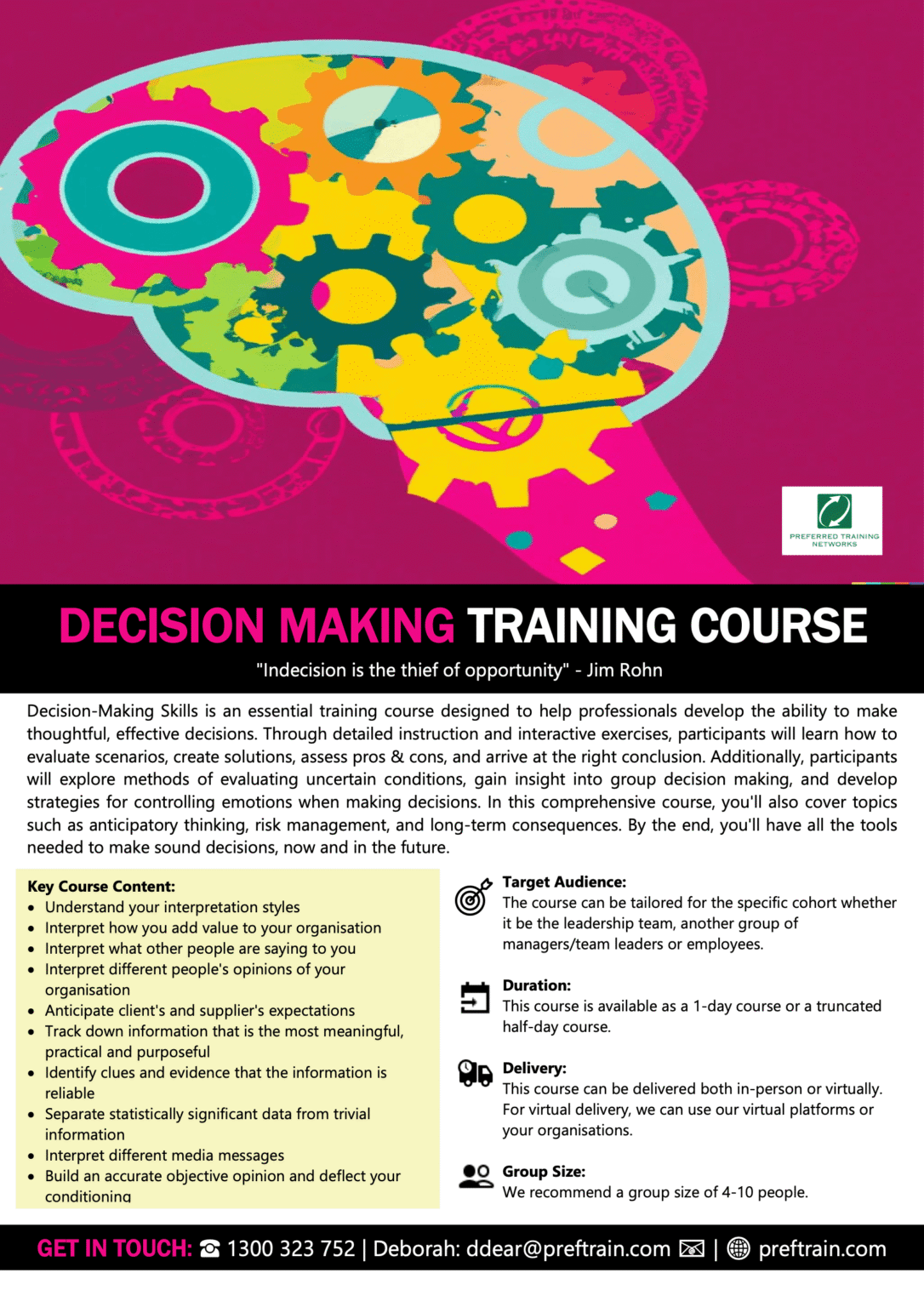
“If it quacks and waddles, it’s a duck” is traditional thinking. Your people need to challenge traditional thinking styles and consider that maybe it’s a chicken disguised as a duck because it’s tired of chickens been branded as poor crossers of the road. Help your people question everything and your organisation will benefit from better decision-making training and your people will become experts at unearthing critical information.

How good are your interpretation skills?

Ask yourself the following:

  1. I can understand my preferred communication style.
  2. I can tailor my communication style to suit my clients, colleagues and manager’s communication style.
  3. At work, we have eliminated role ambiguity.
  4. Our organisation’s goals are easily understood.
  5. Everyone can link our organisation’s mission and vision to the overall strategy.
  6. I can interpret the basics of a profit and loss account and a balance sheet.
  7. I have developed my listening and questioning skills.
  8. I have developed my intuitive skills.
  9. I read information objectively.
  10. I have received professional training in problem-solving and decision-making.
  11. I can identify and label different personality types.
  12. I have a checklist that I use when sourcing information from the internet.
  13. I feel comfortable asking for clarification when I don’t understand instructions from a peer.
  14. I am aware of the psychology of influence.
  15. I set aside thinking time.
  16. I sleep well at nighttime and I can choose my inner voice to be quiet whenever I want.
  17. I value input from other people that may be contrary to what I believe.

Decision-Making In-House Program Details

For maximum effectiveness, this program is best conducted as an in-house program.

  • Ideal group size: 4–12 participants.
  • Venue: For your convenience, you can choose to conduct this program.
  • Duration: This program can be adapted to meet your requirements.
  • Cost: Price on request.
  • Target Audience: Employees, Supervisors, Team Leaders, Senior Managers or CEOs.

If you would like more information on this training program, please contact: Deborah Dear on 1300 323 752 or email: [email protected] or contact us online today.

Decision-Making Training Course 4.3 out of 5 based on 36 user ratings.
Generic selectors
Exact matches only
Search in title
Search in content
Post Type Selectors

Get Lightning Flash Quote Within 30 mins!