A Trusted Learning and Development Advisor
This fundamental ‘Designing a Training Manual’ workshop will provide you with a proven step-by-step process to design such a workbook in one day.
If you would like more information on this training program, please contact: Deborah Dear on 1300 323 752 or email: [email protected] or contact us online today.
This program focuses on developing strategies to promote workplace patience and tolerance and understand the hidden costs associated when this does not occur.
For maximum effectiveness, this program is best conducted as an in-house program.
Ideal group size: 4–12 participants.
Venue: For your convenience, you can choose to conduct this program at your business premises. Alternatively, we can provide a training venue at a small additional cost.
Duration: This program can be adapted to meet your requirements.
Cost: Price on request.
Target Audience: Supervisors, Team Leaders and Management.
If you would like more information on this training program, please contact: Deborah Dear on 1300 323 752 or email: [email protected] or contact us online today.
Managers and Leaders are responsible for driving productivity. Sometimes Managers or Leaders are held back by a fear of accusations of bullying. Do your people know how to proceed without the anxiety? Do they know how to proceed with courageous conversations without being accused of bullying? Do they know how to avoid or manage a bullying accusation?
For maximum effectiveness, this program is best conducted as an in-house program.
Ideal group size: 4–9 participants.
Venue: For your convenience, you can choose to conduct this program at your business premises. Alternatively, we can provide a training venue at a small additional cost.
Duration: Your Performance Management And Bullying Awareness Course can be modified to fit inside your timeframe.
Cost: Price on request.
Target Audience: Employees, Supervisors, Team Leaders, Senior Managers or CEO’s.
If you would like more information on this training program, please contact: Deborah Dear on 1300 323 752 or email: [email protected] or contact us online today.
Who Should Attend
This program is aimed at human resources teams, design teams, trainers, facilitators who are inexperienced and instructional designers who are not overly experienced in putting together a Training Needs Analysis (TNA).
Understand the business – job analysis before getting started
Get started
Process, needs and roles
Design the program
Design the workbook
Design PowerPoint and visuals
30 minute makeover
Benchmark and provide evidence of the quality of the design
Present your program
If you would like more information on this training program, please contact: Deborah Dear on 1300 323 752 or email: [email protected] or contact us online today.
It is critical for organisations to seize opportunities to provide better products and services for your customers and clients. In business, it’s a competitive advantage. In the public sector, customer service performance indicators are constantly monitored for funding and resourcing decisions. The challenge is that it’s much easier to ridicule ideas rather than to take risks exploring opportunities. At a discussion table, it is much easier to find reasons why a concept won’t succeed. Consequently, resisting change and quashing creative ideas hinders organisational opportunities. Imagine if you could unhinge negative thinking styles and transform them into plans of action. This program is guaranteed to change the way concepts are considered and will promote action rather than following the path of least resistance.
6 signs that your meetings have too much negative thinking styles and change resistors
1. At least twice as much time is spent talking about why concepts won’t work.
2. Communications silos have built up in your organisation, with many fiefdom disputes.
3. Negative speakers get more air time at meetings.
4. Often, no matter what the new concept is, the objections will be similar.
5. Doing a lot of analysis and critiquing is mistaken for doing a lot.
6. Much more time is spent accumulating “new” information rather than acting on existing information.
For maximum effectiveness, this program is best conducted as an in-house program.
Ideal group size: 4–12 participants.
Venue: For your convenience, you can choose to conduct this program at your business premises. Alternatively, we can provide a training venue at a small additional cost.
Duration: This program can be adapted to meet your requirements.
Cost: Price on request.
Target Audience: Employees, Supervisors, Team Leaders, Senior Managers or CEOs.
If you would like more information on this training program, please contact: Deborah Dear on 1300 323 752 or email: [email protected] or contact us online today.
Would you believe that a humorous manager is more productive than a manager without a good sense of humour? A humorous manager usually has staff that are more loyal and more likely to give discretionary effort to the organisation. People perform better when they are in a good mood. This course was designed to teach people a framework of how to be humorous in the workplace. The program recognises that not everybody wants to be humorous. However, it is still possible to work in an environment of humour if you have a working knowledge of how to promote humour. How humorous is your workplace?
Ask yourself the following about your workplace:
1. People usually have smiles on their faces as they complete their tasks.
2. People gather in friendly groups and there are plenty of laughs.
3. Our people don’t backstab.
4. Our organisation promotes a positive workplace.
5. Our staff often go out on social occasions together.
6. We often reward people who were particularly positive.
7. Our staff are engaged.
8. Our customers are usually in a good frame of mind.
9. Role descriptions and expectations are very clear.
10. We avoid a blame culture.
11. Positive customer feedback is paramount to our success.
12. Management are very approachable by staff.
13. The banter in the office is positive.
14. Vocabulary in the office is positive, and the outlook is rosy.
Did you know?
Workplaces that are considered positive generally score “YES” to 10 of these questions. If you scored less, you should think about learning how to improve your workplace environment. “I told you I was ill.” – Epitaph on Spike Milligan’s tombstone
For maximum effectiveness, this program is best conducted as an in-house program.
Ideal group size: 4–12 participants.
Venue: For your convenience, you can choose to conduct this program at your business premises. Alternatively, we can provide a training venue at a small additional cost.
Duration: This program can be adapted to meet your requirements.
Cost: Price on request.
Target Audience: Supervisors, Team Leaders and Management.
If you would like more information on this training program, please contact: Deborah Dear on 1300 323 752 or email: [email protected] or contact us online today.
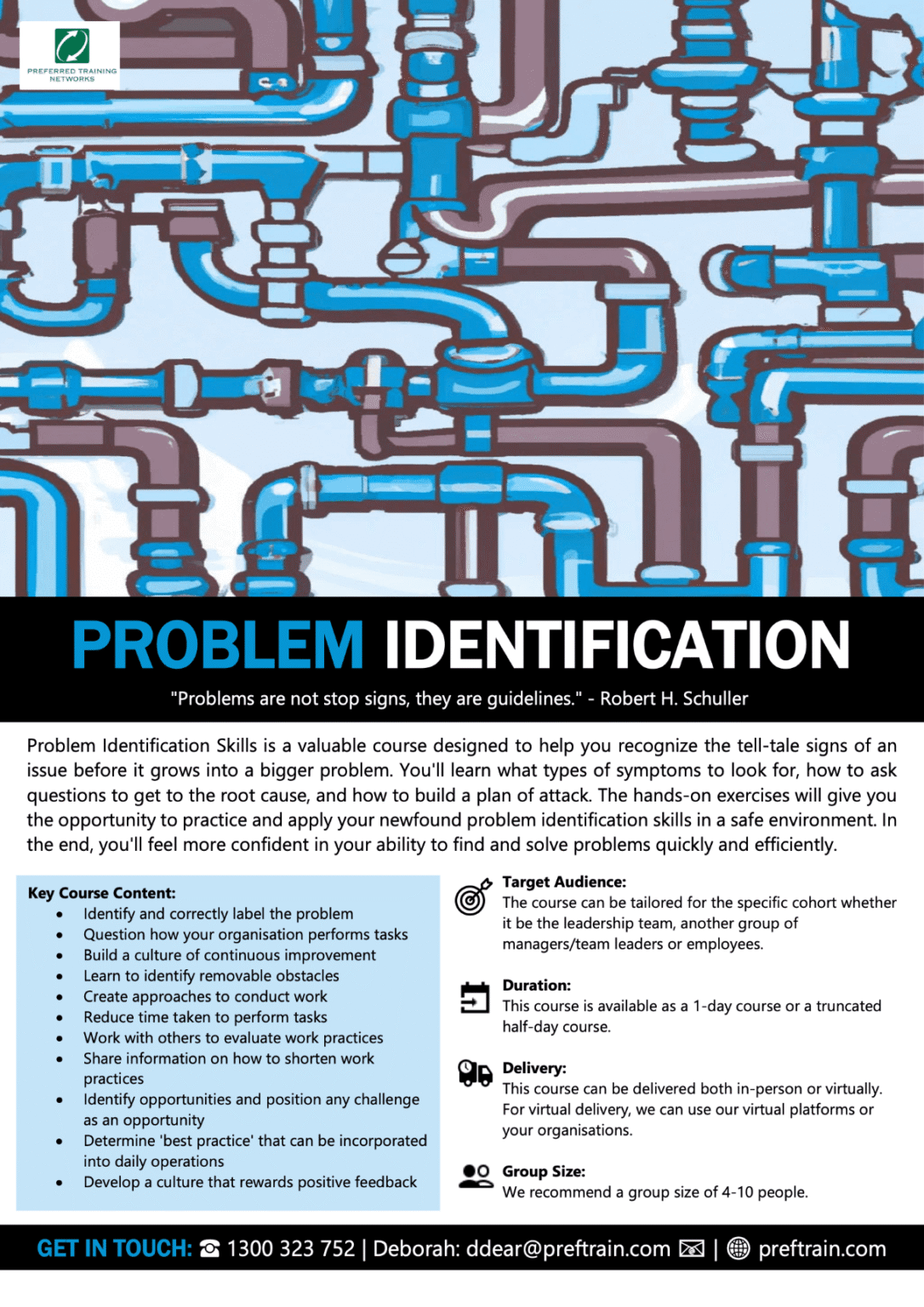
Did you know the number one cause of conflict in the workplace is role ambiguity? How many internal problems could be solved in organisations if they eliminated role ambiguity? Instead, most organisations will tackle the symptoms of role ambiguity rather than the root cause of the problem.
Think about the difference in your organisation if your people could effectively find the root cause of problems like:
Participants will be thought to think laterally. They will learn techniques to quickly get to the root cause of a problem. They will learn to identify and label problems quickly and learn world’s best practice to problem identification and solution techniques.
Real Problem-Solving exercises for you to consider at your next meeting
Slow lifts
The lifts in your organisation are slow. Everyone complains that they are losing productivity.
The lifts cannot be sped up.
What is the real problem, and how can it be solved?
Dissatisfied airline customers
An airline has the industry average delay from disembarkation to passengers picking up their baggage on the carousel. The airline receives multiple complaints, and it is impossible to speed up the process any further due to OHS restraints.
What is the real problem, and how can it be solved?
Cancelled trains
A train company in Europe is fined every time a train is late. There are so many reasons outside their control that delay trains. Passengers expect delays and the fines are crippling the company.
What is the real problem, and how can it be solved?
Poor first impressions
A high quality entertainment venue has beautiful carpets in the foyer. The carpet cost over $200,000 and needs to be replaced quarterly as it gets scuffed and looks worn. Patrons are expecting the highest quality, and it is critical that first impressions are very favourable.
What is the real problem, and how can it be solved?
These are well known short outlines. If you would like to know what actually happened, just call us today, and we will give you the outcomes.
For maximum effectiveness, this program is best conducted as an in-house program.
If you would like more information on this training program, please contact: Deborah Dear on 1300 323 752 or email: [email protected] or contact us online today.
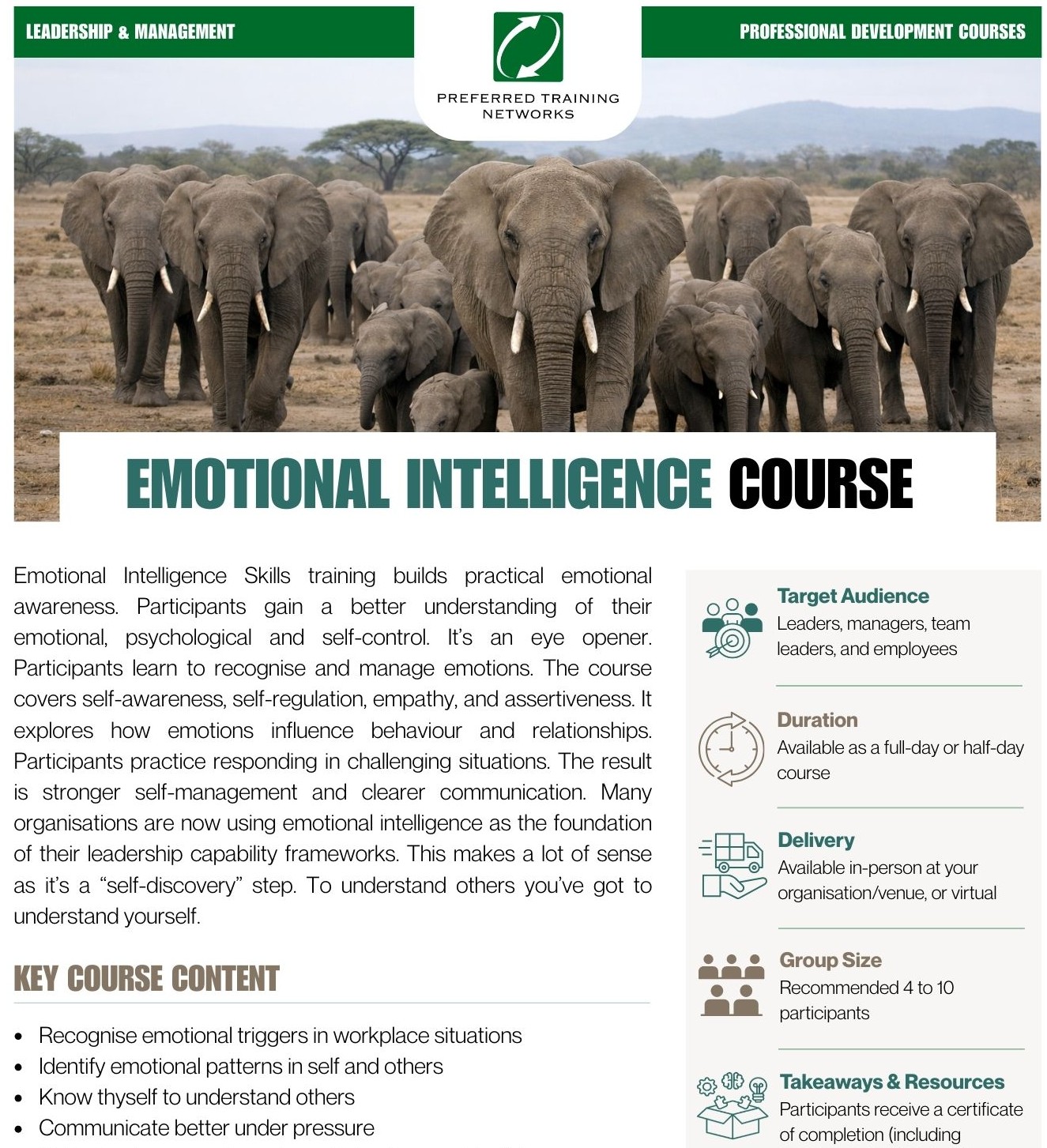
Can your EI really affect your relationship building skills? Research has shown that EI affects team building, leadership, and communication skills. Our Emotional Intelligence Training course helps individuals and teams improve self-awareness, communication, empathy and resilience in the workplace.
If you would like more information on this training program, please contact: Deborah Dear on 1300 323 752 or email: [email protected] or contact us online today.
| Module | Topics | Key Learning Outcomes |
|---|---|---|
| Module 1: Foundations of Emotional Intelligence | Emotional Intelligence (Goleman) |
|
| Key Emotional Intelligence Competencies |
|
|
| Using Emotional Intelligence in Work and Social Settings |
|
|
| Module 2: Building Self-Awareness and Emotional Management | Developing Self-Awareness |
|
| Evaluating Emotional Intelligence Skills |
|
|
| The Emotional Competency Framework |
|
|
| Module 3: Emotional Intelligence in Action | Emotions and Workplace Performance |
|
| Applying the SCARF Model |
|
|
| Module 4: Action Planning and Future Development | Developing a Personal Emotional Intelligence Growth Plan |
|
| Final Reflection and Next Steps |
|
Q: What exactly is emotional intelligence and why is it important at work?
A: Emotional intelligence (EQ) is your ability to recognise, understand and manage emotions in yourself and others. In a work setting, it helps with communication, conflict resolution, leadership, and maintaining psychological safety.
Q: Who should attend this emotional intelligence training course?
A: This course is ideal for team leaders, managers, HR professionals, project leads, and anyone who interacts regularly with others and wants to improve their influence, relationship skills, and self-management.
Q: Can emotional intelligence skills be developed or improved?
A: Yes. Emotional intelligence is not fixed — it can be developed over time using practices like self-awareness, emotional regulation, feedback, and guided training.
Q: How is this course delivered? Is there a virtual option?
A: We offer both in-house face-to-face delivery and virtual delivery. Our virtual sessions are interactive and use tools that simulate real conversations and emotional scenarios.
Q: What will I learn in this emotional intelligence training?
A: Participants will learn to:
Q: How long is the course and what group size works best?
A: The course can be run as a half-day or full-day workshop. We recommend group sizes between 6 to 12 participants to allow for interactive exercises and personalised feedback.
Q: Is emotional intelligence training beneficial for leaders specifically?
A: Absolutely. Leaders with high EQ are better at motivating teams, navigating change, handling conflict, and building trust and engagement within their teams.
Q: What makes this course different from other EQ or soft skills training?
A: Our program is highly tailored to workplace scenarios. We embed role-plays, real organisational challenges, and follow-up reinforcement tools so participants can apply EQ skills immediately on the job.
How good are you at motivating others?
Ask yourself the following:
Your Empowerment and Motivation Skills program can be custom designed to help your people to become better team and self motivators. The program provides an understanding on how people can be motivated in many different ways. Participants will learn the concept of motivation from a theoretical perspective as well as a practical perspective.
For maximum effectiveness, this program is best conducted as an in-house program.
Ideal group size: 4–12 participants.
Venue: For your convenience, you can choose to conduct this program at your business premises. Alternatively, we can provide a training venue at a small additional cost.
Duration: This program can be adapted to meet your requirements.
Cost: Price on request.
Target Audience: Employees, Supervisors, Team Leaders, Senior Managers or CEO’s.
If you would like more information on this training program, please contact: Deborah Dear on 1300 323 752 or email: [email protected] or contact us online today.
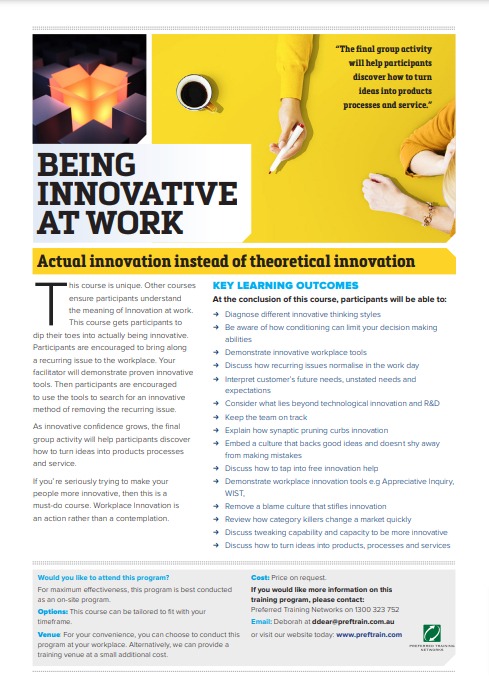
As innovative confidence grows, the final group activity will help participants discover how to turn ideas into products processes and service.
If you’re seriously trying to make your people more innovative, then this is a must-do course. Workplace Innovation is an action rather than a contemplation. The final group activity will help participants discover how to turn ideas into products, processes and service.
Questions you might be asking yourself
How can I make the workplace more innovative? How do I nurture good ideas at work? How do I implement change into the workplace?
For maximum effectiveness, this program is best conducted as an on-site program.
Options: This course can be tailored to fit with your timeframe.
Venue: For your convenience, you can choose to conduct this program at your workplace. Alternatively, we can provide a training venue at a small additional cost.
Cost: Price on request.
If you would like more information on this training program, please contact: Preferred Training Networks on 1300 323 752
Email: Deborah at [email protected]