A Trusted Learning and Development Advisor
This course will help your team embed new behaviours to run their departments more effectively. They will complete tasks more seamlessly and will also have greater clarity on what the organisation expects from them.
Symptoms of leaner departments
Boeing, Borders, Russell Kennedy, ANZ, BHP Billiton, Fosters, CASA, BNP Paribas, Dept of Transport, Esanda, CSIRO, Goldman Sachs JB Were, AIRC, Portfolio Partners, OPP, State Trustees, VGSO, Leaseplan, Mills Oakley, Legal Aid, Dept of Justice, Judicial College, Shell, Babcock & Brown, Lend Lease, Pitcher Partners, Beca
Managing Change – Some departments are 100% confident their department cannot run effectively with fewer people. This course helps your people deal with change and maintain productivity.
Staying Positive – Sagging morale levels are often related to less staff. This course helps everyone to agree that remaining positive is a more rewarding behaviour and reduces levels of anxiety.
A breath of fresh air – For every problem, there is an opportunity. Maybe this is the optimal time to re-examine existing processes and identify and remove any inefficiencies
Clarifying Roles – The number one cause of conflict in departments is role ambiguity. With less resources, this may be an ideal time to rewrite job descriptions and departmental objectives.
Breaking down communication silos – Some interdepartmental processes are seamless and others are not. With fewer resources, you need to ensure information flows transparently and get rid of any bottlenecks.
Fox maximum effectiveness, it is recommended that this course be conducted in-house.
If you would like more information on this training program, please contact us at 1300 323 752 or email: [email protected]
Have a look at your workforce. If they do not appear content, then you are losing productivity. If they are unmotivated, wave goodbye to discretionary effort and engagement. Take the test below to see how motivated your team is.
How well does your organisation motivate your team?
Ask yourself the following:
1. Our people feel valued (if you answer no to this critical question, then your organisation faces an unnecessary uphill battle to survive).
2. Our managers understand the links between motivated employees and increased productivity.
3. We tackle motivational issues individually rather than a one size fits all approach.
4. We actively remove unnecessary processes that demotivate employees.
5. We share the vision, mission and principles of the organisation.
6. Our people are empowered to make decisions.
7. We encourage open and honest feedback.
8. We set and benchmark goals and stretch people to keep them motivated.
9. Our people often give discretionary effort.
10. We actively get to the root cause of any problems instead of focusing resources on symptoms of the problem.
11. The management team is motivated, positive, passionate and energetic.
12. Our values are embedded in our culture.
13. We remove any role ambiguity.
14. We actively listen to employees.
For maximum effectiveness, this program is best conducted as an in-house program.
Ideal group size: 4–12 participants.
Venue: For your convenience, you can choose to conduct this program at your business premises. Alternatively, we can provide a training venue at a small additional cost.
Duration: This program can be adapted to meet your requirements.
Cost: Price on request.
Target Audience: Employees, Supervisors, Team Leaders, Senior Managers or CEOs.
If you would like more information on this training program, please contact: Deborah Dear on 1300 323 752 or email: [email protected] or contact us online today.
Improving your reading skills
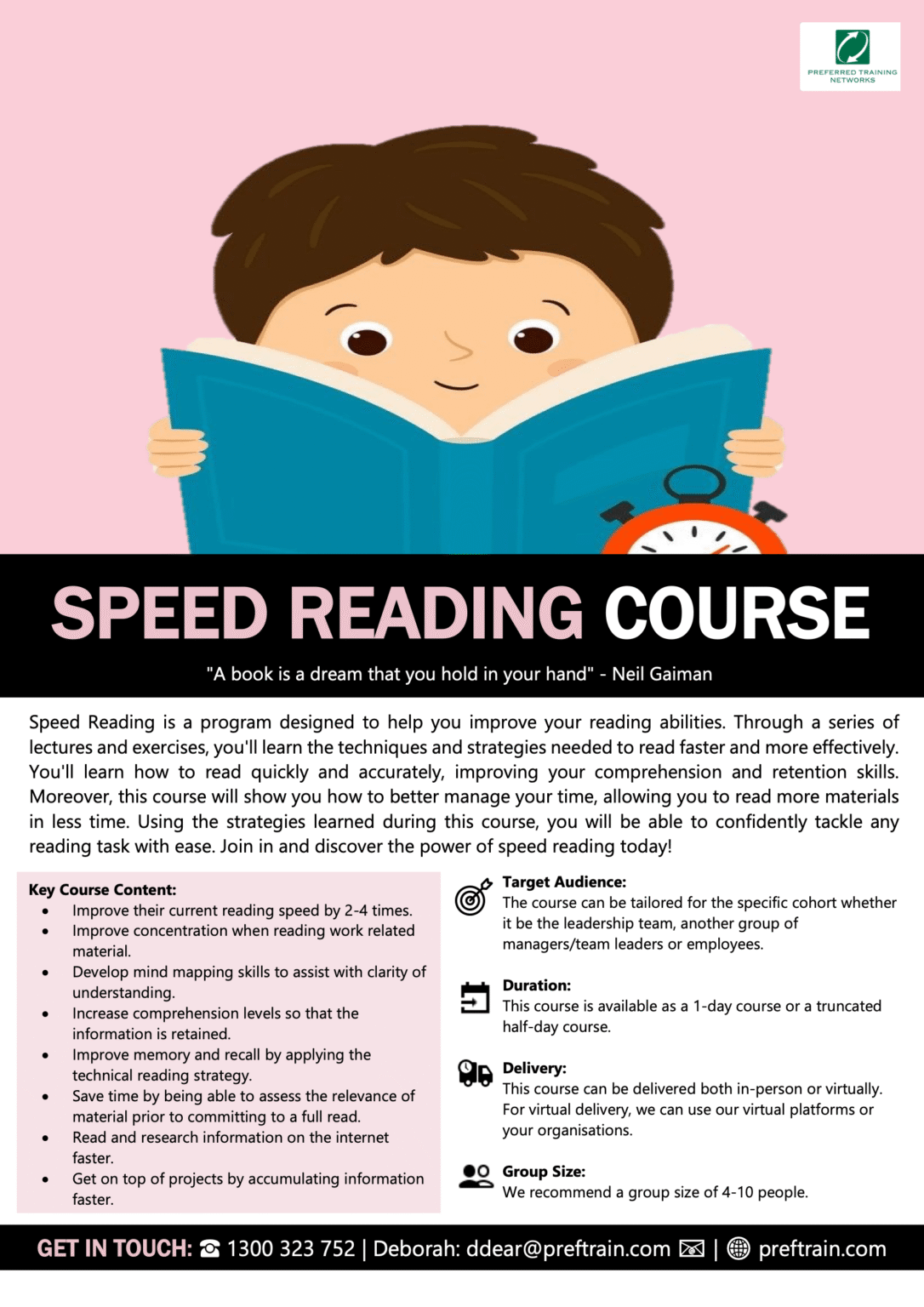
Not only will you read faster, your retention levels will also increase. You won’t have a need to reread information. Improving your reading speed will stop your mind from wandering and help you remain focused. These speed reading techniques are learnt through mind mapping and restructuring your comprehension for easy recall. The main outcomes of our speed reading training program are increased confidence and ability to read information faster. Reading faster will help you to keep up to date with market information.
Speed Reading Training Course Outcomes
Apply these faster reading tactics to your work documents. You will notice yourself improving reading speed by 2–4 times. Reading faster is simply a skill. Download the speed reading course outline and submit your training request online.
Questions you might ask yourself
How can I read emails faster? How can I read reports faster? How can I keep up with my required workplace reading?
For maximum effectiveness, this program is best conducted as an in-house program.
If you would like more information on this training program, please contact: Deborah Dear on 1300 323 752 or email: [email protected] or contact us online today.
HOW GOOD ARE YOUR INTERVIEW AND SELECTION SKILLS?
Ask yourself the following:
1. I know the importance of the job description and how it attracts specific candidates.
2. I know what to write and where to advertise.
3. I maintain focus on the job description when screening applicants.
4. I can identify the criteria to match the correct applicants to the role.
5. I recognise legal implications during the recruitment process.
6. I plan and prepare for a selection interview.
7. I recognise the best selection techniques.
8. I know how to structure an interview.
9. I use behavioural interviewing techniques to address selection criteria.
10. I evaluate candidates in an interview accurately.
11. I create a calm environment during the interview to promote conversation.
12. I project a professional demeanour during interviews to calm the candidate.
13. I use effective questioning techniques to get information from the candidate.
14. I give constructive feedback to unsuccessful applicants.
15. I recognise the need to check up on referees.
For maximum effectiveness, this program is best conducted as an in-house program.
Ideal group size: 4–12 participants
Venue: For your convenience, you can choose to conduct this program at your business premises. Alternatively, we can provide a training venue at a small additional cost.
Duration: Your Interviewing and Selection Skills Course can be modified to fit inside your timeframe.
Cost: Price on request.
Target Audience: Any managers that conduct interviewing and selection for their organisation.
For maximum effectiveness, this program is best conducted as an in-house program.
If you would like more information on this training program, please contact: 1300 323 752 Email:[email protected]
It becomes almost habitual to not notice the elephant in the room. In the “Walking on Eggshells with an Elephant in the Room” course, the facilitators coax the major issue back into the foreground. Participants use different tools to gain different perspectives of the issue. The root cause of the issue is then identified. Participants are often amazed how an independent facilitated session can be such a positive experience after the issue was previously too prickly to touch. Participants discover new solutions, and work collaboratively towards a solution, as your facilitator helps participants begin cracking eggshells at a comfortable pace.
This program can be conducted as in-house training at your offices anywhere in Australia.
Maybe picking up the phone can solve the problem rather than endless keyboard chatter? However, AI is creating significant challenges for managing email correspondence. For example, AI-generated complaints can now stretch to 5,000 words—well beyond the persistence of manual efforts—resulting in longer processing times. Our Email Management Training helps professionals develop strategies to handle these modern challenges efficiently and maintain effective communication workflows.
HR teams are inundated with internal complaints. The amount of external email complaints is now dwarfed by the huge volume of internal email complaints. Since every email is a legal document, it demands careful attention, further adding to the ever-increasing workload.
A recent survey found that email causes more stress than traffic jams. This Managing Mail program offers practical strategies not only for email inbox management but also for improving your overall time management. You’ll enhance your professional writing skills and boost workplace communication effectiveness. By the end of the course, you’ll feel more organised, less stressed, and better equipped to manage digital communication demands.
Take this test and if you answer yes to 5 or more question, this course is ideal for you:
For maximum effectiveness, this program is best conducted as an in-house program.
Ideal group size: 4–9 participants.
Venue: For your convenience, you can choose to conduct this program at your business premises. Alternatively, we can provide a training venue at a small additional cost.
Duration: This program is conducted as a half day program.
Cost: Price on request.
If you would like more information on this training program, please contact: Niall Kennedy – Marketing Manager 1300 323 752 Email: [email protected]
Q. Who should attend this email management training course?
Anyone who wants to reduce email stress and communicate more effectively, including admin staff, team leaders, and executives.
Q. How long is the course?
We offer flexible delivery formats including half-day and full-day workshops.
Q. What will I learn from this training?
You’ll learn tools to organise your inbox, manage email overload, and apply best practices in email communication.
Q. Is this course available across Australia?
Yes, we deliver training Australia-wide or virtually to suit your needs.
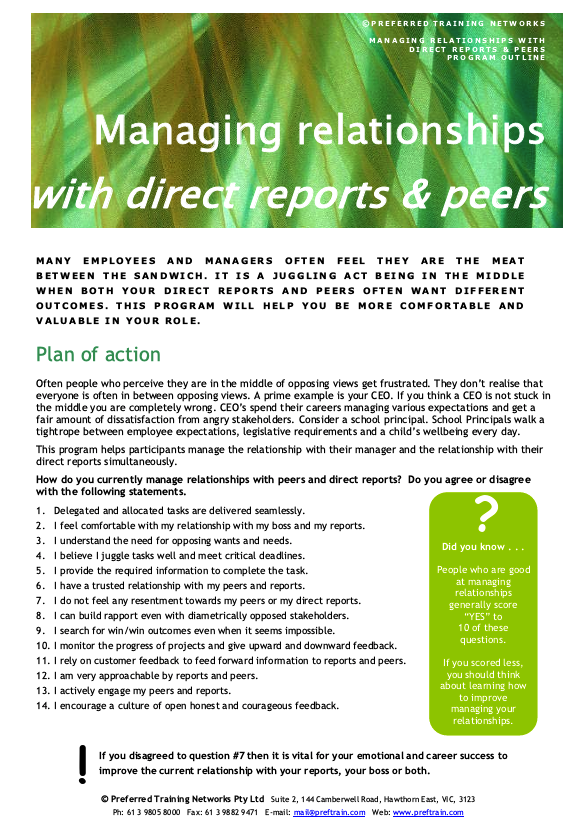
Often, people who perceive they are in the middle of opposing views get frustrated. They don’t realise that everyone is often in between opposing views. A prime example is your CEO. If you think a CEO is not stuck in the middle, you are completely wrong. CEOs spend their careers managing various expectations and get a fair amount of dissatisfaction from angry stakeholders. Consider a school principal. School Principals walk a tightrope between employee expectations, legislative requirements and a child’s wellbeing every day.
This program helps participants manage the relationship with their manager and the relationship with their direct reports simultaneously.
How do you currently manage relationships with peers and direct reports? Do you agree with the following statement?
1. Delegated and allocated tasks are delivered seamlessly.
2. I feel comfortable with my relationship with my boss and my reports.
3. I understand the need for opposing wants and needs.
4. I believe I juggle tasks well and meet critical deadlines.
5. I provide the required information to complete the task.
6. I have a trusted relationship with my peers and reports.
7. I do not feel any resentment towards my peers or my direct reports.
8. I can build rapport even with diametrically opposed stakeholders.
9. I search for win/win outcomes even when it seems impossible.
10. I monitor the progress of projects and give upward and downward feedback.
11. I rely on customer feedback to feed forward information to reports and peers.
12. I am very approachable by reports and peers.
13. I actively engage my peers and reports.
14. I encourage a culture of open, honest and courageous feedback.
Did you know . . .
People who are good at managing relationships generally score “YES” to 10 of these questions.
If you scored less, you should think about learning how to improve managing your relationships.
If you disagreed to question 7 then it is vital for your emotional and career success to improve the current relationship with your reports, your boss or both.
For maximum effectiveness, this program is best conducted as an in-house program.
Ideal group size: 4–12 participants.
Venue: For your convenience, you can choose to conduct this program at your business premises. Alternatively, we can provide a training venue at a small additional cost.
Duration: This program can be adapted to meet your requirements.
Cost: Price on request. Target Audience: Supervisors, Team Leaders and Management.
If you would like more information on this training program, please contact: Deborah Dear on 1300 323 752 or email: [email protected] or contact us online today.
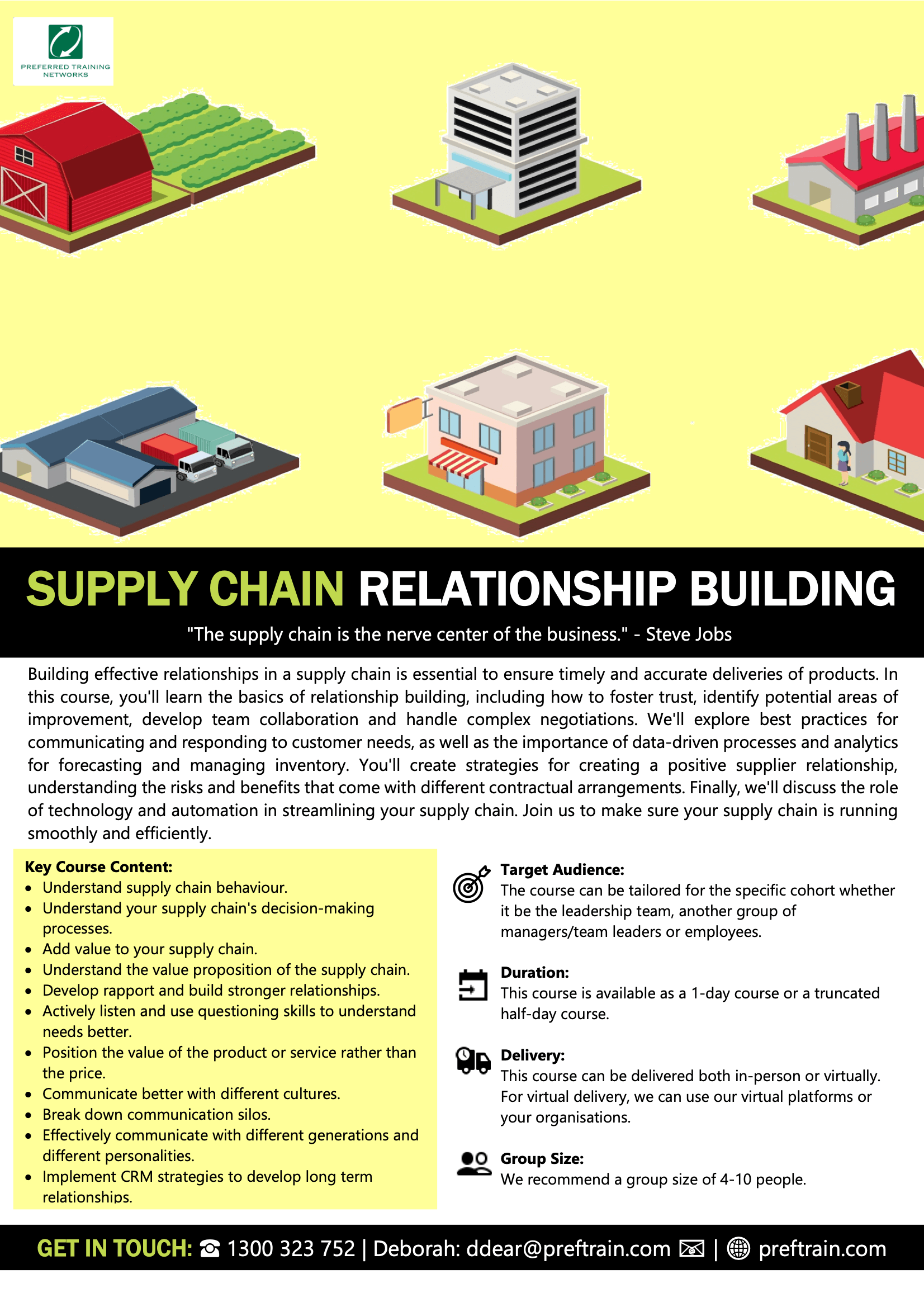
How strong are your relationships with your supply chain?
Ask yourself the following:
Your Supply Chain Relationship Building program can be custom designed to help participants build better relationships with their supply chain.
For maximum effectiveness, this program is best conducted as an in-house program.
If you would like more information on this training program, please contact: Deborah Dear on 1300 323 752 or email: [email protected] or contact us online today.
Here is a way to find out how good you are at delegating and letting go. Ask yourself the following:
Score Check
– People who are good at delegating generally score “Yes” to 9 of these questions. If you scored less, you should think about learning how to improve your delegation skills.
For maximum effectiveness, this program is best conducted as an in-house program.
If you would like more information on this training program, please contact: Deborah Dear on 1300 323 752 or email: [email protected] or contact us online today.