A Trusted Learning and Development Advisor
Lateral Lightbulbs Training workshop showcases ineffectiveness in organisations. The cost of changing a lightbulb before 2020 was $7,030, so today it would be maybe $13,000! Productivity levels in Australia are falling though the floor. If we keep making things more complex, then we’ll keep falling down the global GDP ladder.
“Lateral Lightbulbs” is a breakthrough training course. It refocuses participants on delivering evidence-based outcomes for the organisation by encouraging participants to focus on simplicity. Designed by an organisational psychologist, it also highlights the games that people will play to delay outcomes and why they play them. If you want to improve productivity and reduce complexity, then don’t miss this course.
Reduce the amount of people it takes to change a lightbulb in your organisation!
“LATERAL LIGHTBULBS” Improve productivity and promote simplicity!
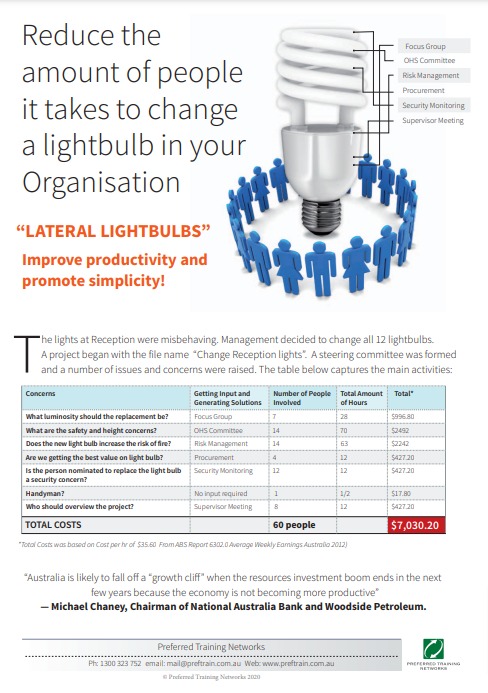
The lights at Reception were misbehaving. Management decided to change all 12 lightbulbs. A project began with the file name “Change Reception Lights”. A steering committee was formed and a number of issues and concerns were raised. The table below captures the main activities:
| Concerns | Getting Input and Generating Solutions |
Number of People Involved |
Total Amount of Hours |
Total* |
|---|---|---|---|---|
| What luminosity should the replacement be? | Focus Group | 7 | 28 | $996.80 |
| What are the safety and height concerns? | OHS Committee | 14 | 70 | $2492 |
| Does the new light bulb increase the risk of fire? | Risk Management | 14 | 63 | $2242 |
| Are we getting the best value on light bulb? | Procurement | 4 | 12 | $427.20 |
| Is the person nominated to replace the light bulb a security concern? |
Security Monitoring | 12 | 12 | $427.20 |
| Handyman? | No input required | 1 | 1/2 | $17.80 |
| Who should overview the project | Supervisor Meeting | 8 | 12 | $427.20 |
| TOTAL COSTS | 60 people | $7,030.20 |
*Total Costs was based on Cost per hr of $35.60 From ABS Report 6302.0 0
Lateral Lightbulbs
A lot of activity was generated around this project. The only downside was that knowledge was replacing action. In the groundbreaking book ‘The Knowing Action Gap’ by Pfeffer and Sutton, the authors relate how organisations often act on gathering knowledge rather than executing the project. Now, this is certainly reflected in the Australian Labour Productivity below. Notice how productivity in Australia continues to decline.
Is your organisation complex or simple?
Are tasks overly complicated in your organisation? Try this HFH Diagnostic Tool, designed by Organisational Psychologists. The level of complexity within organisations is staggering, and it’s only getting worse. Even the simplest of tasks can involve myriad choices, endless stakeholders, data to analyse and processes to manage. Thinking of your own organisation, plot the amount of effort and time (1–10) it takes to complete the following tasks on the graph below. …
Which quadrant is the most populated?
Q1 – Frustration Zone: Too much effort is required to achieve outcomes. Leads to medium to high levels of frustration, complexity and distraction.
Q2 – Dysfunction Zone: Way too much time & effort required to achieve outcomes. Leads to high levels of frustration, complexity and staff turnover.
Q3 – Ideal Zone: Appropriate amount of time and effort required to achieve outcomes. Leads to a calm, seamless working environment.
Q4 – Double Up Zone: Too much time spent to achieve outcomes, with medium to high levels of frustration, complexity and distraction.
This program can be conducted as in house training at your offices.